.svg&w=384&q=75 "Naijagoal logo")
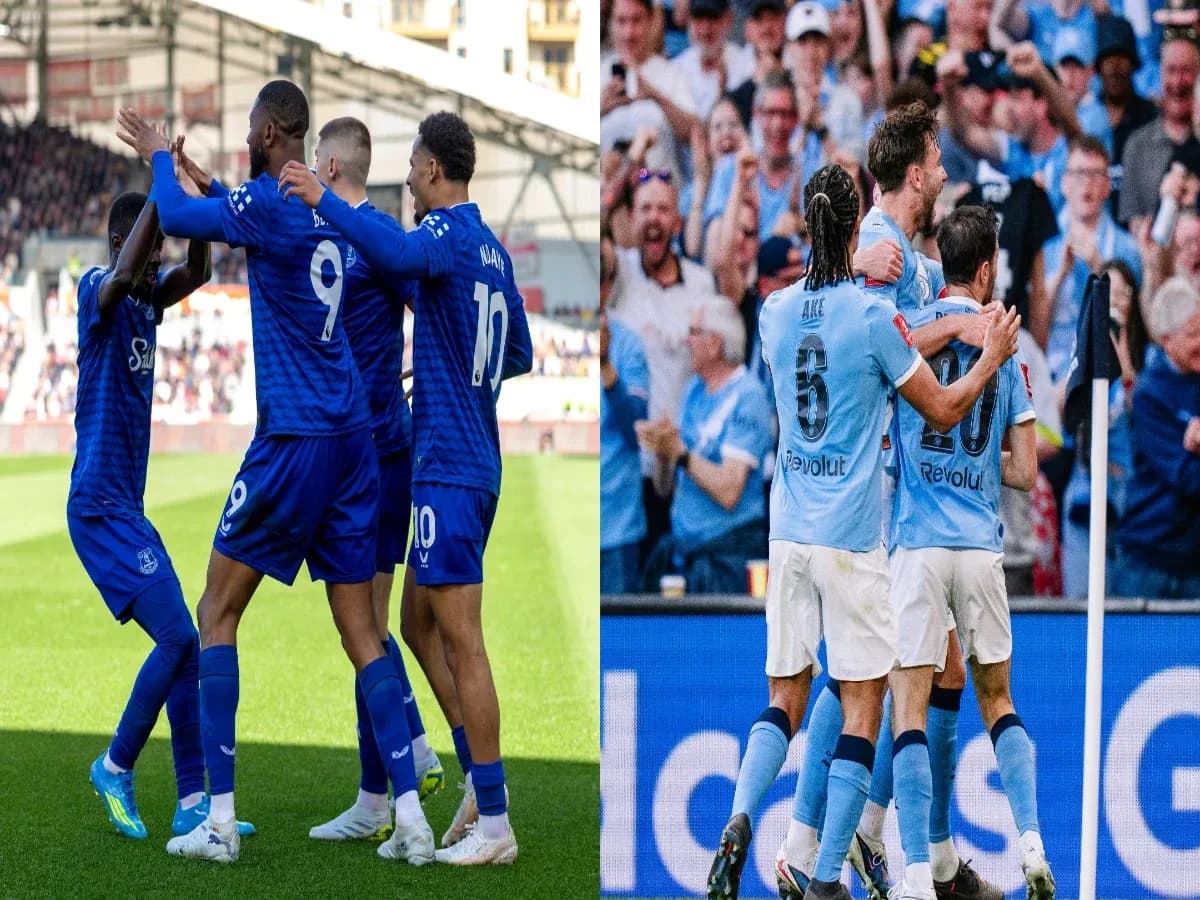
Everton vs Manchester City: A Thrilling 3–3 Premier League Draw
Everton and Manchester City produced a chaotic 3–3 draw at Hill Dickinson Stadium in Premier League Round 35, a match that flipped the script on almost every underlying number. City dominated the ball and controlled territory for long stretches, yet needed a 90' equaliser from J. Doku to escape with a point after Everton’s second-half surge. Leighton Baines’ 4-2-3-1 absorbed pressure and then exploded in transition, while Pep Guardiola’s similarly structured 4-2-3-1 monopolised possession but left itself badly exposed in defensive restarts and wide channels.
Everton’s comeback from 0–1 down at half-time to 3–2 up by 81' was powered by direct running, set-piece threat, and the impact of substitute T. Barry, before City’s superior passing rhythm and bench quality eventually reasserted itself in the closing moments.
The scoring opened on 43', when Manchester City converted their territorial dominance into a breakthrough. From structured possession, R. Cherki found space between the lines and slipped J. Doku in; Doku’s finish gave City a 0–1 lead that reflected their 75% first-half possession and shot volume, even if Everton had defended the box reasonably well to that point. The half-time score was 0–1 to City.
Everton’s disciplinary line began to fray just before the interval. Michael Keane collected a yellow card for a foul on 45', underlining how stretched Everton’s back line had become dealing with City’s rotations. After the break, Beto was booked for another foul on 48', a sign of Everton’s increasingly aggressive pressing triggers as they tried to disrupt City’s buildup. James Tarkowski followed with his own yellow for a foul on 53', leaving both centre-backs cautioned and forcing Everton to manage duels more cautiously.
The match pivoted with Baines’ first substitution. On 64', T. Barry (IN) came on for Beto (OUT), adding pace and vertical threat in the forward line. The impact was immediate. On 68', Barry struck Everton’s equaliser, exploiting space behind City’s advanced defensive line and finishing a transition to make it 1–1. Everton then overturned the deficit on 73': J. O'Brien arrived from right-back to score, assisted by J. Garner, who delivered quality from deeper midfield. That sequence showcased Everton’s ability to push a full-back high once City’s counter-press was broken.
City’s frustration surfaced on 74', when Gianluigi Donnarumma was booked for argument, reflecting the psychological shift as Everton seized momentum. Guardiola reacted immediately: on 74', P. Foden (IN) came on for A. Semenyo (OUT), adding creativity between the lines; on 75', M. Kovacic (IN) replaced Nico (OUT), rebalancing midfield with more control and forward passing.
Yet Everton struck again before City’s adjustments fully settled. On 81', Barry scored his second, again from open play, to put Everton 3–1 up. City hit back quickly on 83', with E. Haaland converting from close range after a Kovacic assist, narrowing the score to 3–2 and re-energising City’s final push. Everton’s right-back J. O'Brien, listed in the card event as Jake O'Brien, was then booked for a foul on 86', a necessary intervention as City flooded the right half-space.
Guardiola made his third change on 87', with O. Marmoush (IN) replacing B. Silva (OUT), pushing more direct threat into the final third. Baines, protecting the lead, reshaped his side in stoppage time: at 90+2', N. Patterson (IN) came on for M. Rohl (OUT), and C. Alcaraz (IN) replaced K. Dewsbury-Hall (OUT), adding defensive legs and fresh energy in midfield and at right-back. On 90+6', H. Armstrong (IN) entered for T. Iroegbunam (OUT), a late attempt to reinforce central areas and press the ball.
Despite Everton’s reshaping, City’s pressure finally told at 90'. Doku struck again, assisted by M. Guehi, to level at 3–3. The late equaliser capped a frenetic second half where Everton’s defensive structure bent repeatedly under City’s sustained possession and crossing volume.
Tactical Analysis
Tactically, both sides lined up in 4-2-3-1 but interpreted the shape very differently. Everton’s double pivot of T. Iroegbunam and J. Garner stayed compact, screening passes into Haaland and forcing City wide. The back four of V. Mykolenko, M. Keane, J. Tarkowski, and J. O'Brien defended deep, prioritising box protection over high pressing. This cede-and-counter approach was underscored by the numbers: only 25% possession and 200 total passes, but 14 total shots, 10 inside the box, and 2.77 xG. Everton were selective but incisive, turning limited phases of attack into high-quality chances, particularly once Barry’s pace stretched the game.
Barry’s introduction redefined Everton’s attacking reference point. With Beto off, Everton shifted from a target-man focal point to a more mobile, depth-seeking threat. Barry repeatedly attacked the space behind M. Nunes and N. O’Reilly in City’s full-back zones, especially in transition when City’s rest defence was exposed. J. O'Brien’s goal highlighted how Everton used underlaps and late runs from full-back to overload City’s back line once their first press was beaten.
Manchester City, by contrast, embodied Guardiola’s control principles. With 75% possession and 610 passes (551 accurate, 90%), they constructed long phases of buildup through Guehi and Khusanov at centre-back, with M. Nunes and N. O’Reilly providing width and progression from full-back. Nico and B. Silva in the double pivot gave City a technical base, while Cherki, Doku, and Semenyo operated between the lines behind Haaland. The 20 total shots and 1.37 xG show City created volume but, relative to territory, were less efficient at generating premium chances than Everton.
Defensively, the goalkeeper realities were stark. J. Pickford made just 1 recorded save, reflecting how often City’s attempts were blocked by the defensive line (Everton had 6 blocked shots) or missed the target. His goals-prevented figure of 0.74 indicates he still added value relative to the quality of shots faced, but Everton’s block density in front of him was the primary shield. Donnarumma, at the other end, registered 3 saves and the same 0.74 goals prevented, but conceded three times against 2.77 xG. That combination points to systemic defensive issues more than goalkeeping errors: City allowed too many high-value shots in central areas and struggled to track Barry’s runs and late arrivals like O'Brien.
City’s defensive index on the day was undermined by their attacking structure. With full-backs high and pivots often dragged wide to support circulation, transition protection was thin. Everton exploited this ruthlessly, especially between 64' and 81', when the home side scored all three of their goals. Guardiola’s in-game corrections via Kovacic and Foden restored some control and chance creation—Kovacic directly assisting Haaland’s goal—but came at the cost of further opening central lanes for counters.
Statistical Summary
From a statistical verdict standpoint, the match is a classic case of stylistic contrast. City’s overall form in this fixture—measured by possession, pass accuracy, and shot volume—was superior: 75% possession, 610 passes at 90% accuracy, 20 shots, and 9 corners. They committed only 5 fouls and took just 1 yellow card (Donnarumma for argument), maintaining structural discipline but lacking defensive bite in key moments.
Everton, by contrast, played a higher-risk, higher-impact game. With only 200 passes at 69% accuracy and 25% possession, they leaned into verticality and set-piece or second-phase situations. Their 15 fouls and 4 yellow cards (Michael Keane 45', Beto 48', James Tarkowski 53', Jake O'Brien 86', all for fouls) reflect a more combative approach. Yet the 2.77 xG against City’s 1.37 underlines that Everton, despite being under sustained pressure, manufactured the better chances.
Card totals were clear: four yellows for Everton, one for City, no reds. In the end, City’s technical control and depth salvaged a draw, but the underlying patterns suggest Everton’s tactical plan—compact block, aggressive duels, and rapid transitions through Barry and O'Brien—very nearly delivered a statement win against a possession-dominant giant.