.svg&w=384&q=75 "Naijagoal logo")
Espanyol's Tactical Mastery in 2-0 Victory Over Athletic Club
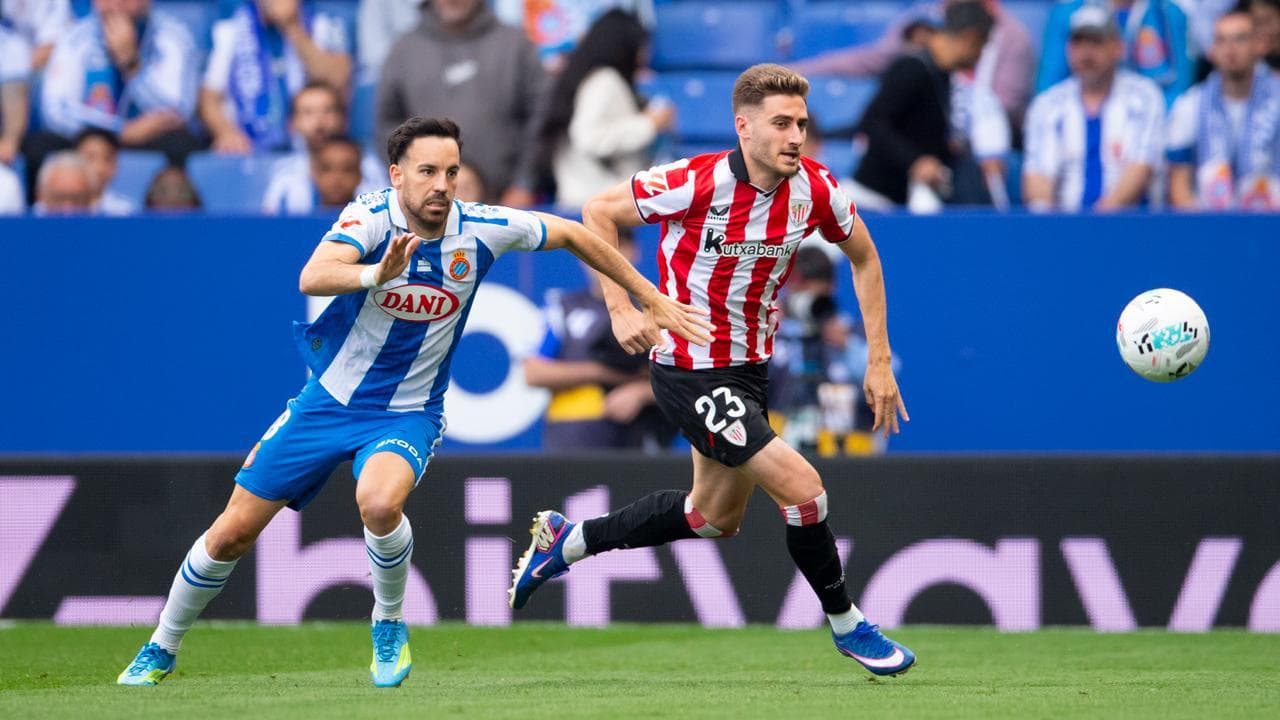
Espanyol’s 2-0 win over Athletic Club at RCDE Stadium was built on structural control rather than sheer chance creation, despite the xG balance (0.76 vs 0.82) suggesting a more even game. Manolo Gonzalez’s 4-4-2 imposed its rhythm through possession and field position, while Ernesto Valverde’s 4-2-3-1 struggled to convert territorial surges into sustained pressure.
Espanyol’s base shape was a classic 4-4-2 with M. Dmitrovic behind a back four of O. El Hilali, C. Riedel, L. Cabrera and C. Romero. In possession, the full-backs, particularly El Hilali on the right, pushed high to create a 2-4-4, with R. Sanchez and A. Roca (before his substitution) stepping inside to connect play. The double forward line of Exposito and R. Fernandez Jaen worked in complementary fashion: one dropping between the lines, the other stretching depth to pin A. Laporte and D. Vivian.
The statistical profile underlines Espanyol’s control: 63% possession, 492 passes with 386 accurate (78%), and 8 corners. This was not sterile circulation; 7 of their 12 shots came from inside the box, reflecting a patient approach that sought to engineer good zones rather than shoot on sight. However, the relatively modest xG of 0.76 shows that while they got into the area, the shot quality was often from slightly wider or more crowded positions.
The game’s tactical hinge came around the hour. At 63', Gonzalez introduced P. Milla (IN) for A. Roca (OUT) and Jofre (IN) for R. Sanchez (OUT). This re-energised the wide lanes and gave Espanyol a more vertical threat from the left. Milla, nominally a midfielder, operated almost as an inside forward, frequently attacking the half-space between A. Boiro and Laporte. Jofre’s entry added direct running and 1v1 threat, forcing Athletic’s back line to defend facing their own goal more often.
Valverde responded simultaneously at 63' with a double change that significantly altered Athletic’s attacking structure: G. Guruzeta (IN) came on for I. Williams (OUT), and M. Jauregizar (IN) replaced I. Ruiz de Galarreta (OUT). With Williams off, Athletic lost their primary depth runner. Guruzeta offered more of a link-forward profile, dropping to combine with U. Gomez and R. Navarro. Jauregizar’s introduction aimed to add forward thrust from midfield, but it also slightly loosened the double pivot’s defensive protection.
The first goal at 69' crystallised these dynamics. P. Milla scored for Espanyol, assisted by C. Romero. The pattern reflected Espanyol’s full-back usage: Romero advanced aggressively from left-back, exploiting the space behind Athletic’s right side after their reshuffle. His delivery or cut-back found Milla arriving from a tucked-in wide position, a direct payoff from Gonzalez’s decision to turn his left flank into an overload zone. Athletic’s 4-2-3-1, already stretched by chasing the ball, failed to track the second-line runner.
Athletic’s response was to keep refreshing the right side defensively. At 71', A. Gorosabel (IN) came on for J. Areso (OUT), giving Valverde a more balanced full-back in possession and perhaps a better crosser. At 78', N. Serrano (IN) replaced U. Gomez (OUT), a move to inject pace and directness from the attacking midfield line. Structurally, Athletic remained in a 4-2-3-1 but with more aggressive wide players and a higher full-back line, turning phases into a 2-3-5 when chasing the equaliser.
Espanyol, in turn, shifted into game-management mode. At 84', R. Terrats (IN) came on for Exposito (OUT), and K. Garcia (IN) replaced R. Fernandez Jaen (OUT). This double change recalibrated the 4-4-2 into something closer to a 4-5-1/4-4-1-1 out of possession, with Terrats adding legs and defensive coverage in midfield and K. Garcia offering fresh pressing and a counter-attacking outlet. The final tweak came at 90+1', when C. Pickel (IN) replaced U. Gonzalez (OUT), adding physicality and ball-winning for the closing moments.
The second goal at 90' sealed the tactical narrative: K. Garcia scored, assisted by R. Terrats. Again, the substitutes were decisive. With Athletic pushed high, Espanyol exploited transition. Terrats, introduced specifically to stabilise the centre and spring counters, provided the final pass, while Garcia’s fresh movement attacked the space behind a stretched defensive line. It encapsulated Espanyol’s late-game plan: absorb, then break with the energy of the bench.
Defensively, Espanyol were compact and selective in their aggression. Only 9 fouls compared to Athletic’s 14 indicate a side that defended more through structure than constant duels. Despite allowing 10 of Athletic’s 11 shots from inside the box, the central pairing of Riedel and Cabrera, screened by U. Gonzalez and P. Lozano, generally forced attempts from less favourable body positions or under pressure. Dmitrovic made 4 saves, but his goals prevented figure of -0.9 suggests he slightly underperformed post-shot metrics; nonetheless, the collective block in front of him limited truly clean looks.
Athletic’s attacking metrics tell a story of frustration: 11 shots (10 in the box), 9 corners, but no goals from an xG of 0.82. Their 37% possession and 273 passes (180 accurate, 66%) underline a reactive game plan, leaning on transitions and wide overloads through A. Berenguer and U. Gomez. However, once Williams departed, their ability to threaten in behind diminished, making it easier for Espanyol’s back four to hold a higher line and compress space.
From a statistical verdict, Espanyol maximised control and bench impact. They out-passed and out-possessed Athletic, created similar xG from fewer total box entries by being more efficient in decisive moments, and used substitutions to tilt both flanks in their favour. Athletic’s season-long identity as a high-intensity, vertical side was visible in their shot profile and corner volume, but in this match their structural tweaks after 63' weakened their depth threat without sufficiently improving central combination play. Espanyol’s 2-0, home-first scoreline at RCDE Stadium thus reflects not dominance in raw chance quality, but superior game management, structural clarity, and decisive use of the bench.