.svg&w=384&q=75 "Naijagoal logo")
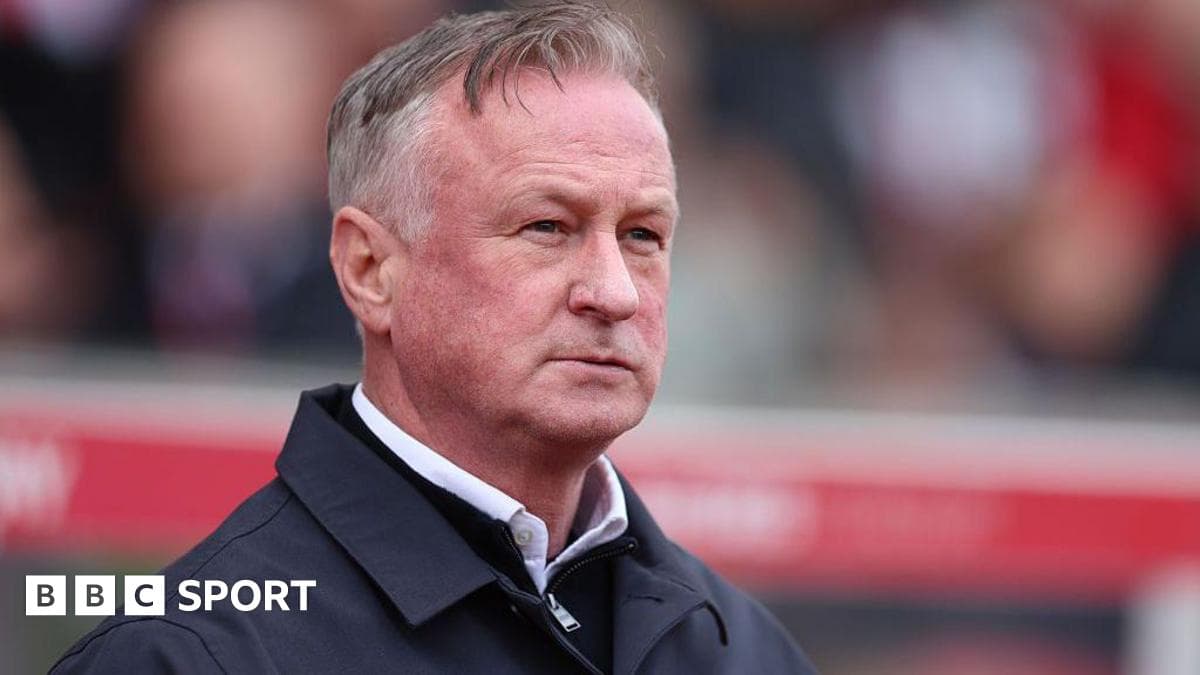
Michael O’Neill Commits to Northern Ireland Ahead of Euro 2028
Michael O’Neill has turned his back on club management – for now – and thrown his full weight behind Northern Ireland’s bid to return to the European stage.
The 56-year-old will not take the Blackburn Rovers job on a permanent basis, ending a short, intense spell of dual duty and confirming what he had hinted for months: you cannot live two football lives forever.
A short stint, a clear decision
O’Neill walked into Ewood Park in February as interim head coach, asked to steady a listing ship while still steering his country. It was a bold arrangement, running until the end of the 2025-26 campaign on paper, but always with an asterisk: this was never going to be a long-term juggling act.
Fifteen games later, he leaves Blackburn with the job he was given done. Five wins, five draws, five defeats. Perfectly symmetrical on paper, but the context mattered more than the numbers. Rovers were drifting towards real trouble in the Championship; they finished 20th and stayed up.
The club wanted clarity. So did the Irish FA. O’Neill, in the end, chose the green shirt.
“Following discussions with the club, Michael has decided to continue his long-term commitment to his role as Northern Ireland head coach, with a focus on leading the national team towards qualification for the Uefa European Championships in 2028,” Blackburn said in a statement that drew a line under the experiment.
O’Neill’s own words underlined the pull of the international game. He spoke warmly of Blackburn – “a historic football club with a proud tradition and passionate supporters” – and thanked owners, board, staff, players and fans for their backing. But the key phrase cut through everything else: “my long-term focus must remain with Northern Ireland and the journey towards the European Championship campaign ahead”.
Relief in Belfast, a reset in Blackburn
For the Irish FA, the outcome could hardly be better. They keep the architect of their last great modern moment, the man who took Northern Ireland to Euro 2016 and has been quietly building a second act since returning in 2022.
“We are delighted Michael has decided to stay on as Northern Ireland manager,” read their statement. They pointed to “another exciting squad of players” and spoke of carrying momentum into the Nations League this autumn and on towards Euro 2028 qualifiers.
Supporters will feel the same. Only a few weeks ago, O’Neill’s future sounded less certain. In March he talked about “returning to the status quo” for June’s fixtures, but by April he admitted a decision was still to be made. That was enough to set nerves jangling. A vacancy at Blackburn, a manager with a proven club and international pedigree, and a young, attractive Northern Ireland side just beginning to find its shape – it felt like a crossroads.
The decision has come early enough to calm all that. O’Neill can now attack the summer and autumn with a clear head. Blackburn, for their part, move into a new recruitment process with time on their side before the 2026-27 season. The club has confirmed it will now begin identifying and appointing a new permanent head coach, with updates to follow.
A second project gathers pace
Strip away the noise and O’Neill’s international record tells a story of longevity and resilience. Across two spells, he has taken charge of 104 games for Northern Ireland: 38 wins, 23 draws, 43 defeats. Those numbers span qualifying campaigns, play-offs, and the highs and lows of reshaping a small nation’s football identity.
This latest chapter has been about renewal. When he replaced Ian Baraclough, Northern Ireland were again struggling, short on results and direction. They missed out on Euro 2024. They missed this year’s World Cup. Yet the trajectory has shifted.
The side that lost to Italy in a World Cup play-off in March offered a glimpse of where O’Neill is taking them. The average age of his starting XI that night was just 22.5 – the second youngest in the country’s history since World War Two. And that was without three key figures: Conor Bradley, Dan Ballard and Ali McCann. Even with them back, the age profile barely changes. This is a squad designed to grow together, not peak and fade.
That youth brings risk, but also a ceiling Northern Ireland have rarely had. O’Neill’s first spell was built on experience, organisation and a ferocious collective spirit. This time, there is more technical quality, more pace, more room to evolve.
Eyes on 2028 – and tests ahead
The road to Euro 2028 does not begin in a blaze of qualifiers; it starts with the smaller steps O’Neill has always valued. June brings friendlies against Guinea in Cadiz and France in Lyon. Different tests, different demands, both useful.
Then comes the Nations League in September, a competition that has quietly become an important proving ground for teams of Northern Ireland’s stature. O’Neill’s side have been drawn in Group B2 with Hungary, Georgia and Ukraine – a demanding but manageable mix that will expose his young squad to exactly the kind of pressure they must learn to handle.
The Irish FA know the job O’Neill leaves behind would be far more attractive now than it was when he returned in 2022. The squad is younger, deeper, more competitive. The style is more progressive. Any successor would have inherited a far healthier situation.
That is precisely why his decision to stay carries such weight. Continuity now feels like an advantage, not a compromise. The building work has already been done; the next phase is about turning potential into qualification.
Northern Ireland have not reached the Euros since O’Neill took them there in 2016, after a patient period of construction that transformed expectations. He has chosen to stay and try to do it again, this time with a new generation at his disposal.
The question now is not whether he is committed. It is how far this young, ambitious squad can go with him locked in for the journey.