.svg&w=384&q=75 "Naijagoal logo")

Declan Rice's Fitness Concerns Ahead of World Cup
Aaron Cresswell calls Declan Rice “a freak of nature”. Watching England’s vice‑captain stagger off in the Florida heat, it felt less like a compliment and more like a warning.
Rice has been running on fumes for a long time. Since the start of the 2020‑21 season he has played 360 matches for club and country. West Ham’s European adventures, Gareth Southgate’s England, Arsenal’s title and Champions League pushes – Rice has been at the heart of all of it. The temptation, always, is simply to ask him to go again.
Against Croatia, the bill finally seemed to arrive.
A rare off‑day
This was his 63rd appearance of the 2025‑26 campaign, and it showed. In England’s wild 4-2 win, Rice looked nothing like the metronome who has carried so many midfields on his shoulders.
The structure around him was a mess. Too much grass between him and Elliot Anderson. Too many moments when Luka Modric dragged him into awkward areas, forcing him deeper and deeper until England’s midfield resembled a chasm rather than a platform. Rice was chasing shadows instead of dictating traffic.
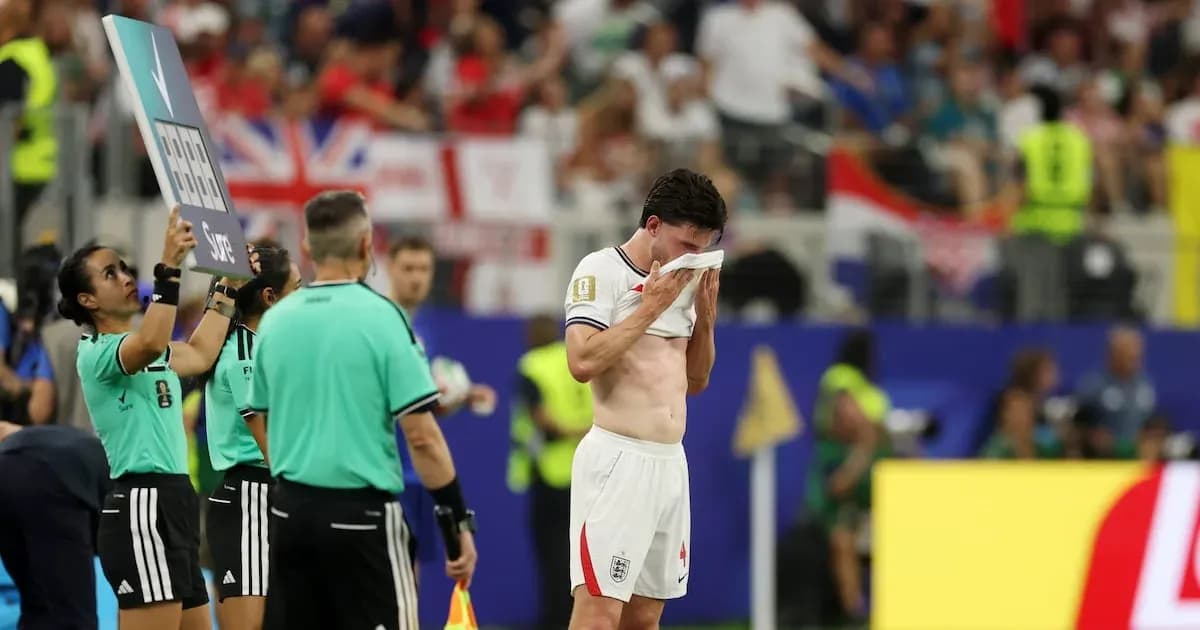
Thomas Tuchel tried to play down the concern, but his actions told their own story. With England clinging to a 3-2 lead and Croatia pushing, Rice came off in the 72nd minute. That almost never happens. When England are under siege, Rice stays on. He is the one who wins the second balls, who plugs the gaps, who turns chaos into something resembling order.
Not this time.
Tuchel spoke of “discomfort” in Rice’s lower back and upper hamstring, describing the change as precautionary. Rice, predictably, insisted he would be available for Tuesday’s game against Ghana. Yet the head coach’s more telling line came in his assessment of the performance: “Declan had some unusual ball losses.”
Unusual is doing a lot of work there. This was Rice far from 100 per cent. And England looked fragile even with him on the pitch.
No like‑for‑like answer
That is the problem. England do not have another Declan Rice. They do not even have a close imitation.
Kobbie Mainoo glides with the ball and sees passes early, but he does not yet have Rice’s frame, his aerial dominance, his set‑piece threat. Jordan Henderson has the experience and the voice, but at 36 he was not summoned when the game against Croatia became stretched and frantic. If Tuchel did not trust him then, when will he?
There is no obvious solution in this squad. Every alternative comes with a caveat.
Tuchel’s first instinct when Rice went off was to pull Jude Bellingham deeper. It almost cost England immediately. Croatia flooded the space, and England lost their out‑ball between the lines. The experiment lasted eight uneasy minutes.
Then came something more interesting.
Djed Spence replaced Bellingham, Reece James moved inside from right back, and suddenly England resembled a team with a plan B.
Reece James, the unexpected pivot
If Rice’s minutes have to be managed, James may be the closest thing to a structural fix.
This is not a whim. James has history in midfield. He played there on loan at Wigan in 2018‑19 and, under Enzo Maresca at Chelsea, he was pushed infield again. It was a bold switch that initially raised eyebrows, not least from Tuchel himself, who had always seen James as the ideal modern right back.
Maresca stuck with it. Chelsea were rewarded. James was outstanding in last year’s Club World Cup final win over Paris Saint‑Germain, and he did not stop there. He dominated the middle of the pitch alongside Moisés Caicedo in a 3-0 dismantling of Barcelona last November, then outplayed Rice when Arsenal went to Stamford Bridge five days later.
Tuchel has clearly been paying attention. When he named his World Cup squad and left out Adam Wharton and Alex Scott, he offered a simple justification: “Reece James can play in the 6 because he does on a high level for Chelsea.”
James brings a defender’s aggression and timing to midfield. He can tackle, he reads danger, and he has the range to hit diagonals or punch passes through the lines. He is not Rice, but he is one of the few in this group who can change the geometry of the team from the centre of the pitch.
If he steps infield, Tuchel has cover at right back. Spence, Ezri Konsa and Jarell Quansah can all fill that role. One option would see Konsa tucking in as a third centre back alongside John Stones and Marc Guéhi, with Nico O’Reilly raiding from left back. It is a shape that could give England the security they crave without Rice while keeping enough thrust in wide areas.
On paper, it works. On grass, there is one major hitch.
The fitness tightrope
James’s body does not always cooperate with his talent. Hamstring issues have stalked his career, the latest layoff coming as recently as March and costing him almost two months. Chelsea have had to ration his minutes, choosing their battles carefully.
England cannot simply throw him into every high‑intensity game, then ask him to anchor the midfield on top of it. Especially not in a tournament that has already claimed Tino Livramento, whose calf injury forced Tuchel to draft in Trevoh Chalobah at the last minute.
This squad is full of players who have been pushed to their limits by a brutal club season. James is first choice at right back, but he cannot start every match. He certainly cannot be the sole answer if Rice’s body starts to protest.
Tuchel saw this coming. The decision to fly early to Florida for a warm‑weather camp was as much about conditioning as tactics. Even then, Rice arrived late after Arsenal’s run to the Champions League final. Another high‑stakes game, another 90 minutes, another demand on a player who never seems to say no.
At some point, the bill comes due.
Seventy games and a question
If England go all the way to the World Cup final and Rice is not rested, he will finish the season with 70 appearances for club and country. Seventy. For a midfielder who covers more ground than almost anyone else on the pitch.
The numbers are staggering. The reliance is even more so. England rarely look convincing when Rice is missing, and there is no ready‑made understudy waiting in the wings.
Tuchel has built a squad full of versatility, players who can flip between positions and systems. He will need every ounce of that flexibility now. Because if the “freak of nature” finally hits a wall, England’s World Cup might hinge on whether Reece James’s legs – and Tuchel’s imagination – can carry the load that Declan Rice has borne almost alone for six relentless years.