.svg&w=384&q=75 "Naijagoal logo")
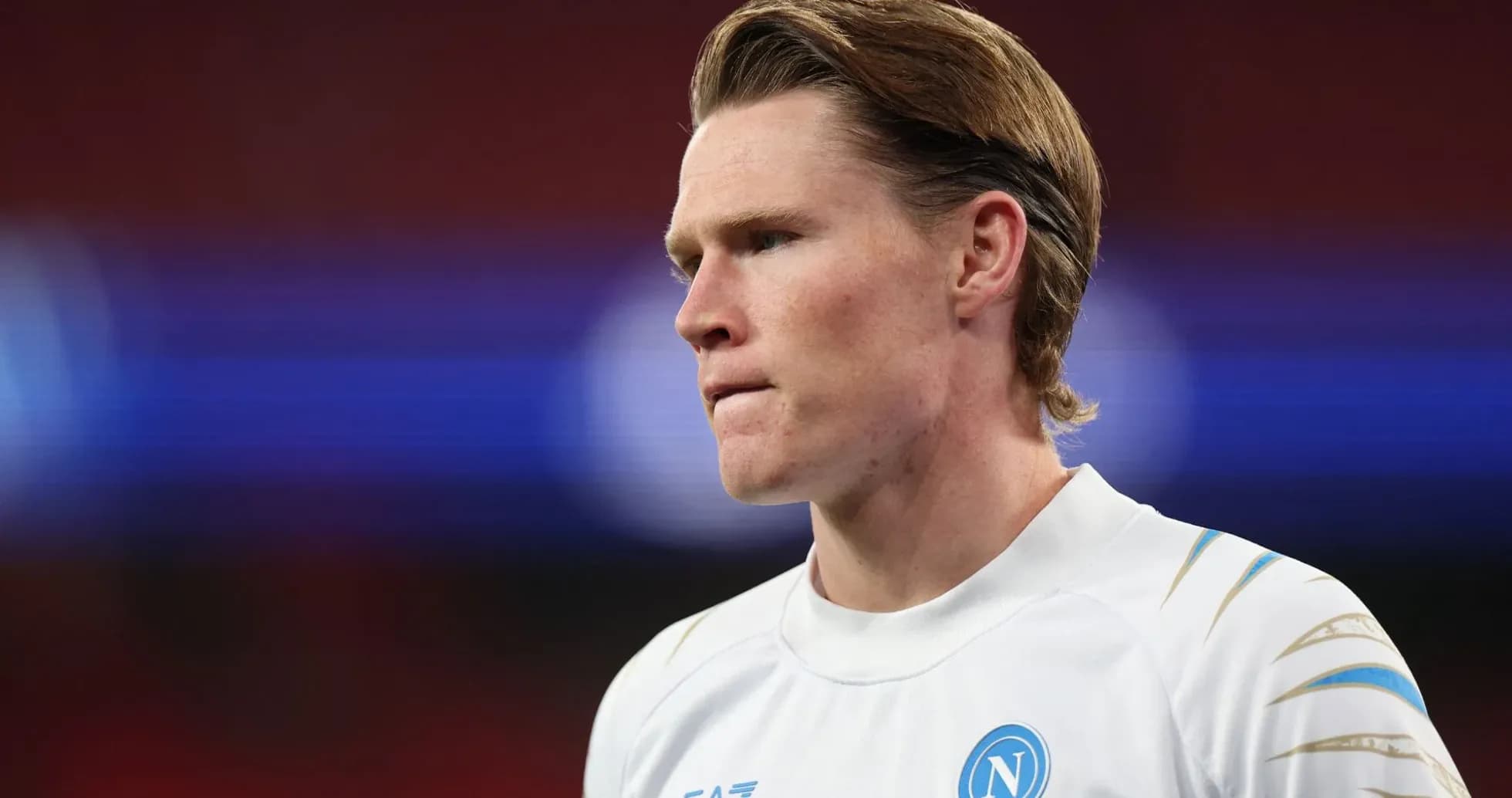

Scott McTominay's Transformation at Napoli: From Benchwarmer to Star
Scott McTominay left Old Trafford as a question mark. He has turned up in Naples as an exclamation.
Manchester United banked £26 million ($35m) when they sold the academy graduate, a player who racked up 255 appearances but never truly nailed down a starting spot. He broke through under Jose Mourinho, was trusted, was used, but rarely unleashed. At United he lived as a holding midfielder, patrolling space, screening centre-backs, sacrificing his attacking instincts for the structure of the team.
In Italy, those restraints have been ripped away.
From water-carrier to match-winner
Napoli handed McTominay the No.10 role and told him to drive games, not just manage them. The response has been emphatic. Twenty-seven goals in two seasons at Stadio Diego Armando Maradona, a league title, a division MVP award and his name thrown into Ballon d’Or conversations.
The same player whose value was debated at Old Trafford is now a symbol of a winning project in Serie A.
That transformation has fuelled a familiar debate back in England. Did United misread one of their own? Did they let a home-grown talent slip away just as he was ready to peak? Criticism has followed the club, and speculation has followed the player. Exit rumours have swirled around McTominay for a couple of transfer windows, yet talk of fresh terms in Naples, potentially running to 2030, suggests he may be settled where the city has embraced him.
Still, the Premier League pull never fully disappears.
“Somebody in England” will look again
Former Scotland defender Colin Hendry is convinced McTominay’s resurgence will not have gone unnoticed back home. Speaking to GOAL in association with Estafa.info, he was asked whether British football had seen the last of the midfielder.
“Seeing what he's done for Napoli a couple of years back, such a massive influence on them and what they achieved, then there's going to be somebody in England probably thinking, ‘you know what, we wouldn't mind bringing that here because he has got that winning mentality’,” Hendry said.
He stressed that the elite in England are hardly short of competitors, but he knows how rare that edge can be.
“And I'm not saying that the top six, top eight clubs don't have a winning mentality, but over the years, it’s not easy to find. So Scott, he was going to be a big player for us in the World Cup and the World Cup didn't work I don't think for him as it didn’t for a lot of Scottish players.”
For Scotland, McTominay has already delivered a piece of modern folklore: that stunning overhead kick against Denmark in qualifying, a goal that helped drag the country to its first World Cup since 1998. The stage in North America, though, was far less kind.
World Cup hope, World Cup let-down
Scotland arrived at the 2026 tournament with optimism and a core of players hardened by Premier League and European football. They left with the familiar bruise of a group-stage exit.
McTominay was not alone in struggling to replicate qualifying form on the biggest stage, and Hendry did not hide his frustration.
“I was disappointed with Scotland in the World Cup, if I'm being honest. Then again, I suppose a lot of people would say that we were disappointing in 1998,” he admitted.
On the pitch, the campaign faltered. Off it, something else caught fire.
“The one shining light about the World Cup in 2026 was the Tartan Army,” Hendry said. “They've now got history in America that's totally untouched. I've even seen some of the fans that are local to me, North East Tartan Army from Peterhead, they're back out in Boston in October - they're going back, they've got the boat and everything organised, it’s remarkable.”
The football failed to match the colour in the stands. A 1-0 defeat to Haiti in the opener cut deep.
“I think everybody was completely disappointed after 1-0 against Haiti. The initial game really set us up - I mean, really, really set us up,” Hendry reflected.
Then came Morocco. A nightmare start, strangely, gave Scotland a lifeline.
“In a strange fashion as well, us going down 1-0 within 70 seconds against Morocco actually worked in our favour a little bit because they had their noses in front and we had to then react. The good thing is that they didn't score a second or a third goal, but we had to actually react to that and had a practically whole game to do that.”
Scotland pushed. They felt aggrieved, too.
“Could we have had a penalty on John McGinn? I think so. I think generally if that's a free-kick outside the box, which it would have been given as a free-kick outside the box, it's obviously a penalty if it's in the box and it wasn't given.”
The margins went against them. The overall verdict, in Hendry’s eyes, was clear.
“But I think on the whole, we were disappointing. But then again, as I said, people going back to 1998, it was disappointing in the end because we ended up getting gubbed by Morocco in the final game, which was a disappointment as well.”
A player at his peak, and a decision looming
So McTominay stands at an intriguing crossroads. In club football he has reinvented himself, driving Napoli to trophies and personal honours from a role United never truly gave him. For his country, he remains central to the story – a qualifier hero still searching for a defining tournament moment.
England will watch. Napoli will push to protect their asset. Scotland will hope that the buccaneering No.10 who conquered Serie A can carry that same swagger into the next campaign.
Does he stay in Naples and build a legacy, or answer the inevitable call to return and test himself again in the league that once kept him on a leash?