.svg&w=384&q=75 "Naijagoal logo")
Crystal Palace vs Everton: Tactical Analysis of 2-2 Draw
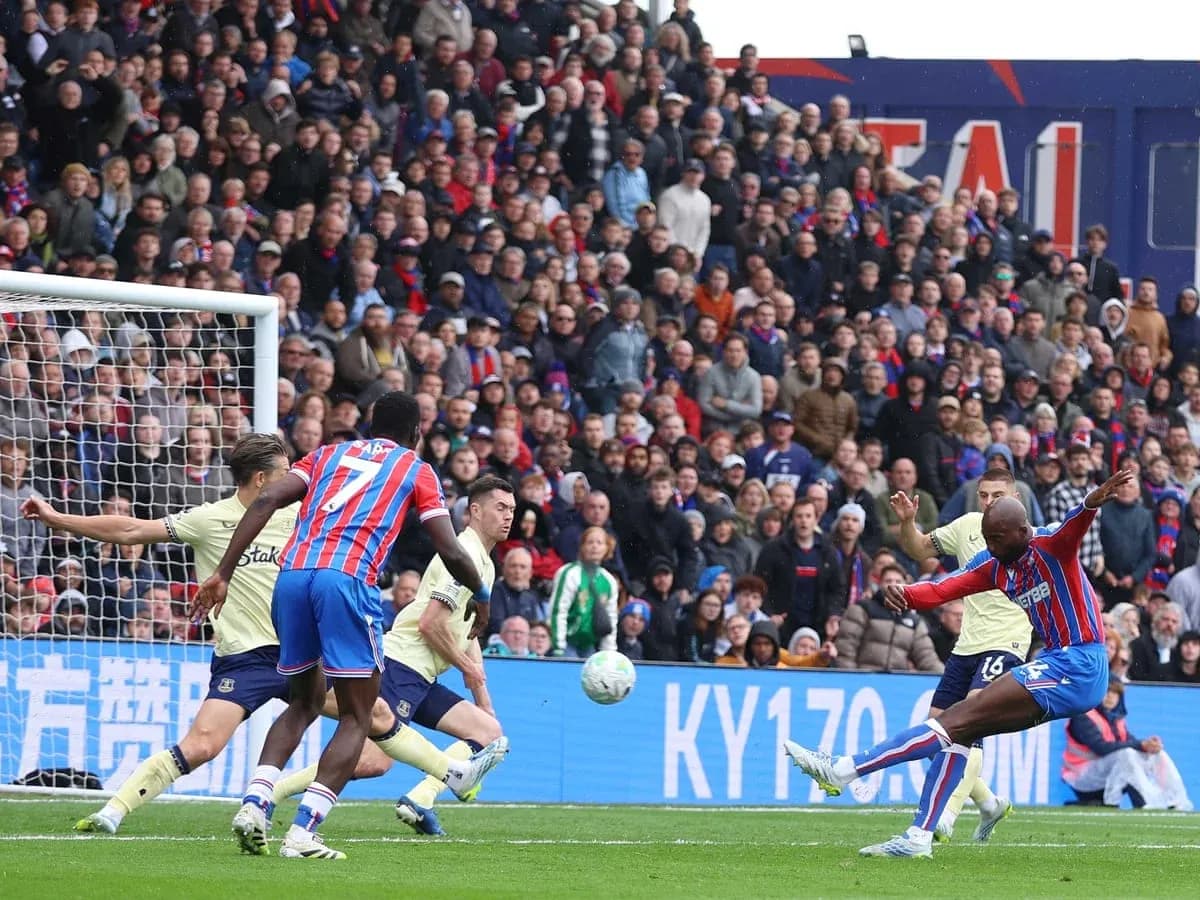
Crystal Palace and Everton played out a 2-2 draw at Selhurst Park in Premier League Regular Season Round 36, a match where the underlying data paints Palace as the more structured and proactive side, but Everton as ruthlessly efficient in key moments. Palace’s 3-4-2-1 under Oliver Glasner generated more volume, territory and xG (2.66 vs Everton’s 1.44), yet Everton’s 4-2-3-1, built on set-piece threat and direct play into Beto, repeatedly punctured Palace’s back three. The final score mirrored Everton’s resilience and penalty-box sharpness rather than the overall flow of the game.
Disciplinary Log
Disciplinary log (all cards, in chronological order):
- 30' James Garner (Everton) — Foul
- 45' Vitaliy Mykolenko (Everton) — Foul
Card totals: Crystal Palace: 0, Everton: 2, Total: 2.
Scoring Sequence
The scoring sequence began with Everton striking early. On 6', James Tarkowski converted for the visitors, capitalising on Palace’s early vulnerability in rest-defence as the back three were slow to deal with the first wave of pressure. That goal immediately tilted the tactical picture: Palace had to push their wing-backs higher, while Everton could sit in a compact 4-4-1-1 out of possession, with Iliman Ndiaye dropping alongside Merlin Röhl to clog central lanes.
The first card arrived on 30', when James Garner was booked for “Foul”, emblematic of Everton’s willingness to disrupt Palace’s rhythm in midfield. Palace’s response was measured rather than frantic, and it paid off on 34' when Ismaïla Sarr equalised. Operating from the right half-space in the 3-4-2-1, Sarr exploited the gap between Mykolenko and Michael Keane, attacking the channel once Palace had successfully circulated through Adam Wharton and Daichi Kamada. By 45', the match was level at 1-1, but Everton’s back line was under growing stress; Mykolenko’s yellow card for “Foul” at 45' underscored how often Palace were isolating him in wide defensive duels.
Second Half
Early in the second half, Everton flipped the script again. On 47', Beto restored the lead, finishing a move assisted by Tarkowski. Tactically, it was a classic Everton pattern: win the first or second ball, then find Beto early against a retreating back three. Palace’s central trio of Maxence Lacroix, Chris Richards and Jaydee Canvot struggled whenever Everton bypassed midfield and attacked the space behind their high line.
Oliver Glasner’s first decisive adjustment came on 65': Jean Philippe Mateta (IN) came on for Jørgen Strand Larsen (OUT). This substitution shifted Palace’s attacking reference point. Mateta offered more penalty-box presence and a stronger back-to-goal option, allowing Brennan Johnson and Sarr to start narrower and attack second balls. On 70', Everton mirrored the centre-forward refresh: Thierno Barry (IN) came on for Beto (OUT), suggesting a desire to maintain vertical threat but with fresher legs for pressing and counter-runs.
Palace’s territorial control intensified, and the data supports this: 59% ball possession, 459 passes, 382 accurate (83%), and a heavy shot volume (21 total shots, 8 on target, 15 from inside the box). The equaliser on 77' was a logical outcome of that pressure. Mateta, the earlier substitute, found the net to make it 2-2, again highlighting how Glasner’s change recalibrated Palace’s presence in the area. Palace then sought more midfield control and pressing energy on 80', with Jefferson Lerma (IN) coming on for Brennan Johnson (OUT), effectively turning the shape into a more solid 3-5-1-1 in possession and a 5-3-2 without the ball.
Everton's Response
Everton’s response on 80' and 90+4' was to refresh their attacking midfield line: Tyrique George (IN) came on for Merlin Röhl (OUT) at 80', and Carlos Alcaraz (IN) replaced Kiernan Dewsbury-Hall (OUT) at 90+4'. These moves aimed to inject ball-carrying and transitional threat, but structurally Everton remained reactive, defending deep and trying to spring forward from a 4-4-2/4-5-1 block.
Goalkeeping Performance
From a goalkeeping perspective, both Dean Henderson and Jordan Pickford were central to the final outcome. Henderson faced 13 Everton shots (6 on target) and produced 5 saves, with the data crediting him with 1.2 goals prevented. That figure, combined with Everton’s xG of 1.44, underlines that Henderson’s interventions kept Palace from turning a draw into a defeat; his shot-stopping compensated for some structural fragility when Everton attacked quickly through Beto. Pickford, meanwhile, dealt with heavier volume: 21 shots faced, 8 on target, and 6 saves, also with 1.2 goals prevented. Against Palace’s 2.66 xG, Pickford’s performance was the main reason Everton escaped with a point; he repeatedly denied Palace from central and inside-box positions that, on another day, would have produced a third goal.
Defensive Analysis
Defensively, Palace’s back three plus double pivot gave them a strong “Defensive Index” in terms of shot suppression zones and second-ball recovery, but they were vulnerable to the first direct ball into Beto and set-piece moments around Tarkowski. Everton’s defensive profile was more attritional: 13 fouls to Palace’s 5, 2 yellow cards, and long spells defending their own third. Yet their box defence, anchored by Tarkowski and Keane, combined with Pickford’s shot-stopping, held up under sustained pressure.
Statistical Verdict
Statistically, the verdict is clear. Palace’s Overall Form in this match — 59% possession, 459 passes, 382 accurate (83%), 21 shots and 2.66 xG — reflects a side that controlled territory and created enough to win. Everton’s Overall Form — 41% possession, 313 passes, 232 accurate (74%), 13 shots and 1.44 xG — speaks to a more opportunistic, transition-focused approach. Both keepers’ 1.2 goals prevented highlight a game defined as much by last-line excellence as by tactical structure. The 2-2 scoreline ultimately represents Everton’s efficiency and resilience more than it does the underlying balance of play, with Palace left to rue their inability to convert dominance into three points.