.svg&w=384&q=75 "Naijagoal logo")
Chelsea's Home Defeat: A Summary of Their 2025 Campaign
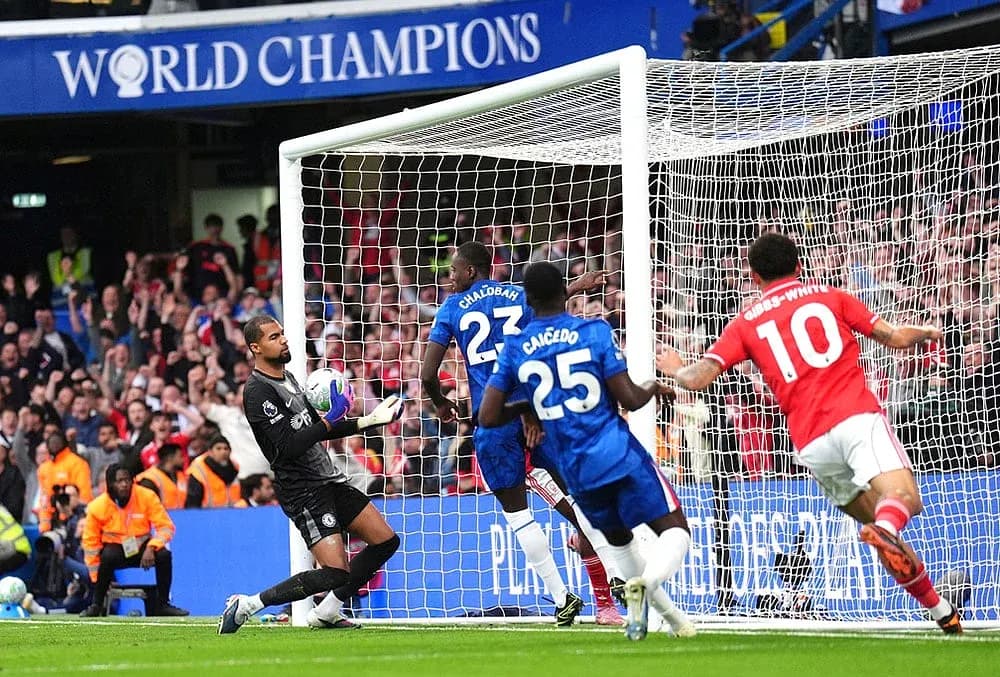
Under a grey London sky at Stamford Bridge, the Premier League’s contrasting narratives collided and then twisted again. Following this result, Chelsea’s 3-1 home defeat to Nottingham Forest felt less like a single bad afternoon and more like a sharp, painful summary of their entire 2025 campaign: fragile at home, streaky in form, and too often undone before they truly start to play.
I. The Big Picture – Forest’s steel vs Chelsea’s slide
This was Round 35 of the Premier League season, and the table framed the story even before kick-off. Chelsea, 9th with 48 points and a goal difference of +6 (54 scored, 48 conceded overall), came in on a brutal run of five straight league losses, their form line reading “LLLLL”. At home they had been strangely ordinary: 6 wins, 5 draws, 7 defeats at Stamford Bridge, with both goals scored and conceded locked at 24. An average of 1.3 goals for and 1.3 against at home underlined the sense of a side that never quite imposes itself on its own turf.
Forest arrived as the side in crisis on paper but not in rhythm. They were 16th with 42 points and a goal difference of -2 (44 for, 46 against overall), but their form was surging: “WWWDW” heading into this game. On their travels they had been quietly dangerous, winning 7 of 18 away matches, drawing 3 and losing 8, with 26 goals scored and 25 conceded. An away average of 1.4 goals for and 1.4 against suggested a team that embraces risk but increasingly manages it.
On the day, that pattern crystallised. Forest led 2-0 by half-time and never truly looked like surrendering control, even as Chelsea briefly threatened a second-half response.
II. Tactical Voids – Absences and edge
Both squads walked into this fixture carrying scars. Chelsea were without A. Garnacho (Inactive), J. Gittens (Muscle Injury), M. Mudryk (Suspended) and P. Neto (Inactive), removing pace and one‑v‑one threat from the flanks. The absence of Mudryk in particular stripped Calum McFarlane of a vertical outlet to stretch Forest’s back line and open pockets for Joao Pedro and Cole Palmer.
Forest’s list was even longer: O. Aina, W. Boly, C. Hudson-Odoi, John Victor, Murillo, D. Ndoye, I. Sangare and N. Savona all missed out through various injuries and knee or muscle issues. Yet Vitor Pereira’s side have become used to patchwork solutions. Their season-long reliance on a 4-2-3-1 shape gave way here to a 4-4-2, but the underlying principles—compactness, quick transitions, and aggressive full-backs—remained.
Disciplinary trends framed the contest’s edge. Chelsea are one of the league’s most combustible sides: across the season they have accumulated 10 yellow cards and 1 red for M. Caicedo alone, with their yellow card distribution peaking late—22.35% of their cautions arriving between 76-90 minutes, and 28.57% of their reds between 61-75 minutes. Forest, by contrast, spread their cautions more through the middle of games, with 23.21% of yellows in both the 46-60 and 61-75 minute windows, and their single red card coming between 31-45 minutes. The match followed that pattern of emotional volatility: Chelsea chased, Forest controlled, and the visitors rarely looked like losing their composure.
III. Key Matchups – Hunter vs Shield, Engine Room wars
The headline duel was always going to be Joao Pedro against Forest’s defensive shield. With 15 goals and 5 assists overall, and 48 shots (28 on target), the Brazilian is Chelsea’s primary hunter in the final third. He started as the lone forward in a 4-2-3-1, ahead of an attacking band of Palmer, E. Fernandez and J. Derry.
Yet Forest’s back four—Z. Abbott, Cunha, Morato and L. Netz—were protected by a disciplined midfield line of D. Bakwa, R. Yates, N. Dominguez and J. McAtee. Forest have conceded 25 goals away at an average of 1.4 per game, but that number hides their growing resilience in big away fixtures, where they lean into compact lines and controlled aggression. Here, they limited Chelsea’s ability to find Joao Pedro between the lines, forcing him to drift wide and drop deeper, reducing his penalty-box presence.
The true heart of the game, though, lay in the “Engine Room” clash. Chelsea’s double pivot of R. Lavia and M. Caicedo was tasked with both building play and stifling transitions. Caicedo’s season numbers—83 tackles, 14 successful blocks, 56 interceptions, and a 92% pass accuracy from 1,877 passes—mark him as one of the league’s premier ball-winners and distributors. His propensity for cards, however, always hovers in the background.
Opposite him, R. Yates and N. Dominguez formed Forest’s central spine, with McAtee drifting inside from the flank to overload zones. Forest’s season-long average of 1.3 goals conceded overall reflects a side that, while not watertight, is structurally sound when their midfield screen is intact. In this match, they repeatedly broke Chelsea’s central rhythm, forcing McFarlane’s side into sterile possession and hopeful wide deliveries.
Up front, the physical pairing of Igor Jesus and T. Awoniyi embodied Forest’s “Hunter vs Shield” narrative in reverse. Against a Chelsea defence led by T. Chalobah and T. Adarabioyo—who between them bring strong aerial presence and, in Chalobah’s case, 16 successful blocks and 35 interceptions this season—Forest’s strikers offered constant movement and channels. The first-half two-goal burst owed much to their willingness to run into the gaps between full-back and centre-back, exploiting Chelsea’s hesitation in transition.
IV. Statistical Prognosis – xG shadows and defensive solidity
Even without explicit xG figures, the season data sketches the underlying story. Chelsea’s overall scoring average of 1.5 goals per game, combined with 1.4 conceded, suggests a side whose attacking talent is undermined by structural leaks. Forest, at 1.3 scored and 1.3 conceded overall, are more modest but more balanced.
Following this result, Forest’s away record of 7 wins, 3 draws and 8 losses with 26 goals scored and 25 conceded looks less like overperformance and more like a coherent plan: defend in numbers, attack with clarity. Their ability to go 2-0 up by half-time at Stamford Bridge fits that pattern of clinical, high-value chance creation rather than sheer volume.
Chelsea, meanwhile, saw their home fragility once again exposed. With 24 goals scored and 24 conceded at Stamford Bridge, their goal difference at home is exactly 0, and this match underlined why: they allow too many high-quality transitions and struggle to convert territorial dominance into truly dangerous shots.
In narrative terms, Forest leave London as the side whose numbers and identity now align. Chelsea remain a puzzle of elite individual pieces—Joao Pedro’s end product, Caicedo’s control, Palmer’s creativity—trapped inside a structure that still cannot reliably protect its own goal or bend games to its will.