.svg&w=384&q=75 "Naijagoal logo")
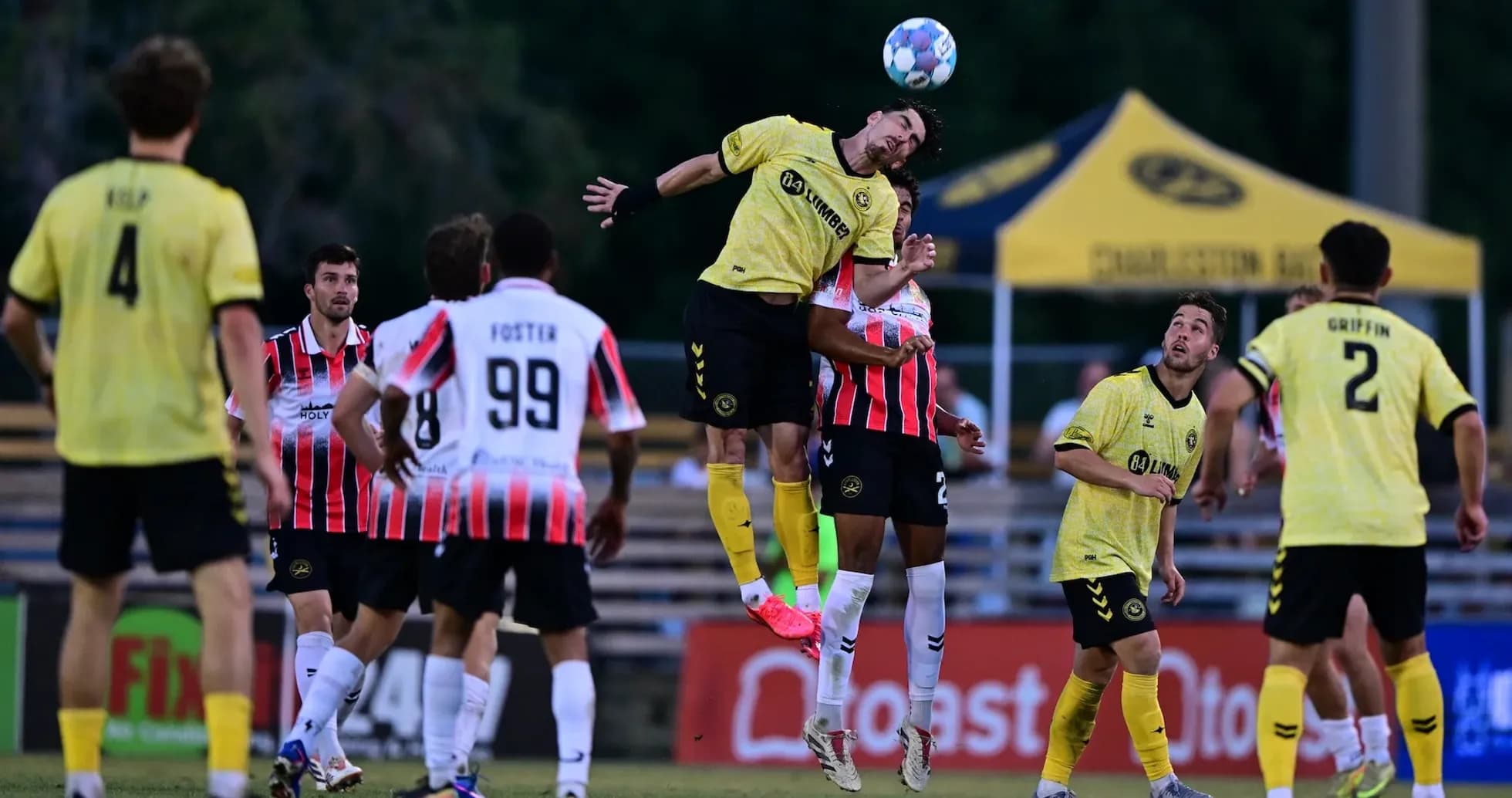

Charleston Battery Triumphs Over Pittsburgh Riverhounds in Penalty Shootout
Under the lights at Patriots Point Soccer Complex, Charleston Battery and Pittsburgh Riverhounds played out 120 minutes that refused to yield a goal, before the hosts finally bent the night to their will from the spot, winning 4–2 on penalties. Following this result, the Group Stage of the USL League One Cup felt less like an early-tournament formality and more like a statement of intent from a side already sitting 1st in Group 6, and a warning for a Riverhounds team whose margins are narrowing fast.
For Charleston, this shootout triumph fits neatly into a broader seasonal pattern. Overall this campaign, they have been ruthlessly efficient: 3 wins from 3 in the competition, with 7 goals for and just 1 against. That yields a total goals-for average of 2.3 and a goals-against average of 0.3, numbers that speak to a side that does not need many chances to put a game away and rarely allows opponents a way back in. At home, the sample is small but pristine: 1 match, 1 win, 1 goal scored, 0 conceded. The defensive clarity that has underpinned their rise was on full display again here, even as the match stretched all the way to penalties.
Ben Pirmann’s starting XI underlined that defensive backbone. J. Berner, wearing 1, anchored the side from goal, protected by a back line built around the presence of D. Martinez, G. Smith, J. Akpunonu and N. Messer. In front of them, the double presence of K. Pakhomov and S. Suber offered ballast in central areas, allowing the more advanced trio of M. Foster, E. Ycaza and L. Blackstock to probe between the lines and support lone forward M. Berry, in shirt 90. It is a group designed less for chaos and more for control: Charleston have kept 2 clean sheets in total this campaign, and have yet to fail to score either at home or on their travels.
On the opposite bench, Rob Vincent’s Riverhounds arrived as a side still searching for equilibrium. Their Group 6 standing – 3rd, with 5 points and a goal difference of -1 – reflects a campaign of sharp contrasts. At home, they have been ruthless, winning their single match 3–0 and averaging 3.0 goals for and 0.0 against. Away, the picture darkens: 2 defeats from 2, with just 1 goal scored and 3 conceded, for an away goals-for average of 0.5 and goals-against of 1.5. This trip to Patriots Point was always going to be a test of whether they could export that home swagger into hostile territory.
Vincent’s selection leaned into mobility and technical craft. M. Sheridan stood in goal, shielded by a defensive line including P. Barnes, V. Souza, O. Mikoy and L. Kelp. Ahead of them, the midfield blend of E. Goldthorp, R. Mertz, D. Griffin and C. Ahl promised both industry and invention, with S. Bassett and T. Amann tasked with stretching the Battery’s compact block. On the bench, the presence of A. Dikwa, B. Larsen and M. Viera hinted at attacking changes that could tilt the late phases of the game, but Charleston’s defensive organisation meant those weapons never quite found a decisive opening.
If the scoreboard refused to move across 120 minutes, the underlying tactical battle was still vivid. Charleston came into the night with a clear seasonal identity: they concede very little and manage games with a mature sense of risk. Their total clean-sheet count of 2 in 3 matches, combined with a failed-to-score tally of 0, shows a side that almost always gets on the board while keeping opponents at arm’s length. Even without explicit formation data, the personnel mix suggested a compact mid-block, with Pakhomov and Suber screening the centre and full-backs like Martinez and Messer choosing their moments to advance.
Pittsburgh, by contrast, arrived with a more volatile statistical profile. Overall, they have scored 4 and conceded 3, for a total goals-for average of 1.3 and goals-against of 1.0. Their biggest win – 3–0 at home – and their heaviest away loss – 2–1 – underline the split personality between their own turf and their travels. Here, against a Battery side that has allowed just 1 goal overall this campaign, their usual away fragility was replaced by a more conservative, risk-averse posture. Sheridan’s calm presence and the work of Souza and Mikoy in front of him kept Charleston from turning territorial pressure into clear chances.
Discipline, too, played its part in the narrative. Heading into this game, Charleston’s yellow-card distribution revealed a spike between 46–60 minutes, when 50.00% of their cautions have arrived, with additional bookings spread across the opening quarter-hour (16.67%), 16–30 (16.67%) and 76–90 (16.67%). That pattern hints at a side that tightens the screws after half-time, occasionally stepping over the line to prevent counters. Pittsburgh’s own yellow profile is similar in shape: 42.86% of their cautions also fall in the 46–60 window, with 14.29% each in 0–15, 31–45, 61–75 and 76–90. Crucially, their red-card data shows a 100.00% concentration in the 76–90 range, suggesting that late-game stress can tip them into dangerous territory. Even without specific bookings listed for this fixture, both teams’ histories framed a second half and extra time that were always likely to be attritional, card-strewn and finely balanced.
In the end, the penalty shootout felt almost inevitable. Neither side had conceded a spot-kick in the competition heading into this match – both had penalty totals of 0, with no attempts scored or missed – so the shootout was a plunge into statistical unknowns. Charleston’s 4–2 conversion under pressure fits their broader pattern of efficiency and calm: a group that rarely wastes what it creates and trusts its structure to carry them through thin margins.
From a broader tactical prognosis, this result reinforces Charleston Battery as the group’s standard-bearers. Their combination of a total goals-for average of 2.3, a total goals-against average of just 0.3, and a perfect record in fixtures played (3 wins, 0 draws, 0 losses) marks them as a side whose xG and defensive solidity are likely trending in the right direction, even if the raw xG numbers are not provided. Pittsburgh Riverhounds, meanwhile, remain a puzzle: potent at home, blunted away, and now carrying the weight of another road disappointment decided on the thinnest of margins.
Following this result, the story of Group 6 is clear. Charleston Battery look built for the long haul of knockout football – disciplined, efficient, and unflustered over 120 minutes. Pittsburgh Riverhounds, for all their flashes of quality, must find a way to translate home dominance into away resilience, or nights like this one at Patriots Point will continue to end in someone else’s celebration.