.svg&w=384&q=75 "Naijagoal logo")

Canada Celebrates Historic 6-0 Victory Over Qatar in World Cup
Canada arrived in Vancouver hoping for a routine win and a clean start. It walked away with a landmark.
A 6-0 demolition of Qatar, the country’s first-ever men’s World Cup victory, turned a nervous night into a statement of intent – and, for many, proof that Canada now belongs in the global football conversation. The scoreline was wild. The emotions were split.
Because in the middle of the party, Ismaël Koné’s tournament ended on a stretcher.
A city painted red
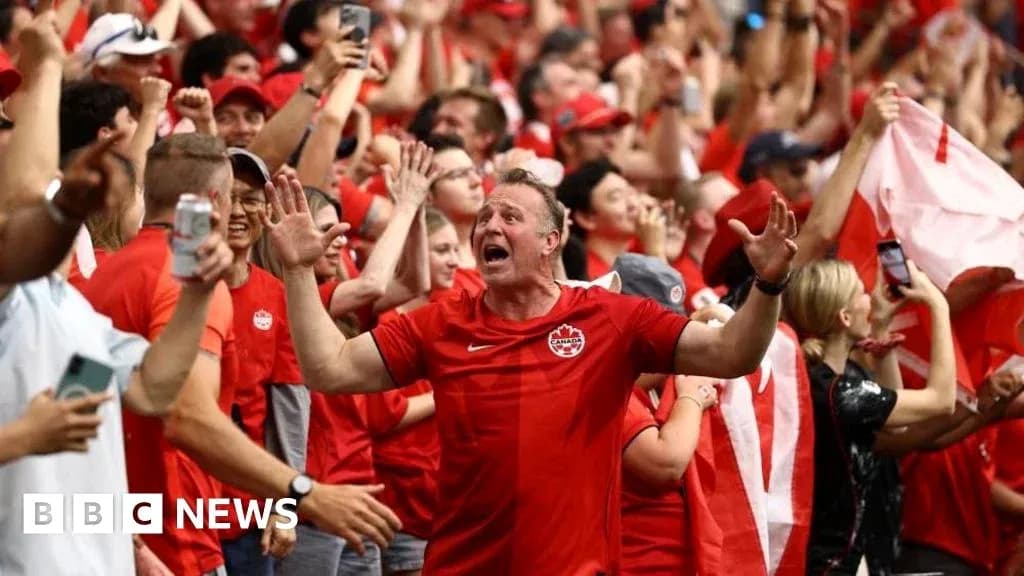
By kickoff, Vancouver looked less like a cautious host city and more like a place that had been waiting decades for this. The “last mile” to the stadium was a river of red and white, smoke flares hanging over thousands of fans marching toward a sold-out crowd of 52,000.
Inside, it was almost entirely Canada. Shirts, flags, scarves, faces – all in the national colours, all roaring through the anthem as if trying to drag the team into history by sheer noise.
Across the country, the scene repeated on a smaller scale. Packed watch parties on Granville Street. Crowded neighbourhood bars in Toronto. Longtime supporters who had lived through the thin years of Canadian men’s football now leaning forward, wondering if this time would be different.
One of them, Dave Di Cola, settled into a bar stool with what he called “reserved optimism”. He knew the sport too well to assume anything.
That caution did not last long.
A rout with the world watching
Canada tore into Qatar from the opening whistle. The early tension evaporated as the goals came in waves, three before half-time, the contest effectively over before the break.
By the final whistle it was a 6-0 blowout, the margin swollen by two Qatari red cards but still underpinned by Canadian control and aggression. Les Rouges did not just win; they dominated, they punished, they strutted.
Jonathan David, already the poster boy of this new generation, helped himself to a hat-trick. Somewhere in the stands, a fan in a Connor McDavid hockey jersey had taped over the “Mc” with a homemade “J” – a small, improvised tribute that said everything about a hockey nation starting to bend toward football.
For supporters like Di Cola, this was more than a big win. It was vindication.
“Canada soccer has always been kind of a joke. It’s always secondary,” he said. Watching the country rally around the team, he admitted, “nearly brought a tear to my eye.”
On social media, clips of the goals and the celebrations rocketed around the world. For once, Canada were not the plucky outsiders or the brave losers. They were the ones handing out the lesson.
Joy, then a hush
The noise dropped in an instant.
Koné, the Ottawa-born midfielder who had become such a central part of Jesse Marsch’s high-energy side, went down and stayed down. The replays told the story no fan wants to see at a World Cup. Medics rushed on. Teammates gathered, some visibly shaken, others shouting at officials, all of them understanding what this meant.
Marsch had called Koné “a big part of the heart of our team”. Now that heart had been ripped out of the tournament.
As Koné was treated and then taken off, the atmosphere shifted from euphoria to a kind of stunned concern. The scoreboard said 4-0, then 5-0, then 6-0, but every Canadian fan knew the cost.
Nathan Saliba, sent on in Koné’s place, offered the most immediate response. He scored Canada’s fourth, then lifted Koné’s jersey in tribute – a simple gesture that cut through the chaos of the night.
By Friday morning, after surgery, Koné posted his own message on Instagram: “What you guys did yesterday will stay with me forever.” The words carried the weight of someone who knew he would not be part of whatever comes next.
Di Cola admitted the injury changed everything. Without it, he said, he would have been “running up and down the avenue”. Instead, the celebrations came with a lump in the throat.
Character in the spotlight
In the dressing room after the match, the team received a visitor. Prime Minister Mark Carney addressed the players, not about the scoreline, but about their reaction to the injury that had shaken the stadium.
He praised them for showing “a level of character that some people never achieve” in how they rallied around Koné and kept their focus. This was not just about six goals; it was about how a young team handled a brutal moment with the cameras trained on them.
“You showed it when the entire country and a good part of the world is watching,” Carney told them. “And if they didn’t watch they would have watched the highlights tomorrow.”
On a night when Canada grabbed headlines for its football, the message was clear: style matters, but so does substance.
A new chapter, not yet a finished story
Canadian sport already has its shrines: Sidney Crosby’s golden goal in 2010, the Toronto Raptors climbing the NBA mountain in 2019, the women’s football team claiming Olympic gold in Tokyo. Those are the moments etched into the national psyche.
Di Cola is under no illusion that a 6-0 win over Qatar sits on that same shelf. He calls it “much smaller in comparison”, and he is right. This is not a finish line. It is a starting gun.
Canada’s men still have, in his words, “a long way to go”.
But momentum is a powerful thing. A country that once shrugged at men’s football just watched its team storm to a record World Cup win, fill a stadium, flood the streets, and dominate the global highlight reels.
Next up is Switzerland – a step up in quality, a different kind of examination. The scoreline will not be as forgiving. The spaces will be tighter. The margin for error will shrink.
Koné will not be there. His absence leaves a hole in Marsch’s midfield and a test of depth and resolve.
The question now is no longer whether Canada can win on this stage. It is whether this team can turn one historic night into a habit.