.svg&w=384&q=75 "Naijagoal logo")
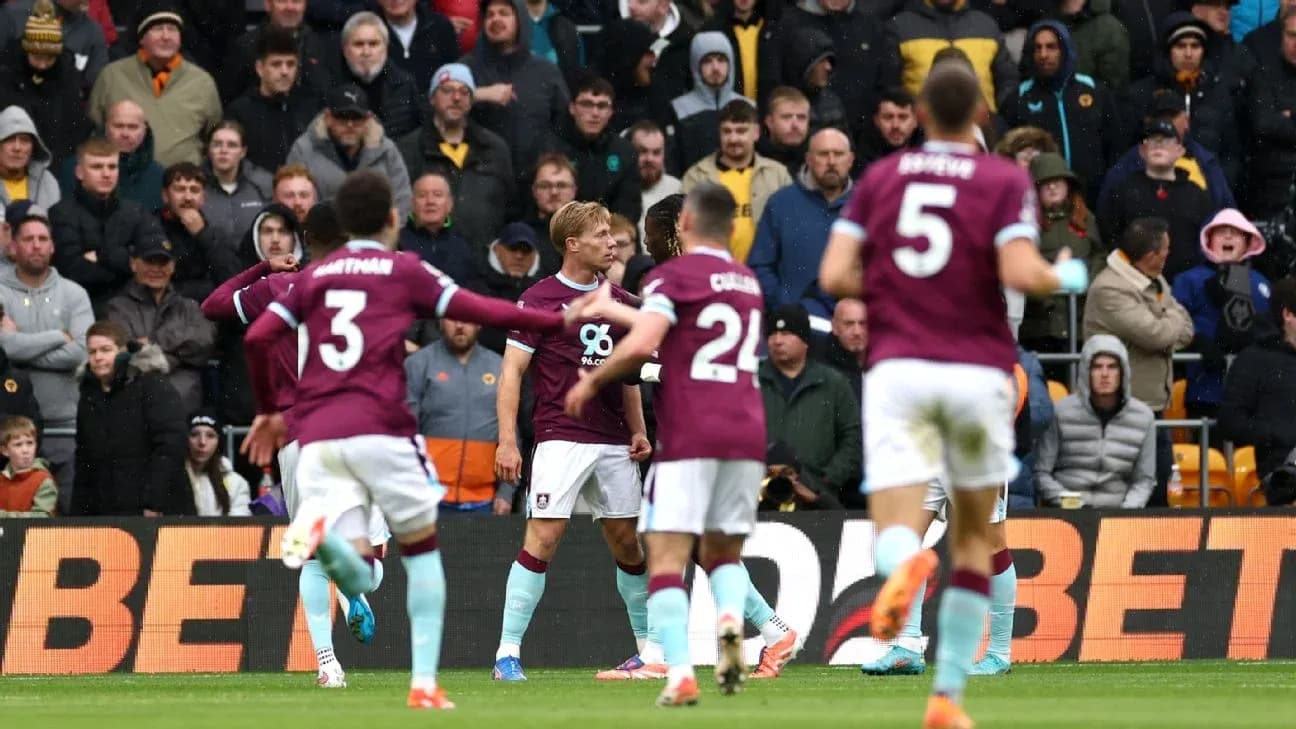

Burnley and Wolves End Season with Draw in Premier League Finale
Turf Moor staged a bleakly fitting finale to two bruised seasons as Burnley and Wolves, already condemned to relegation, shared a 1-1 draw in the Premier League’s Regular Season - 38. Following this result, Burnley closed the campaign 19th on 22 points, Wolves 20th on 20 – two clubs whose numbers tell of long, grinding decline rather than a final‑day flourish.
Burnley’s seasonal DNA is clear in the standings and team statistics: in total this campaign they played 38 league matches, winning 4, drawing 10 and losing 24. Their goal difference of -37 is the stark product of 38 goals for and 75 against. At home they were marginally more competitive but still fragile: 19 games at Turf Moor produced 2 wins, 7 draws and 10 defeats, with 18 goals scored and 29 conceded. An average of 0.9 home goals for against 1.5 home goals against captures a side that rarely outscored anyone.
Wolves arrive at the end of the road with an even more anaemic attack. In total they scored only 27 league goals and conceded 68, a goal difference of -41. On their travels they failed to win a single game: 0 away victories, 6 draws and 13 defeats, with 8 away goals for and 34 against. An away average of 0.4 goals scored and 1.8 conceded underlines how much Rob Edwards’ team leaned on defensive structure and damage limitation rather than ambition.
Within that context, a 1-1 draw – Wolves leading 1-0 at half-time before Burnley’s second‑half response – felt less like a twist and more like a mirror held up to both campaigns: Wolves’ inability to kill games, Burnley’s habit of clawing back from deficits without quite having the quality to turn them into wins.
Tactical Voids and Discipline
Both coaches had to navigate notable absences that shaped the match’s tactical texture. For Burnley, the repeated listing of J. Beyer (hamstring injury) and J. Cullen (knee injury) as “Missing Fixture” stripped Mike Jackson of a natural centre-back option and a key midfield connector. Without Cullen, the double pivot of Florentino and L. Ugochukwu in the 4-2-3-1 had to shoulder progression and protection, forcing Burnley to build more directly into the advanced line of L. Tchaouna, H. Mejbri, J. Anthony and Z. Flemming.
Wolves’ injury list was longer and more disruptive. L. Chiwome (knee injury) removed one forward option, while M. Doherty (muscle injury) and E. Gonzalez (knee injury) limited wing-back and defensive flexibility. Perhaps most tellingly, S. Johnstone’s knock ruled out a senior goalkeeping alternative, placing full responsibility on J. Sa between the posts. For a side already conceding an average of 1.8 goals per game both at home and away, that lack of depth narrowed Edwards’ tactical levers.
Season-long disciplinary trends framed the risk landscape. Burnley’s yellow card distribution shows a spread of aggression across the match, with pronounced spikes at 16-30 minutes (19.70%), 76-90 minutes (18.18%) and deep into stoppage time at 91-105 minutes (19.70%). Their red cards are tellingly late: 33.33% of their dismissals in 31-45 minutes, another 33.33% in 76-90, and 33.33% in 91-105. This is a team that often loses emotional control at the end of halves – a pattern embodied by J. Laurent, whose single red card and 7 yellows this season mark him as a combustible presence off the bench.
Wolves’ yellows spike after the interval: 27.50% of their bookings arrive between 46-60 minutes, with 20.00% from 61-75 and 18.75% from 76-90. Their reds are tightly clustered in the heart of contests: 31-45, 46-60 and 61-75 each account for 33.33% of dismissals. André and Y. Mosquera, each on 12 yellows, personify that knife‑edge: André as a high‑volume presser in midfield, Mosquera as an aggressive front‑foot defender. Against Burnley’s direct runners, any late press or mistimed step could easily have tilted the numerical balance.
Key Matchups
Burnley’s primary “hunter” this season has been Z. Flemming, even if he lined up as the nominal forward here rather than a classic No.10. In total this campaign he scored 11 league goals, from 38 shots with 21 on target, a remarkable haul in a side averaging only 1.0 goals per game overall. His 10 key passes and 2 penalties scored (from 2 taken, with no misses) underline a player who can both finish and shoulder set‑piece responsibility.
His task against Wolves’ “shield” was nuanced rather than straightforward. Wolves’ overall defensive record – 68 goals conceded in 38 matches – is poor, but structurally they are not chaotic. In a 3-4-2-1, the trio of Y. Mosquera, S. Bueno and L. Krejci in this match formed a compact central block. Mosquera’s 17 blocked shots in the league and 29 interceptions show a defender who steps out and engages; S. Bueno’s quieter numbers complement that with positional solidity. The problem for Wolves has not been the first contact, but the second: with only 4 clean sheets in total and 34 goals conceded away, they often repel the initial threat but fail to control rebounds, cut-backs and second phases. Flemming’s instinct to hover in pockets around the box made him the ideal predator in those moments, and Burnley’s equaliser reflected that pattern of sustained pressure rather than a single, isolated chance.
Engine Room
The midfield battle was the game’s true narrative core. For Burnley, Florentino and L. Ugochukwu formed a double pivot tasked with screening the back four and funnelling possession into Mejbri between the lines. Mejbri’s season numbers – 1 goal, 4 assists, 21 key passes and 10 yellow cards – paint him as both creator and agitator. He is a conduit who thrives in chaos, drawing 47 fouls and committing 24, capable of dragging the tempo into a scrap that suits Burnley’s direct transitions.
Opposite them, Wolves’ engine was André. Across the season he attempted 1306 passes with 91% accuracy and produced 18 key passes, while making 82 tackles, 13 blocks and 30 interceptions. He is both metronome and breaker, the player who decides when Wolves sit and when they step. Alongside him, A. Gomes and D. M. Wolfe added legs and bite, but André’s 12 yellows and 47 fouls committed reveal the cost of his constant engagement.
In this match, that duel was finely poised. Burnley’s central pair needed to disrupt Wolves’ build-up enough to prevent clean service into Hwang Hee-Chan and A. Armstrong, while Mejbri sought pockets behind André’s pressing line. Wolves, in turn, tried to funnel Burnley wide, trusting Mosquera and S. Bueno to deal with crosses and Flemming’s movement. The 1-1 scoreline reflects a stalemate in that engine room: neither side fully imposed its rhythm, and both midfields oscillated between control and scramble.
Statistical Prognosis
From a season-long perspective, the numbers made a low‑margin, attritional game almost inevitable. Burnley’s attack at home averaged 0.9 goals per match, Wolves’ away attack only 0.4. Both conceded heavily – Burnley 1.5 goals per home game, Wolves 1.8 on their travels – but Wolves’ chronic inability to score away from home always limited their ceiling. Even without explicit xG figures, the profiles suggest that any Expected Goals model would lean towards a narrow Burnley edge at Turf Moor, tempered by their habit of conceding soft chances.
Defensively, neither side offered the solidity required to control variance. Burnley’s 4 clean sheets in total and Wolves’ 4 across the campaign underline that both rely on reactive defending and last‑ditch interventions rather than systemic suppression of chances. In that environment, the individual quality of Flemming in the box and André’s defensive reading in midfield become the decisive micro‑battles.
Following this result, the statistical verdict is that the draw is a faithful reflection of who these teams have been all season: Burnley, marginally more adventurous but structurally fragile; Wolves, marginally more organised but toothless on their travels. The 1-1 at Turf Moor reads less like a twist in the tale and more like a closing chapter written in the same ink as everything that came before.