.svg&w=384&q=75 "Naijagoal logo")
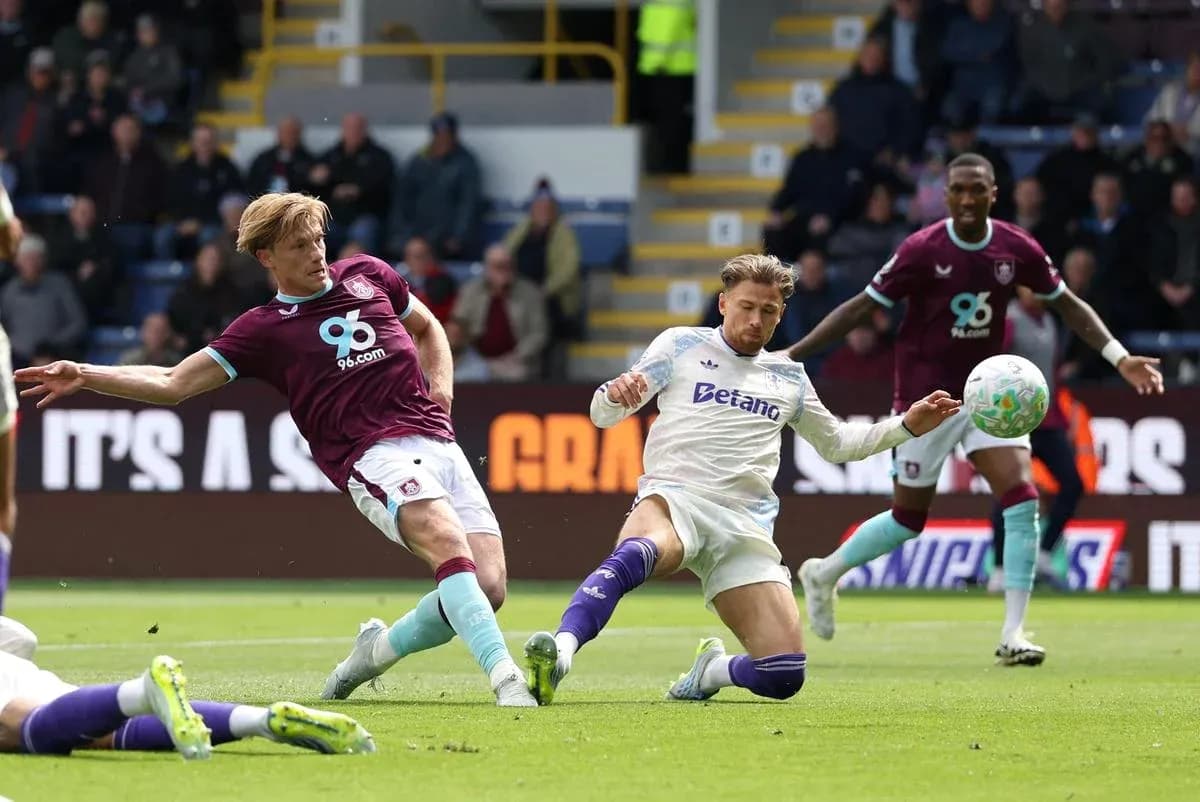
Burnley vs Aston Villa: A 2-2 Draw that Highlights Identities
Turf Moor felt like a crossroads more than a stadium. A relegation-threatened Burnley, 19th in the Premier League heading into this game with 21 points and a goal difference of -36 (37 scored, 73 conceded overall), stood in the drizzle against an Aston Villa side chasing Europe from 5th, on 59 points with a goal difference of 4 (50 for, 46 against overall). The 2-2 draw that followed did not change the trajectories of their seasons so much as illuminate their identities: Burnley as stubborn survivors clinging to top-flight status, Villa as a side of higher quality still wrestling with control.
I. The Big Picture – Mirrors in a 4-2-3-1
Both teams stepped into this regular season Round 36 clash in matching 4-2-3-1 shapes, but with very different emotional weights.
Burnley’s season has been built on suffering. At home they had played 18, winning 2, drawing 6 and losing 10, with 17 goals for and 28 against. An average of 0.9 goals for and 1.6 against at Turf Moor underlined why they were where they were. Yet Mike Jackson leaned into familiarity: a 4-2-3-1 that has been his most-used blueprint this season, played 11 times overall.
M. Weiss in goal sat behind a back four of K. Walker, A. Tuanzebe, M. Esteve and Lucas Pires. Ahead of them, the double pivot of Florentino and L. Ugochukwu was tasked with screening a fragile defence that had conceded 73 overall at an average of 2.0 per game. The attacking band of three – L. Tchaouna, H. Mejbri and J. Anthony – were built to feed the lone forward, Z. Flemming, Burnley’s leading scorer with 10 league goals.
Aston Villa arrived with a very different narrative. Unai Emery’s side had played 36 overall, winning 17, drawing 8 and losing 11, scoring 50 and conceding 46 – an attacking team with enough defensive vulnerability to keep games alive. Their 4-2-3-1 is their default system, deployed 32 times this season.
E. Martinez anchored a back four of M. Cash, E. Konsa, T. Mings and I. Maatsen. In front, V. Lindelof and Y. Tielemans formed the double pivot, with J. McGinn, R. Barkley and M. Rogers supporting O. Watkins, the league’s eighth-ranked scorer with 12 goals and 2 assists. Rogers, with 9 goals and 5 assists, is both Villa’s creative hub and transition spear.
The symmetry of the formations set up a game of individual duels and structural discipline rather than tactical surprises.
II. Tactical Voids – Who Was Missing, and What It Cost
Burnley’s absentees were concentrated in their defensive and midfield spine. J. Beyer (hamstring), J. Cullen (knee) and C. Roberts (muscle) were all listed as missing. In a side already conceding heavily – 28 at home and 45 on their travels – the loss of Beyer’s presence and Roberts’ energy on the flank forced Jackson to lean harder on Walker’s experience and Tuanzebe’s aerial work.
For Villa, the absences of Alysson (muscle), B. Kamara (knee) and A. Onana (calf) trimmed Emery’s options in midfield and depth. Kamara’s absence in particular removed a natural destroyer from the base of midfield, which likely influenced the decision to use Lindelof as a holding presence. It left Villa a little more technical than combative in the centre, a nuance that Burnley’s aggressive attackers could exploit in phases.
Disciplinary trends also shaped the emotional undercurrent. Burnley’s season-long yellow card distribution shows spikes in the 16-30 and 76-90 minute ranges, both at 19.67%, with a late-game red card tendency as well: 33.33% of their reds in 31-45, 33.33% in 76-90 and 33.33% in 91-105. They are a side that frays at the edges under pressure. Villa, meanwhile, pick up 29.09% of their yellows between 46-60 and another 18.18% in 91-105, with their only red this season arriving between 61-75 (100.00% in that window). This is a team that can lose control just as games open up after the break.
III. Key Matchups – Hunter vs Shield, Engine vs Enforcer
The headline duel was simple: O. Watkins versus Burnley’s battered defensive record. Watkins’ 12 goals come from 51 shots, 31 on target, and he thrives on attacking the channels between full-back and centre-back. Against a Burnley back line that has allowed 73 overall, his movement was always going to stretch Walker and Esteve, forcing Tuanzebe into constant covering duty.
At the other end, Z. Flemming carried Burnley’s attacking threat. With 10 goals from 37 shots (20 on target), and 5 blocked shots recorded in his defensive work, he is both finisher and first presser. His duel was against a Villa defence that has conceded 46 overall, including 26 on their travels at an average of 1.4 per away game. Konsa and Mings, usually comfortable defending higher, had to navigate his physicality and late penalty-box arrivals.
In the engine room, the clash was more nuanced. M. Rogers, Villa’s creative metronome, arrived with 9 goals, 5 assists and 43 key passes from 1033 total passes at 74% accuracy. He is both dribbler (117 attempts, 41 successes) and connector, linking transitions with McGinn and Barkley. His opposite numbers, Florentino and L. Ugochukwu, were less about numbers and more about resistance – tasked with collapsing the central lanes that Rogers loves to glide through.
Burnley’s disciplinary leader, K. Walker, brought 9 yellow cards into the season narrative, alongside 53 tackles, 10 blocked shots and 43 interceptions. His job was double-edged: hold the line against Rogers and McGinn drifting wide, and still find the legs to overlap and support Tchaouna and Anthony. One mistimed challenge risked tilting the balance, especially given Burnley’s late-card tendencies.
From the bench, Jackson had different tools to flip the script. A. Broja, L. Foster, J. Bruun Larsen and Z. Amdouni offered a variety of profiles to either chase or protect a result, while J. Ward-Prowse and J. Laurent provided set-piece quality and midfield steel. Laurent’s season includes 1 goal, 1 red card and 7 yellows, with 45 tackles and 8 blocked shots – an archetypal enforcer capable of both anchoring and igniting chaos.
Emery’s bench was laced with quality: L. Bailey’s direct pace, Douglas Luiz’s passing range, P. Torres’ composure at the back, and the creative unpredictability of E. Buendia and J. Sancho. T. Abraham added a different penalty-box profile if Watkins needed support or rest.
IV. Statistical Prognosis – A Draw that Fits the Numbers
Following this result, the 2-2 scoreline felt like a statistical compromise between Burnley’s desperation and Villa’s quality. Burnley’s overall average of 1.0 goals for and 2.0 against met a Villa side averaging 1.4 for and 1.3 against, and the four-goal spread sat squarely in the zone their seasons have hinted at.
Burnley’s inability to consistently shut games down – only 4 clean sheets overall, all at home – again surfaced, even as their front line, led by Flemming and supported by the fluid trio behind him, found enough incision to trouble a Villa defence that has been solid but far from impermeable.
Villa’s lack of penalties this season (0 taken, 0 missed) contrasted with Burnley’s perfect record from the spot (2 scored from 2, 100.00%), hinting that if chaos arrived in the box, it might favour the hosts. Yet in open play, Villa’s superior technical base, embodied by Rogers’ dual role as scorer and creator, ensured they could always claw their way back into the contest.
In tactical terms, this was a match that confirmed identities rather than rewrote them. Burnley remain a side that fights, scores just enough to believe, but concedes too much to truly escape. Aston Villa remain an expansive, occasionally ragged European contender: dangerous in attack, intermittently loose in control, but always capable of rescuing something, even on difficult northern afternoons like this one at Turf Moor.