.svg&w=384&q=75 "Naijagoal logo")
Burnley vs Aston Villa: Tactical Analysis of Premier League Draw
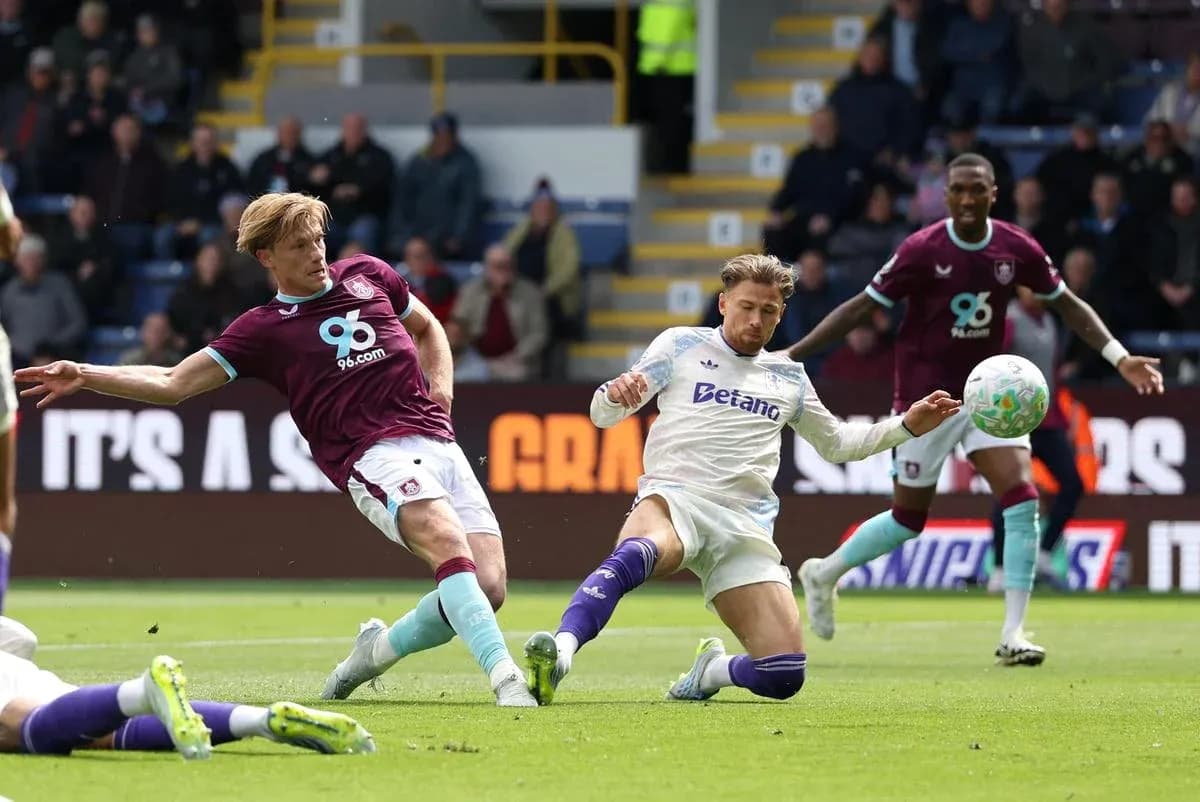
Burnley and Aston Villa shared a 2-2 draw at Turf Moor in Round 36 of the Premier League, a contest defined by contrasting game models and a sharp momentum swing either side of half-time. Burnley, under Mike Jackson, leaned into a compact 4-2-3-1 and direct transitions; Unai Emery’s Aston Villa imposed a possession-heavy version of the same base shape, circulating patiently and attacking through structured wide rotations. The statistical profile – 66% possession and 510 passes for Villa against Burnley’s 34% and 255 – underlines a game where the hosts were outpassed but not out-created, with xG narrowly favouring Burnley (1.77 to 1.42) and justifying the eventual parity on the scoreboard.
The scoring opened early when Jaidon Anthony struck for Burnley on 8', capitalising on the hosts’ aggressive start and willingness to attack quickly once they broke Villa’s first line. Villa thought they had levelled on 40' when a potential goal by Ollie Watkins was disallowed by VAR, a pivotal moment that nonetheless signalled Villa’s growing territorial control. The visitors did equalise before the break: on 42', Ross Barkley arrived from midfield to finish a move assisted by John McGinn, punishing Burnley’s difficulty in tracking late runners once their block was stretched.
Second Half
The second half began with a key disciplinary and momentum inflection. At 49', Tyrone Mings (Aston Villa) received a yellow card — Foul — as Burnley tried to reassert physicality and direct play into the channels. Villa then translated their dominance into the scoreline on 56', when Ollie Watkins finished a move initiated from deep by goalkeeper Emiliano Martínez, whose assist reflected Villa’s insistence on building from the back and exploiting space behind Burnley’s back four. Burnley’s response was immediate and structurally coherent: on 58', Zian Flemming, supplied by Hannibal Mejbri, struck to make it 2-2, a sequence born from Burnley’s aggressive counter-press once Villa lost their defensive shape in transition.
Disciplinary Log
49' Tyrone Mings (Aston Villa) — Foul
60' Zian Flemming (Burnley) — Persistent fouling
Flemming’s yellow at 60' for Persistent fouling encapsulated Burnley’s approach out of possession: repeated, controlled aggression from the No. 10 line to disrupt Villa’s midfield rhythm, particularly when Youri Tielemans and Barkley sought to receive between the lines.
From a structural standpoint, both sides mirrored each other on paper in 4-2-3-1, but used the shape very differently. Burnley’s back four of Kyle Walker, Axel Tuanzebe, Maxime Estève and Lucas Pires stayed relatively narrow, with Walker often tucking in to form a back three in build-up, allowing Pires to step higher on the left. The double pivot of Florentino Luís and Lesley Ugochukwu was primarily protective, screening Watkins and blocking central access to Barkley and McGinn. Ahead of them, Loum Tchaouna and Jaidon Anthony provided vertical outlets wide, while Hannibal Mejbri operated as a high-activity No. 10 behind Flemming, tasked with initiating counters and pressing Villa’s first pass into midfield.
Villa’s 4-2-3-1 was more expansive. Full-backs Matty Cash and Ian Maatsen advanced aggressively, especially Maatsen on the left, with Victor Lindelöf and Tielemans forming the double pivot. Lindelöf’s role as a nominal midfielder was key: he dropped alongside the centre-backs to create a 3+1 structure in the first phase, freeing Maatsen and Cash to push high and pin Burnley’s wingers. McGinn and Barkley operated as dual advanced midfielders, rotating between half-spaces and wide channels, while Morgan Rogers tucked in from the left to overload central pockets behind Florentino Luís and Ugochukwu. Watkins’ movement, both in behind and into the channels, constantly tested Burnley’s centre-backs and created the conditions for both the disallowed effort and his eventual goal.
Substitution Pattern
The substitution pattern from 69' onwards reflected game-state management more than tactical overhaul. For Burnley, Lyle Foster (IN) came on for Hannibal Mejbri (OUT) at 69', adding a second natural forward presence and slightly shifting Flemming’s responsibilities in the attacking band. At 79', Josh Laurent (IN) replaced Lesley Ugochukwu (OUT), injecting fresh legs and more vertical running from midfield, while Zeki Amdouni (IN) came on for Zian Flemming (OUT) to provide a different profile between the lines, more oriented to link play than to press. Late on, at 87', James Ward-Prowse (IN) replaced Florentino Luís (OUT), giving Burnley a higher passing range in deep areas and set-piece quality, and Jacob Bruun Larsen (IN) came on for Jaidon Anthony (OUT), refreshing the left flank for the final minutes.
Villa’s bench moves were about protecting structure and managing fatigue. At 74', Lucas Digne (IN) came on for Ian Maatsen (OUT), maintaining the attacking left-back threat while stabilising defensively. Simultaneously, Emiliano Buendía (IN) replaced Victor Lindelöf (OUT), shifting Villa toward a more orthodox midfield with greater creativity, as Buendía could drop between lines and combine with Barkley and McGinn. On 80', Douglas Luiz (IN) came on for Ross Barkley (OUT), rebalancing the midfield with more positional discipline, and Lamare Bogarde (IN) replaced Matty Cash (OUT), ensuring defensive energy on the right. Finally, at 85', Leon Bailey (IN) came on for John McGinn (OUT), adding direct pace and 1v1 threat on the flank as Villa chased a late winner without losing the 4-2-3-1 skeleton.
Statistical Overview
Statistically, the game underlines the clash of philosophies. Villa’s 510 passes, 439 accurate (86%), and 66% possession show a controlled, ball-dominant approach that produced 18 total shots, 7 on target, and 8 corners. Burnley, with 255 passes, 186 accurate (73%), and 34% possession, were far more direct but still generated 15 total shots, 6 on target, from only 2 corners. The xG split – Burnley 1.77, Aston Villa 1.42 – suggests that while Villa had more volume, Burnley carved out slightly higher-quality chances relative to their time on the ball. Defensively, Max Weiss made 5 saves for Burnley against Emiliano Martínez’s 4 for Villa, reinforcing the sense that Villa applied more sustained pressure, but Burnley’s transitions were more incisive per attack. With both goalkeepers posting -0.16 in goals prevented, neither side could lean on shot-stopping heroics; instead, the 2-2 felt like the logical outcome of two coherent, contrasting game plans that both found enough structural success to earn a point.