.svg&w=384&q=75 "Naijagoal logo")

Brazil's World Cup Evolution: Matheus Cunha as the Key Player
Brazil’s World Cup machine is starting to hum – and, crucially, so is its centre-forward.
Carlo Ancelotti appears to have settled on his best XI. The group stage has brought a steady climb: performances sharper, confidence higher, the structure clearer with every game. That timing matters. Japan await in the last 32, a far more complex test than Haiti or Scotland, and Brazil arrive with the feeling of a team gathering speed.
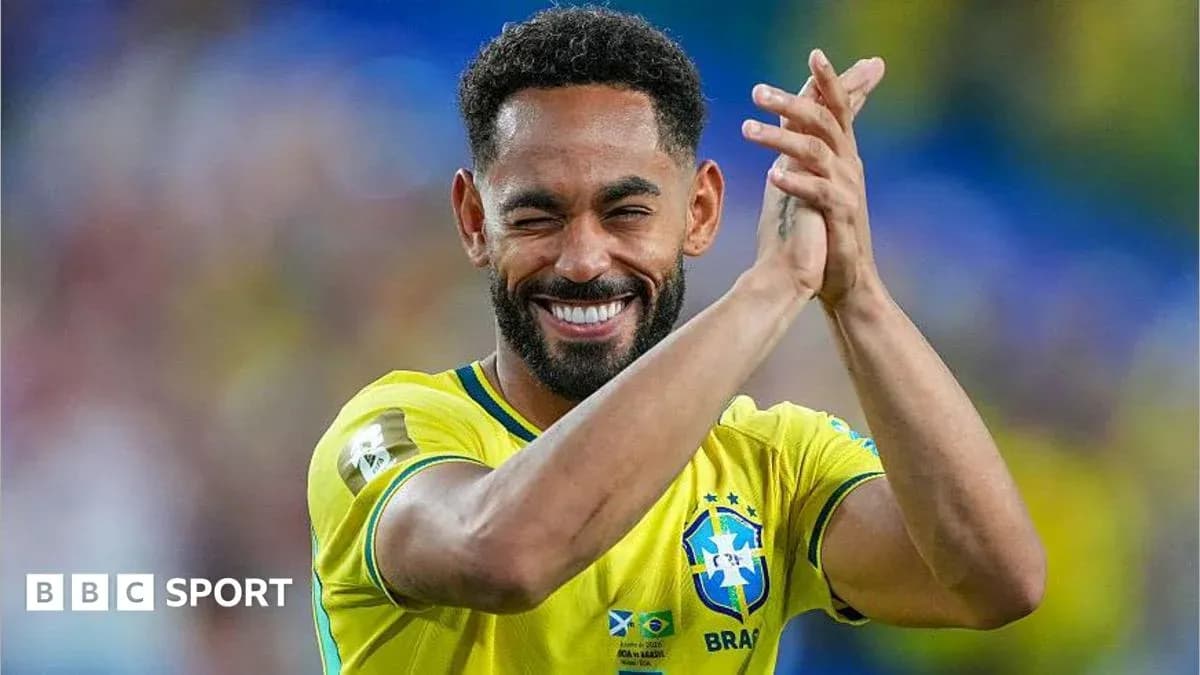
At the heart of it all stands Matheus Cunha, the forward who doesn’t quite fit the old Brazilian template yet suddenly looks indispensable.
A No 9 Who Isn’t Really a No 9
Brazilian fans are used to a certain kind of striker. Ronaldo, Adriano, Romario – the lineage is heavy with pure penalty-box predators, classic number nines who live on the shoulder and finish moves rather than build them.
Cunha is something else. A “nine-and-a-half” is how those close to the camp describe him. He can play like a nine, he can drift and link like a 10, but he isn’t fully either. He has already scored three times at this World Cup, so he is no mere creator, yet he also refuses to be boxed in as a traditional playmaker.
What he gives Brazil is different. Maybe even something they have never truly had from a central striker.
His movement constantly asks questions. Cunha drops off the line, pulls centre-backs into places they do not want to go, then suddenly appears between the lines. The comparison with Roberto Firmino feels natural: the same willingness to retreat into midfield, the same habit of making the defender marking him doubt every decision.
If the centre-back tracks him, space opens for Vinicius Jr on one side and Rayan on the other. If the defender holds position, Cunha turns, receives, and has time to thread passes or shoot. Either way, Brazil dictate the terms.
He has embraced the ugly work too. When Brazil press, Cunha often starts it, sometimes almost as a temporary number six, screening in front of the midfield and triggering the press at the moment agreed on the training ground. That defensive contribution has helped balance an attack loaded with individual talent but in need of structure.
From Uncertainty to Clarity Up Front
Not long ago, Brazil did not even know who their number nine would be.
Right up to the Scotland game, the position was open. Ancelotti tested Cunha, Igor Thiago, Endrick, Joao Pedro and Richarlison. None immediately nailed the role. For a nation used to arriving at World Cups with a clear attacking reference point, it was a strange feeling.
Then injuries nudged the puzzle into place.
Raphinha, a gifted, restless attacker who roams between lines and flanks, started the tournament as a central figure, playing as a 10 behind Thiago against Morocco and also capable of operating on either wing. His hamstring injury in that same match forced a change. On came Rayan, a more orthodox wide player who naturally holds the right side.
That small shift altered the geometry of Brazil’s attack. Vinicius wide left, Rayan wide right, both stretching the pitch. Cunha, now, finds himself with pockets of space in central areas that suit his hybrid game perfectly. He often stands alone between the lines, free to choose whether to link, spin in behind, or press.
The alternatives remain. Thiago offers a heavier, more physical option, ideal if Brazil need someone to occupy centre-halves and pin them deep. Ancelotti can go more direct, keep a striker high, and flood runners around him. The key difference now is that these are options, not guesses.
Back home, the debate is shifting. With each performance, more Brazilians are starting to see Cunha as the solution rather than the experiment. Opponents will study him, of course, but his intelligence and variety make him a difficult mark even when you know what is coming.
Ancelotti’s Brazil: Control Without Obsession
Behind this evolution stands Ancelotti, a manager whose reputation for man-management sometimes overshadows a sharp tactical mind.
This Brazil side does not chase sterile dominance. It does not need 70% possession to feel in charge. Ancelotti is comfortable giving the ball away on his own terms, luring opponents into areas where Brazil want them, then snapping into a coordinated press.
That plan was clear against Scotland. Brazil allowed Scotland to build, then channelled them into specific zones. They “did not have the ball but had control,” and when the trap closed, it did so with purpose. The first goal came from that strategy; a second, created in similar fashion, was ruled out harshly. Those moments echoed patterns already seen in warm-up wins over Panama and Egypt. This is not luck. It is design.
Ancelotti refuses to be tied to a single identity label – not purely a possession team, not purely a counter-attacking one. The approach bends to the opposition and the moment, made possible by a squad comfortable adapting within games.
This, in many ways, is a different Brazil.
A New Shape Without the Flying Full-Backs
For decades, the image of Brazil at a World Cup has involved full-backs thundering forward: Roberto Carlos and Cafu, then Maicon, Marcelo, Dani Alves. This time, the picture is more restrained.
With Douglas Santos on one flank and Roger Ibanez or Danilo on the other, the full-backs choose their moments carefully. They do not constantly bomb on. That restraint has a purpose: it keeps the defensive line stable and allows Vinicius Jr to stay higher, conserve energy, and attack with more freshness and frequency.
The back four looks solid. Brazil have conceded only one goal so far. In front of them, the midfield has been recalibrated.
Casemiro, at 34, cannot be asked to cover the entire middle third on his own. In the opening game against Morocco, he was left exposed in a 4-2-3-1 shape that stretched him too far. Criticism followed, but the flaw lay in the structure, not the player.
Ancelotti adjusted. Brazil shifted to a 4-3-3. Now, when Bruno Guimaraes surges forward as the more advanced midfielder, Casemiro has Lucas Paqueta alongside him. The responsibility is shared, the distances shorter, the protection stronger.
That tweak has paid off. Against Haiti and Scotland, Brazil controlled central spaces with far greater assurance. The same compactness will be vital against Japan, whose attack is far more fluid and threatening than either of those sides.
Momentum, Goals and a Nation Re-Engaged
Seven goals scored, one conceded. A settled spine. A forward line that finally looks complementary rather than crowded. All of it feeds a growing sense of momentum.
Before the first game, anxiety hung over Brazil. After it, worry deepened. Three matches later, the mood has flipped. The public are smiling again, drawn back in by a team that looks less like a collection of stars and more like a coherent plan.
The numbers matter only so far. At this stage, the only statistic that truly counts is the next result. But as the knockout rounds begin, Brazil arrive with something they did not have at the start: clarity.
A coach who knows his best shape. A midfield that protects as well as it creates. Wide players who stretch the pitch. And at the centre of it all, a “nine-and-a-half” who might just be the piece this new Brazil did not know it was missing.
Japan will test that belief. The question now is simple: is this just early momentum, or the start of something that can carry Brazil all the way?