.svg&w=384&q=75 "Naijagoal logo")
Athletic Club vs Valencia: Tactical Insights from a Frustrating La Liga Clash
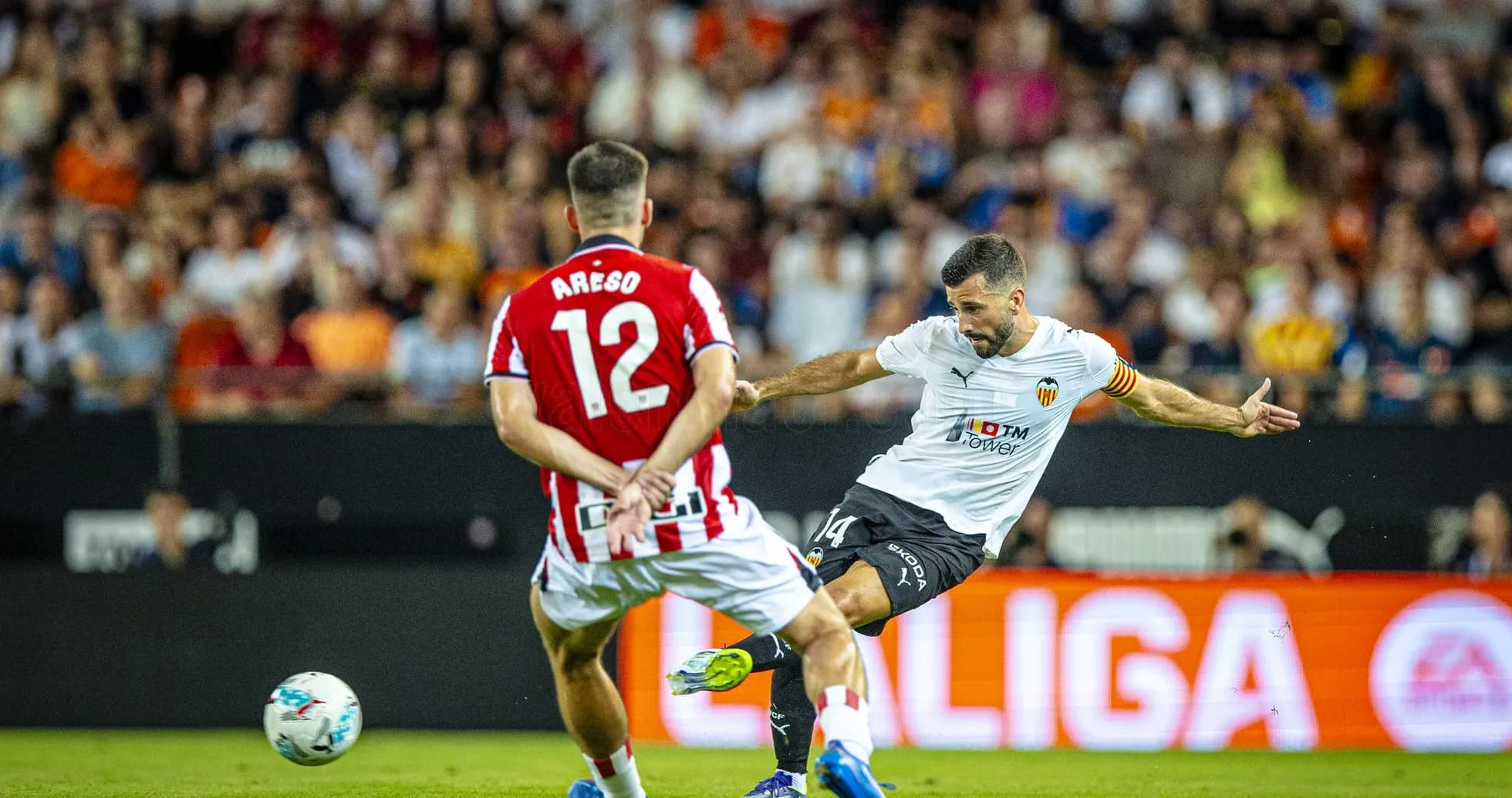
San Mamés under grey Bilbao skies has seen its share of bruising La Liga nights, but this one finished with a twist of frustration for the home crowd. In a tight, attritional contest on Matchday 35, Athletic Club’s familiar 4-2-3-1 shape ran aground against a disciplined Valencia side mirroring the same structure and ultimately stealing a 1-0 win on their travels.
Heading into this game, the league table framed it as a duel between mid‑table neighbours. Athletic sat 9th on 44 points with a goal difference of -11, Valencia 12th on 42 points with a goal difference of -12. Both were close enough to the European conversation to care, far enough away that margins of focus and structure would decide the night more than desperation.
I. The Big Picture – Two 4-2-3-1s, two different identities
Ernesto Valverde stayed loyal to his season’s blueprint: a 4-2-3-1 that has been used in 34 of Athletic’s 35 league fixtures. Unai Simón anchored the side behind a back four of Aitor Gorosabel, Yeray Álvarez, Aymeric Laporte and Yuri Berchiche. In front of them, Mikel Jauregizar and Aitor Rego formed the double pivot, with a fluid band of three – Rodrigo Navarro, Oihan Sancet and Nico Williams – feeding centre‑forward Gorka Guruzeta.
The numbers explain why Valverde leans on this structure. At home this season, Athletic have scored 21 goals in 18 matches, an average of 1.2, while conceding 20 at San Mamés, an average of 1.1. It is a profile of a side that usually edges games rather than overwhelms them: compact, front‑foot in phases, but reliant on their creative trio to turn possession into incision.
Carlos Corberán matched the shape but not the intent. Valencia’s 4-2-3-1 was built on defensive clarity. Stole Dimitrievski stood behind a back line of Renzo Saravia, César Tárrega, Eray Cömert and José Gayà. Pepelu and Gabriel Rodríguez sat as the screening pair, with Diego López, Javi Guerra and Luis Rioja supporting lone forward Hugo Duro.
Valencia’s season data told its own story before a ball was kicked. On their travels they had managed just 15 goals in 18 away matches, an average of 0.8, but conceded 29, an average of 1.6. Away from Mestalla they have been brittle, but their nine clean sheets overall – five of them away – hinted at a side capable of shutting down games when structure and concentration align. This night in Bilbao became one of those.
II. Tactical Voids – Absences and the discipline battle
Both squads arrived with notable absentees that subtly reshaped their tactical ceilings.
Athletic were without U. Egiluz (injury), Beñat Prados Díaz (knee injury), Iñigo Ruiz de Galarreta (personal reasons) and M. Sannadi (coach’s decision). Ruiz de Galarreta’s absence was particularly significant. In La Liga this season he has been a central metronome: 1,117 passes at 82% accuracy, 24 key passes, 58 tackles and 4 blocked shots. He is also one of the league’s leading card magnets with 10 yellows, the embodiment of Valverde’s aggressive midfield press. Without him, Jauregizar and Rego had to combine his ball‑progression with his bite, a tall order against Valencia’s compact block.
Valencia’s casualty list was longer: L. Beltrán (knee), J. Copete (ankle), Mouctar Diakhaby (muscle), Dimitri Foulquier (knee) and T. Rendall (muscle) all missing. The absence of Diakhaby and Foulquier stripped Corberán of defensive depth and physicality, but the starting back four responded with a near‑flawless, low‑risk performance. Gayà, who has already taken a red card in La Liga this season and six yellows, managed his aggression expertly, choosing his moments to step in rather than over‑commit.
From a disciplinary perspective, both teams carried reputations that shaped the tempo. Heading into this game, Athletic’s yellow card profile peaked between 61-75 minutes, when they collected 22.37% of their cautions, with another 18.42% arriving between 46-60 minutes – a clear pattern of second‑half intensity that often spills over. Valencia, by contrast, saw their yellow peak late, with 23.19% between 76-90 minutes and 20.29% from 46-60, suggesting a team that defends deeper and fouls more as legs tire and the game stretches. It was no surprise that the second half became increasingly fragmented, with both midfields trading tactical fouls to break rhythm.
III. Key Matchups – Hunter vs Shield, Engine Room vs Enforcer
The central duel of the night was Athletic’s attacking band against Valencia’s protective spine.
Gorka Guruzeta, supported by Sancet and the Williams–Navarro width, was tasked with cracking a defence that, despite Valencia’s overall negative goal difference, has shown resilience in phases. Overall this season, Valencia have conceded 50 goals in 35 matches, an average of 1.4 per game, but their away clean‑sheet count (5) underlines their capacity to execute a conservative game plan. Dimitrievski’s positioning and command of his box reduced Athletic’s usual crossing threat, forcing them into shots from less dangerous zones.
On the flanks, Nico Williams against Renzo Saravia was a battle of pure verticality versus containment. Saravia, protected by Pepelu sliding across, narrowed the channel and invited Athletic to funnel possession inside, where Pepelu and Rodríguez could swarm Sancet. That central clogging was crucial: Sancet’s ability to receive between the lines and turn is often the trigger for Athletic’s most dangerous sequences.
In the engine room, the absence of Ruiz de Galarreta shifted the burden onto Jauregizar and Rego to both build and break. Opposite them, Pepelu played the enforcer‑playmaker hybrid, screening passing lanes into Guruzeta while recycling possession calmly. Javi Guerra’s positioning as the advanced central midfielder allowed Valencia to spring forward when the ball was turned over, connecting quickly with Duro and Rioja.
Luis Rioja, one of La Liga’s top assist providers this season, was Valencia’s most reliable outlet. Across the campaign he has delivered 6 assists, created 35 key passes and attempted 60 dribbles, completing 34. His duel with Gorosabel and Álvarez was less about raw pace and more about timing: drifting into half‑spaces, drawing fouls, and relieving pressure. His work without the ball – 32 tackles and 17 interceptions overall – also underpinned Valencia’s compactness on the left side.
IV. Statistical Prognosis and Tactical Verdict
Strip away the noise and the season data frames this result as an upset in context but not in method. Athletic, with 40 goals scored and 51 conceded overall – averages of 1.1 for and 1.5 against per match – are a team whose attacking output often fails to compensate for defensive lapses. At home they are stronger, but five failures to score at San Mamés heading into this game hinted at exactly the kind of stalemate that unfolded, only this time tilted by a single Valencia strike.
Valencia, with 38 goals for and 50 against overall (1.1 scored, 1.4 conceded per match), are not prolific, especially away, but their nine clean sheets and relatively flexible use of formations across the season prepared them well for a reactive, low‑margin contest. Choosing 4-2-3-1 here, a system they had deployed nine times previously, allowed Corberán to mirror Athletic’s structure while subtly winning key zones: denying central pockets to Sancet, doubling wide on Nico Williams, and funnelling crosses into areas where Tárrega and Cömert could dominate.
In xG terms, this had all the hallmarks of a low‑margin game: one where set‑pieces, second balls and a single high‑quality transition would likely decide it. Valencia’s defensive solidity on their travels – five away clean sheets before this match – combined with Athletic’s tendency to labour when their first wave of pressure is broken, suggested that if the visitors could survive the early San Mamés surge, the game would tilt towards them in the final half hour.
Following this result, the narrative is clear. Athletic’s structural consistency could not compensate for the creative void left by Ruiz de Galarreta’s absence and Valencia’s compact mid‑block. Valencia, despite their fragile away record on paper, executed a textbook smash‑and‑contain away performance, leaning on the intelligence of Pepelu, the leadership of Gayà and the dual‑threat work of Luis Rioja.
On a night defined by discipline, structure and one decisive moment, it was Valencia’s version of the 4-2-3-1 that proved sharper, more ruthless and ultimately more mature.