.svg&w=384&q=75 "Naijagoal logo")
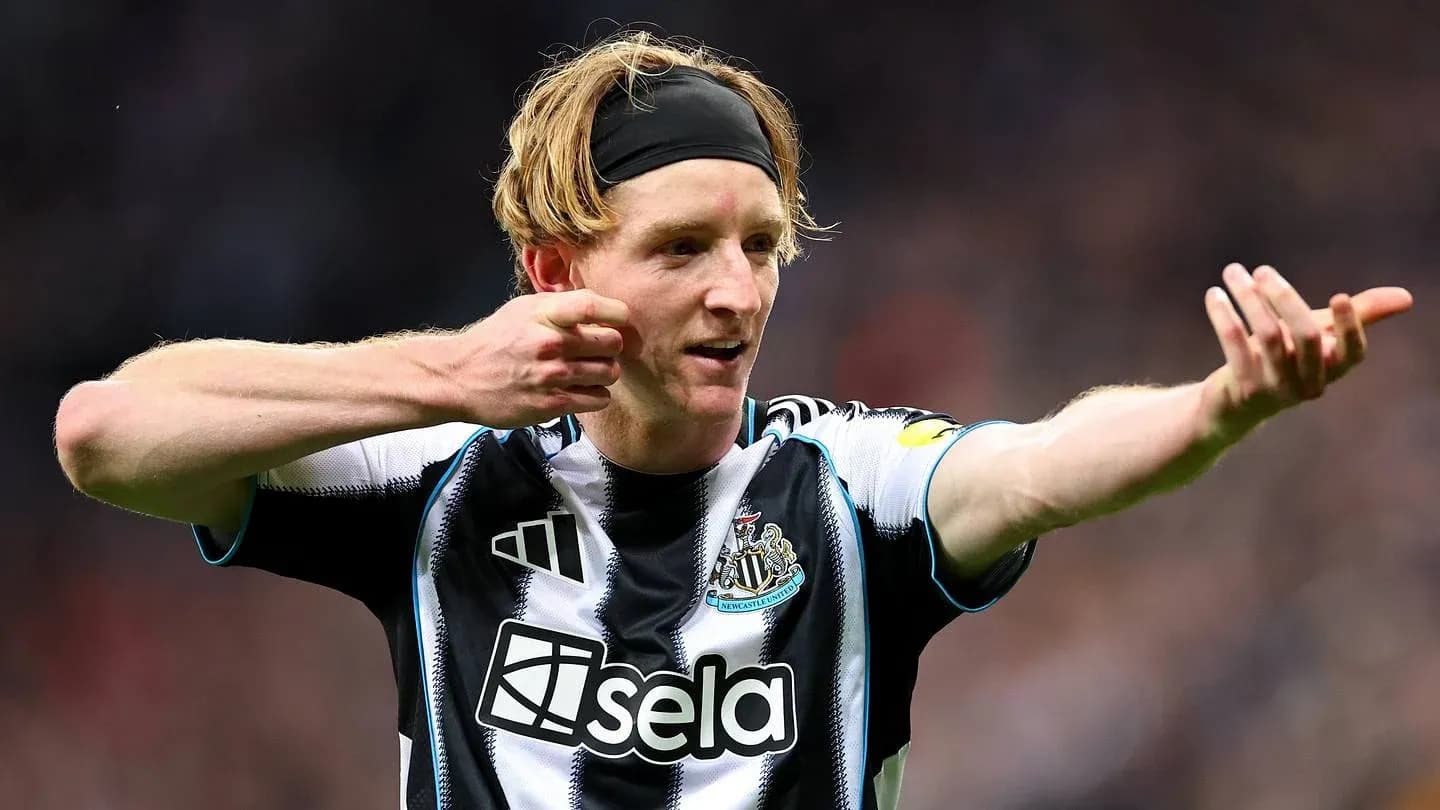

Anthony Gordon's Transfer to Barcelona: A New Chapter Begins
Anthony Gordon is on the brink of a move that will change the shape of his career and send a jolt through the summer market. An €80 million (£69.3m, $93.2m) switch from Newcastle United to Barcelona is close, and with it comes the weight of history, expectation and, intriguingly, a new shirt number in one of football’s most scrutinised dressing rooms.
This is not a quiet transfer. It’s a statement.
Barcelona have moved aggressively to get it done, fending off serious interest from Bayern Munich, Arsenal and Liverpool. Once the season ended, the noise around Gordon’s future only grew louder. Camp Nou called, and there was only ever likely to be one answer. His future looks set to be settled before he joins up with England ahead of the 2026 World Cup, allowing him to step into that tournament as a Barcelona player and one of the most expensive English footballers of all time.
He will become just the third Englishman to wear the famous colours of La Blaugrana. That alone carries a certain romance. The next question is more modern, more commercial, but no less symbolic: what number goes on the back?
From 70 to 10: Gordon’s journey through the numbers
Gordon’s relationship with shirt numbers tells the story of his rise.
He emerged at Everton as a teenager in 2017–18 wearing No. 70, the kind of high, awkward number that screams “academy prospect” and “short-term squad option.” Two seasons later, he stepped into No. 42, a sign that he was edging closer to the first team and carving out a place in the senior setup.
In 2020–21, he flipped that around. No. 24 for the first half of the season at Everton, then back to No. 42 on loan at Preston North End. Those numbers don’t carry the same aura as a classic playmaker’s shirt, but they mark the grind: the loan spell, the minutes, the graft to prove he belonged at the top level.
The real shift came with No. 10.
In his final season at Everton, Gordon claimed one of football’s most iconic jerseys. No. 10 is a statement, a responsibility. It followed him to Newcastle, where he has also worn that number, but not straight away. His first campaign at St James’ Park saw him in No. 8, waiting for Allan Saint-Maximin to move on and vacate the shirt he truly wanted. When the Frenchman departed, Gordon stepped into No. 10 again, underlining his growing status as a central figure rather than a supporting act.
For England, the pattern has been less linear. International football is often more fluid with numbers, and Gordon has bounced between 18, 17, 11 and 7. Those choices still say something: wide forward, attacking threat, trusted option. Not the spare man.
Now he arrives at a club where shirt numbers are part of the mythology.
The Barcelona wardrobe: legendary shirts, limited options
La Liga rules restrict first-team players to numbers between 1 and 25. That immediately tightens the field for Gordon and strips away the quirky high numbers he wore in his early days.
At Barcelona, certain shirts do more than identify a player. They define eras.
The No. 9 is the most eye-catching vacancy. Robert Lewandowski’s impending departure as a free agent will free up a shirt worn by Luis Suárez, Zlatan Ibrahimović, Samuel Eto’o and Ronaldo. It’s a number that screams goals, pressure, and centre-stage responsibility.
Yet that might not be Gordon’s to take. Barcelona are targeting a new striker this summer, and the club are likely to keep No. 9 untouched until their next central forward walks through the door. The shirt is too loaded, too central to their recruitment plan, to hand to a winger on arrival.
That doesn’t leave Gordon short of meaningful options.
No. 12 is open, a clean slate without heavy baggage but still comfortably within the core squad range. No. 14 is also free, a number with its own rich history at Barcelona and one that recently belonged to Marcus Rashford during his loan spell in Catalonia. For a wide forward with pace, directness and a growing reputation, 14 feels like a natural fit: important, recognisable, but not suffocating.
Other possibilities depend on exits. No. 7, another shirt steeped in attacking tradition, could become available if Ferran Torres moves on. No. 15 might open up if Andreas Christensen leaves. Both would offer Gordon a chance to align himself with a classic forward’s identity or a more understated, versatile role within the squad hierarchy.
Then there is the wildcard: No. 2.
João Cancelo’s loan spell is ending, and with it the availability of a number traditionally reserved for full-backs. Modern football has loosened those old rules, and a winger in No. 2 would certainly stand out. It would be unorthodox, almost rebellious, but not unprecedented in a game that has seen defenders in 10s and forwards in 3s.
For a player who has already jumped from 70 to 42 to 10, it would be another twist in a career that refuses to follow a neat, predictable line.
A new chapter, a new identity
The number on Gordon’s back in Catalonia will not define whether this move succeeds. That will come down to how quickly he adapts to Barcelona’s demands, how he handles the tactical rigour, the scrutiny, the expectation to deliver in La Liga and in Europe.
Yet at a club like this, the shirt matters. It shapes first impressions, marketing campaigns, even how a player is perceived in the dressing room.
From academy prospect at Everton to marquee signing at Barcelona, Gordon has grown into the kind of footballer whose number carries weight. When he finally walks out at Camp Nou, the choice he makes will say a lot about how he sees himself in this new era.
Is he the heir to a legendary line of forwards, the new face of a rebuilt attack, or the electric wide threat carving his own path on the flank?
Barcelona will announce the transfer fee. They’ll unveil the contract length. The coaches will talk about his pressing, his pace, his potential.
But the moment the shirt turns around and the number appears, the story of Anthony Gordon in Catalonia will truly begin.