.svg&w=384&q=75 "Naijagoal logo")

Amad Diallo: More Than a Right Winger for Man Utd
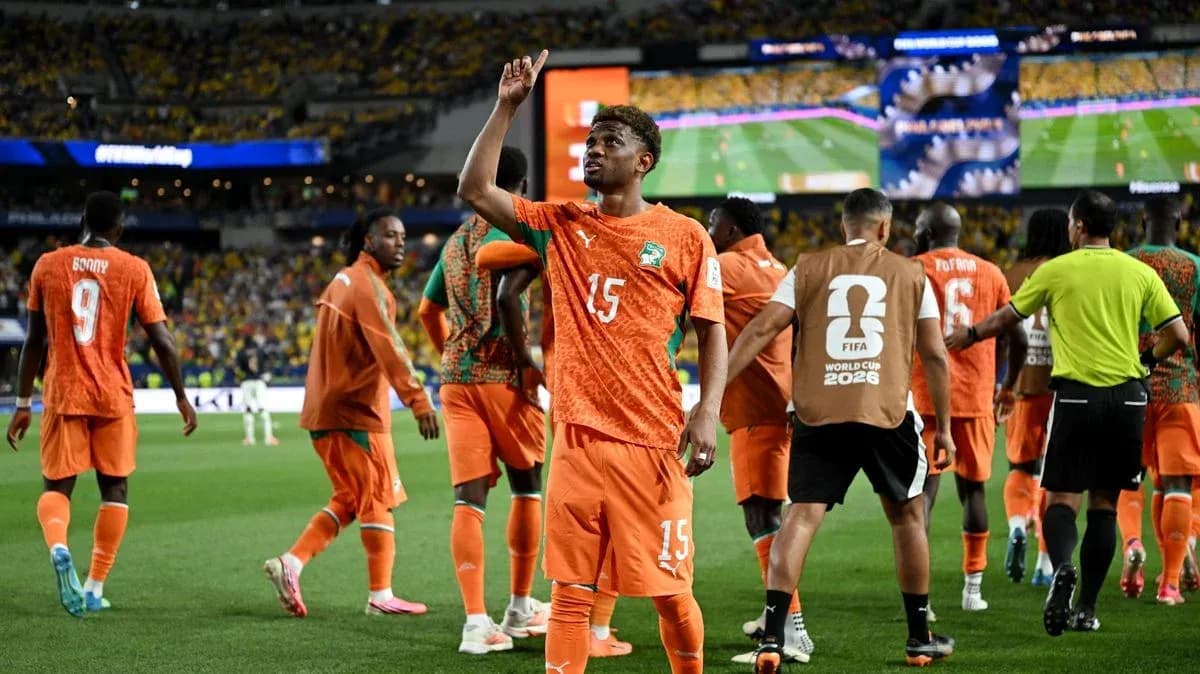
Amad Diallo walked off the pitch in Philadelphia with a familiar feeling. Another game, another decisive moment in an Ivory Coast shirt. Another nudge to Manchester United that they still haven’t quite worked out what, or where, he really is.
He had every reason to think his time had come before a ball was kicked against Ecuador. Days earlier he’d scored the winner against France in a World Cup warm-up, a statement goal in a statement fixture. For most players, that’s the ticket to a starting spot when the tournament begins for real.
Instead, he watched the anthems from the bench.
Emerse Fae shuffled his deck and dealt Amad out. Yan Diomande, just 19 and already heavily courted by Europe’s elite, took the right flank. Bazoumana Toure, 20, started on the left. Nicolas Pepe, the old head at 31, operated as the No. 10. In one swoop, Amad found himself squeezed out of his preferred territory.
It said plenty about Ivory Coast’s attacking depth. It also set up the kind of test that often defines careers at this level: accept the role on the periphery, or change the game when the door opens.
The door opened on 56 minutes.
Amad replaced Toure and didn’t simply hug the touchline. He drifted, he probed, he stepped into central pockets. He became the point of the attack as much as a part of it. The tempo changed. So did the mood.
The pressure finally told. A low ball came in from the right, and there he was, in that space between centre-backs and certainty. One touch, one sweep, one brilliantly taken finish. Game won against Ecuador, and quite possibly his starting place won back as well.
That goal should do more than secure three points. With minnows Curacao still to come, Ivory Coast are now on the brink of reaching the World Cup knockouts for the first time in their history. Amad’s strike has nudged them towards a landmark moment for the country – and reminded his manager that leaving him out is a luxury, not a plan.
It also served as a sharp counterpoint to his club season.
Two goals and four assists in 32 Premier League appearances for United is a thin return on paper. It has been a difficult year at Old Trafford, one where his influence often felt greater than his numbers suggested. For his country, the story reads differently. Since the start of the Africa Cup of Nations in December, he has five goals and two assists in nine games. When he pulls on the orange shirt, he looks like a man who knows exactly where the goal is and exactly where he should stand to hurt teams.
Look closely at those recent goals and a pattern emerges. Both have come from central positions, both first-time finishes from low deliveries from the right. He isn’t just a winger cutting inside and hoping. He’s attacking the box like a forward, timing his runs, trusting his instincts.
That should ring a bell in Manchester.
Amad spent almost all of last season stationed on the right for United, chalk on his boots, stretching the pitch. Yet his most prolific spell in English football came in a different role entirely. At Sunderland, he often played as a false nine in the Championship, drifting between the lines, arriving late, scoring regularly for the Black Cats. Not a traditional striker, not a classic No. 10, but something awkward and dangerous in between.
Michael Carrick knows that version of Amad well. The United manager mounted a firm defence of him towards the end of the campaign, urging people to look beyond the raw figures and see the tactical value: the movement, the link play, the way he knits a front line together in a winning side. Carrick’s United do not rely on fixed positions in attack. They rely on threats appearing in uncomfortable places.
Which is why these performances for Ivory Coast matter.
United’s forward line is already flexible. Bryan Mbeumo and Matheus Cunha can operate across the front three. Recruitment plans centre on adding either an experienced forward or someone who can play from the left. The idea is clear: keep the attack rotating, keep defenders guessing.
There is, however, a different gap opening up.
Bruno Fernandes has just produced the season of his life. He remains the heartbeat of this team, the creative conscience, the one who drags United through tight games. But he turns 32 in September and has played relentless football since arriving in January 2020. At some point, the club need more than emergency cover. They need a genuine alternative profile in that No. 10 slot.
Cunha can fill in. Mason Mount can step up for certain games. Neither is a like-for-like replacement, and that might be the point. United do not need a Bruno clone; they need someone who can threaten goal from central areas, press aggressively, and still drift wide when the system demands it.
Amad is quietly putting his name in that conversation.
His cameos through the middle for Ivory Coast show a player comfortable receiving the ball between the lines, spinning into space, and finishing with conviction. He has the touch of a playmaker and the penalty-box instincts of a wide forward who has learned to trust his timing. In an attack built on rotation and unpredictability, he fits the blueprint.
There is another factor. Diomande’s rise on the right for Ivory Coast, and his likely move to Liverpool from RB Leipzig, mirrors the pressure Amad will feel at club level. Competition on the flank is only going to intensify. If he wants to play, he may need to redefine himself. Pepe’s central role for Ivory Coast, with age starting to bite, looks ripe for succession. So does the prospect of spells deputising for Fernandes at Old Trafford.
Amad doesn’t need a reinvention. He needs recognition of what he already is: not just a right winger, but a forward who can hurt teams from the middle, who can finish moves as well as start them.
Ivory Coast have just been given a timely reminder. Manchester United might be next.