.svg&w=384&q=75 "Naijagoal logo")


Warri Wolves Secure Narrow Victory Over Shooting Stars
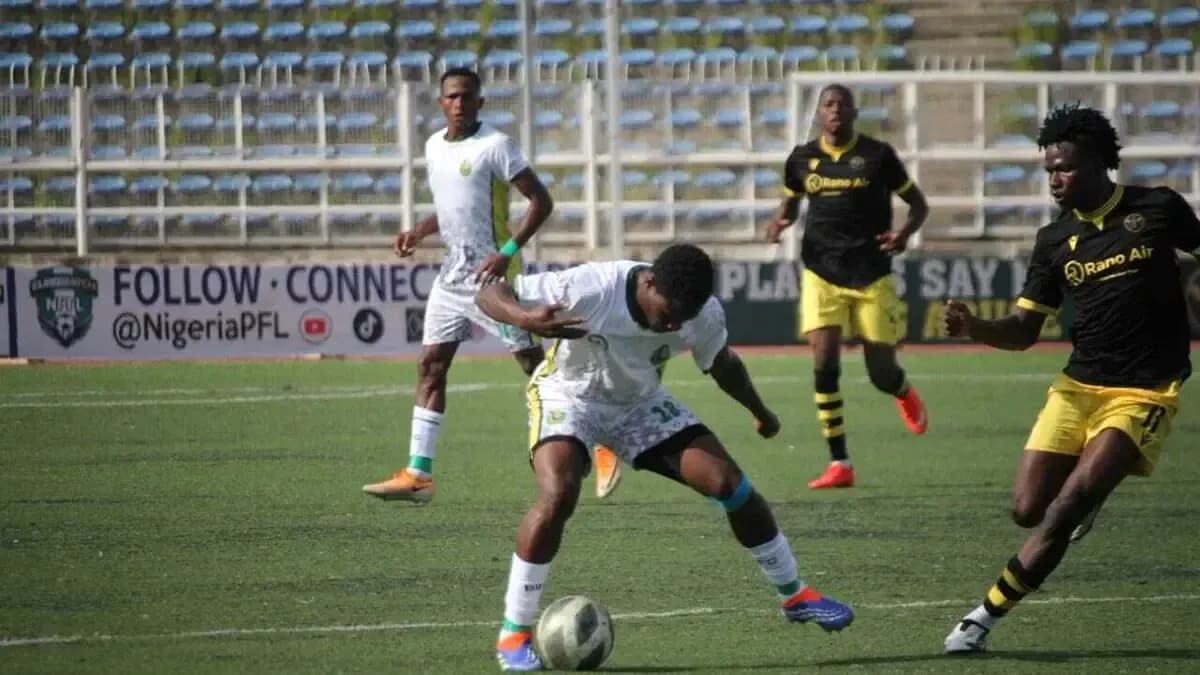
Under the late afternoon heat at Warri Township Stadium, Warri Wolves edged Shooting Stars 1–0, a narrow scoreline that neatly captured the contrast between the hosts’ rugged home discipline and the visitors’ fragile away identity. In the context of the NPFL Regular Season - 6, this was less a spectacle than a statement: Wolves are turning Warri into a fortress, while Shooting Stars remain two very different teams depending on the postcode.
The Big Picture – Home Steel vs Away Fractures
Following this result, Warri Wolves’ seasonal profile looks increasingly binary. Overall they have 3 goals for and 4 against in total, giving them a goal difference of -1 across 5 matches. But the split is stark: at home they have scored 2 and conceded 0; on their travels they have managed just 1 for and shipped 4. The averages tell the same story: at home they average 1.0 goals for and 0.0 against, away it drops to 0.3 for and 1.3 against.
Shooting Stars arrived as the league’s Jekyll-and-Hyde act. Overall, they had scored 5 and conceded 5 in total across 4 matches, a goal difference of 0. At home they had been vibrant, with 4 goals for and only 1 against, but away they had scored just 1 and conceded 4. Their attacking average on their travels stood at 0.5 goals for and a worrying 2.0 against, a defensive frailty that would again be exposed in Warri.
The first half’s 1–0 scoreline to Wolves would ultimately hold, but the real story lay in how each squad’s structural strengths and weaknesses were expressed over 90 minutes.
Tactical Voids – Discipline, Risk, and Missing Edges
Neither side came into this fixture with a published injury list, so the tactical voids were less about absences and more about systemic gaps.
For Warri Wolves, the season’s disciplinary map hinted at a team that can be dragged into awkward moments before the interval. Heading into this game, 66.67% of their yellow cards had arrived between 31–45 minutes, with another 33.33% in the 76–90 window. That pattern suggests a side that tightens its grip in the middle of each half, sometimes at the cost of cautions. It also frames the importance of concentration around half-time and in the closing stretch, where a mistimed challenge can undo an otherwise solid defensive performance.
Shooting Stars’ discipline profile was even more volatile. Before this match, 20.00% of their yellow cards came between 16–30 minutes, 40.00% between 46–60, and another 40.00% in the 76–90 window. More tellingly, 100.00% of their red cards had come between 76–90 minutes. This is a side that tends to escalate in aggression as the game wears on, often in the very phase when composure is most needed. Add in the psychological weight of having missed their only penalty of the season (1 taken, 1 missed, 0 scored) and you get a team whose risk profile spikes just as legs tire and decisions slow.
Key Matchups – Hunter vs Shield, Engine Room Battles
Without official formations, the tactical shapes had to be read from personnel and season trends. Warri Wolves’ starting cast of B. Adeniyi, S. Ahmed, G. Oham, E. Itolowo and S. E. Gift formed the core of a defence that has yet to concede at home this season. Behind the clean-sheet record is a collective that thrives on compactness rather than chaos; the hosts have already recorded 2 home clean sheets and 3 in total.
Against them, Shooting Stars’ attacking trident of J. Atule, R. O. Olanrewaju and A. Mustapha carried the burden of breaking down that shield. Overall, Shooting Stars had 5 goals in total across 4 matches, but the away split – just 1 goal on their travels – underlined how much their forwards rely on home momentum. The “hunter vs shield” duel was therefore asymmetric: Wolves’ home defence was in its comfort zone, while Shooting Stars’ attack was out of its.
In midfield, the Wolves’ axis of E. Uzoechi, C. Olisemah and U. Sabastine offered a blend of industry and control. Their task was twofold: protect a back line that has built its identity on clean sheets, and feed creative sparks like O. Egbo and C. Orji between the lines. With Warri Wolves having failed to score in 2 away matches but never at home, this midfield unit becomes the hinge of their entire game model: control at home, survival away.
For Shooting Stars, the pairing of S. Amos and O. Akala in the middle had to balance progression with protection. The visitors’ overall defensive numbers – 5 goals conceded in total, with 4 of those on their travels – point to a midfield that sometimes leaves its back four too exposed once they step out of their home comfort zone. D. Ojietefian, G. Adelowo, J. Apaingolo and I. Yusuf formed a back line that has been solid in Ibadan but porous away, a split that again surfaced in Warri.
On the benches, Warri Wolves had defensive and structural insurance in A. Olayemi, B. Ndubuisi and C. Ogbun, plus attacking or transitional options like Y. Omotayo and J. Innocent Akawu. Shooting Stars could call on the experience of V. Sochima in goal, the defensive cover of M. Aliyu and T. Otaniyi, and attacking reinforcements such as D. Akinola and A. Haruna. But with no penalty reliability to lean on and a history of late cards, the visitors’ substitutions were always going to be a gamble between chasing the game and keeping eleven on the pitch.
Statistical Prognosis – Wolves’ Fortress vs Stars’ Fragile Travels
Following this result, the underlying numbers continue to favour Warri Wolves at home. Their average of 1.0 goals scored and 0.0 conceded at Warri Township Stadium, coupled with 2 wins from 2 at home, paints a clear picture: this is a low-scoring but highly controlled environment, where one goal often decides the contest.
Shooting Stars, by contrast, remain a side of extremes. Overall their averages of 1.3 goals for and 1.3 against in total suggest balance, but the away split – 0.5 scored and 2.0 conceded – exposes a structural fragility whenever they leave home. Their missed penalty this season underscores a lack of ruthlessness in high-leverage moments, while the late red-card pattern hints at emotional rather than tactical endings.
In tactical terms, the prognosis going forward is straightforward. Warri Wolves can continue to lean on a disciplined, risk-averse home blueprint built around Adeniyi’s back line and a hard-working midfield core. If they can export even part of that defensive solidity to their away fixtures, their overall goal difference of -1 is likely to improve.
For Shooting Stars, the path is more complex. They must reconcile a vibrant home identity with a timid, error-prone away persona. Until their midfield screen protects the back four better on their travels, and until their forwards convert more than the current 0.5 goals per away game, they will remain vulnerable in fixtures like this: tight, physical, and decided by the team more comfortable suffering without the ball.