.svg&w=384&q=75 "Naijagoal logo")

Vinicius Jr and the Premier League's Superstar Dilemma
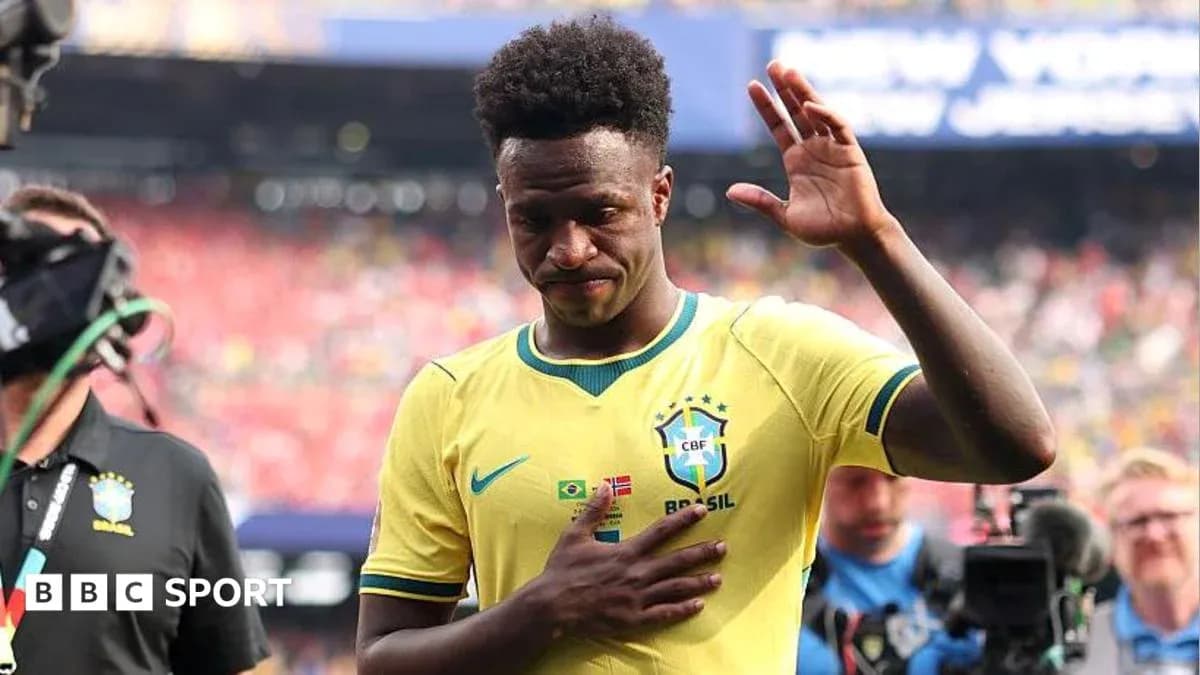
If Vinicius Jr had walked into London Colney this summer, it would have felt like a glitch in the modern game. A genuine, fully formed global superstar, leaving Real Madrid at 26 for Arsenal, not as a prospect or a reclamation project, but at the absolute height of his powers.
Arsenal were ready. He was open to it. For a moment, the idea lived.
Then reality reasserted itself. Vinicius signed a new deal at the Bernabeu running to 2032, tying one of the sport’s most recognisable forwards to the club that still sits at the top of football’s food chain.
And with that, the Premier League’s strangest contradiction came back into sharp focus.
The richest league, missing the brightest lights
No competition spends like England’s top flight. No league sells itself better as the toughest, deepest, most relentless domestic battleground on the planet. Broadcast deals dwarf rivals. Mid-table sides pay fees that once belonged only to the European aristocracy.
Yet when it comes to attracting the finished article – the true, current Ballon d’Or heavyweights – the Premier League keeps running into the same wall.
Since the league’s launch in 1992, only three men have lifted the Ballon d’Or while playing for an English club: Michael Owen at Liverpool in 2001, Cristiano Ronaldo at Manchester United in 2008, and Rodri at Manchester City in 2024. Three decades of domination, three winners.
Clubs have no issue stockpiling elite centre-backs and goalkeepers. They can outbid almost anyone for the best defensive talent on the market. The shortage comes higher up the pitch, where the very top-tier forwards and attacking midfielders still often look elsewhere when they reach their peak.
Vinicius staying at Real Madrid is just the latest reminder.
England, the finishing school
What the Premier League has excelled at is something slightly different: it turns gifted players into global icons.
Dennis Bergkamp arrived at Arsenal after a bruising spell at Inter Milan and became one of the most influential figures English football has seen. Eric Cantona reached Manchester United with a reputation and a temper, but not yet as the defining symbol of a new era. He left as exactly that.
Thierry Henry came to north London from Juventus with doubts hanging over him as a winger-turned-striker. In England, he grew into one of his generation’s outstanding forwards, the face of an Arsenal side that redefined attacking football.
Ronaldo’s first spell at United followed the same pattern. Signed at 18 from Sporting, he dazzled, frustrated, then detonated into a Ballon d’Or winner five years later, before heading to Madrid as the most coveted player in the world.
Erling Haaland is the modern example. Manchester City bought him from Borussia Dortmund in 2022 knowing they were getting one of Europe’s most feared young strikers. They did not yet have the monster who would shatter scoring records and terrorise defences on a weekly basis. That version was forged in the Premier League.
This is the distinction. English clubs are brilliant at taking the almost-complete and turning them into the finished product. Signing someone like Vinicius, already a multi-time Champions League winner and global marketing phenomenon, is a different equation entirely.
The rare superstars who did arrive
There have been exceptions, and they stand out precisely because they are so rare.
The closest comparison to what a Vinicius move would have looked like is Andriy Shevchenko’s transfer to Chelsea from AC Milan in 2006. He was 29, had claimed the Ballon d’Or two years earlier and finished fifth in the voting in 2005. He arrived as one of the few bona fide, still-near-his-peak megastars to choose the Premier League.
Others came with the golden trophy already on their CVs but not the same timing. Ruud Gullit and George Weah joined Chelsea later in their careers. Ronaldo’s second stint at United began at 36, more epilogue than main act. Zlatan Ibrahimovic walked into Old Trafford at 34. Jurgen Klinsmann signed for Tottenham at 30.
Big names, huge stories, but not quite the same as prising away a 26-year-old already sitting at the summit.
From Serie A’s heyday to England’s new reality
To understand the shift, you have to look back.
In the 1980s and 1990s, Serie A was the centre of gravity. Italian clubs were rich, glamorous, and ruthless in the market. The world’s greatest players didn’t dream of going there. They simply did.
Diego Maradona left Barcelona for Napoli and became a god in the south. Ronaldo, the Brazilian phenomenon, swapped Barcelona for Inter at his explosive peak. Michel Platini, Marco van Basten, Lothar Matthaus, Zinedine Zidane – they all spent some of their finest years in Italy.
That era has gone. The Premier League now holds the financial power, but the way it spends has created a different landscape.
English clubs still throw around enormous sums, only the money is often spread across deep squads or paid to rivals within the same league. Alexander Isak, Morgan Rogers, Elliot Anderson, Moises Caicedo, Declan Rice and Jack Grealish have all moved between Premier League clubs for fees north of £100m.
Others, like Liverpool’s Florian Wirtz, arrive from abroad with huge reputations but with the sense that the best is yet to come. The model is clear: not one Galactico, but 18 to 22 top-level players, all capable of surviving a 60-game season and the physical grind that comes with it.
It is team-building by accumulation rather than coronation.
Haaland, Madrid and the pull of the crest
Haaland himself serves as both the exception and the warning.
City signed him at 21. They gave him the platform, the service and the stage to become arguably the most feared number nine in the world. If there is a counterargument to the idea that the Premier League can’t host peak superstars, he is wearing sky blue.
Yet even his story points back to Madrid.
During the 2026 World Cup, his father Alfie Haaland spoke to DAZN and was asked about the idea of his son one day moving to the Bernabeu. His answer was blunt and revealing: Haaland is happy at City, he has a long contract, “but any player wants to play for Real Madrid.”
That line cuts through the noise. It explains why Vinicius stays, why so many others still circle around that white shirt, and why even England’s financial might cannot always close the deal.
The Premier League has become the game’s greatest stage for making superstars. The challenge that remains is more delicate, and more telling: convincing those who already stand at the top of the mountain to climb down from Madrid – and persuading the ones who reach that summit in England not to look longingly towards the Bernabeu when they get there.