.svg&w=384&q=75 "Naijagoal logo")
Villarreal vs Sevilla: Tactical Analysis of a 2-3 Defeat
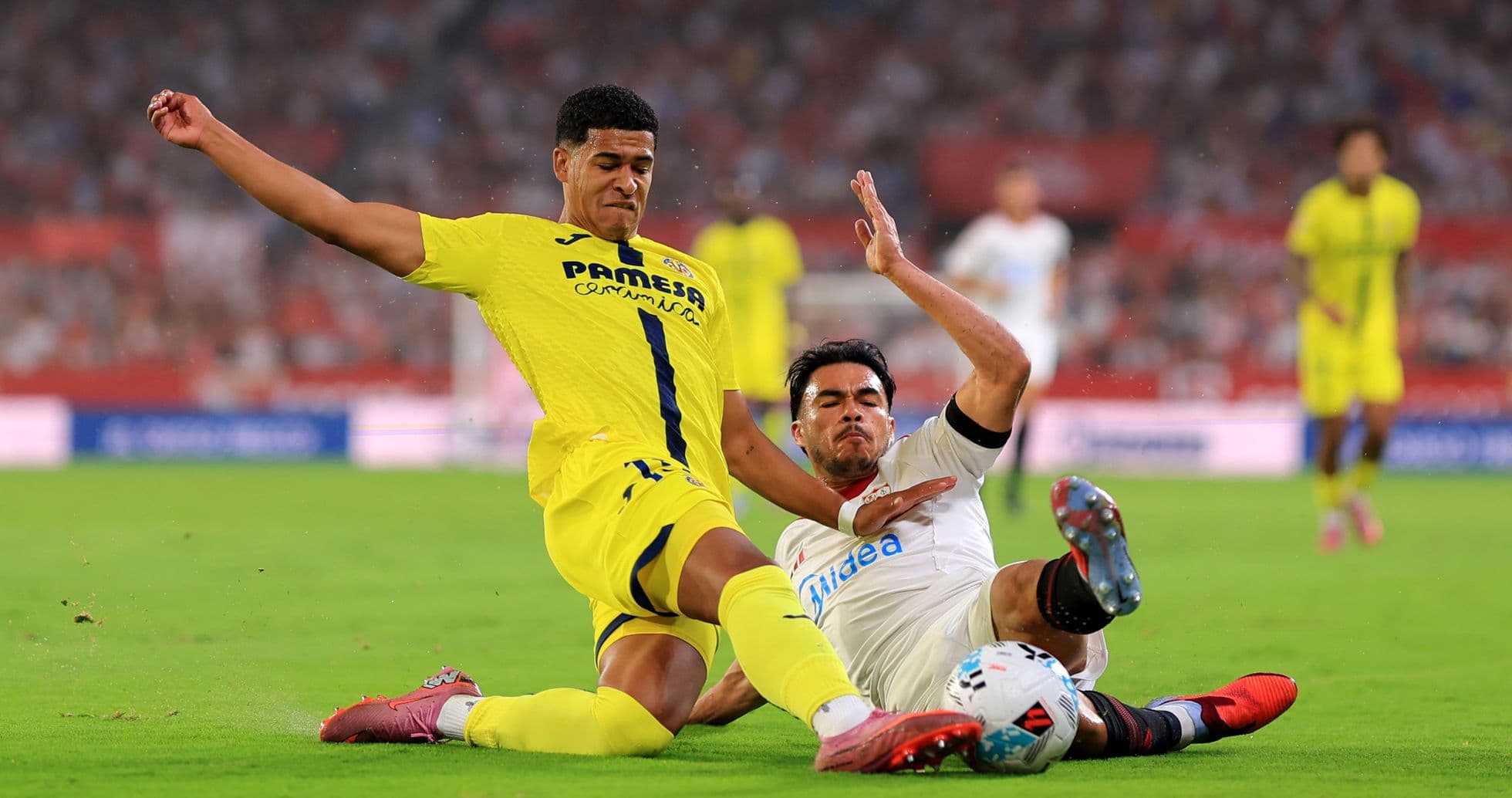
Villarreal’s 2-3 home defeat to Sevilla at Estadio de la Ceramica was a match where territorial control and possession were undone by sharper structural adaptation and superior penalty-box efficiency from the visitors. In a La Liga fixture from Regular Season - 36, Marcelino’s 4-4-2 built an early 2-0 platform, only for Luis Garcia Plaza’s 5-3-2 to absorb pressure, recalibrate its pressing triggers, and strike three times with a blend of set defensive organisation and direct vertical attacks. The statistical profile – 63% possession and 554 passes for Villarreal against Sevilla’s 37% and 325 – underlines how the home side dictated the ball, but not the decisive spaces.
Scoring Sequence
The scoring sequence reflected a tactical swing rather than a chaotic contest. On 13', Gerard Moreno (Villarreal) finished a well-constructed move, assisted by Georges Mikautadze, exploiting the inside-right channel where Villarreal’s front two could isolate Sevilla’s central defenders. By 20', the pattern repeated with a variation: Mikautadze (Villarreal), now dropping between the lines, converted after a pass from Alberto Moleiro, whose drifting from the left half-space disrupted Sevilla’s back five.
At 2-0, Sevilla’s 5-3-2 began to step higher. The wing-backs and outside centre-backs compressed the flanks, and the visitors started to win second balls in midfield. On 36', Oso (Sevilla) scored, assisted by Lucien Agoume, a move that came from Sevilla’s improved central occupation: Agoume received between Villarreal’s lines and released Oso from the left side of the back line, attacking the space behind the advanced full-back. The equaliser at 45' came from another defender stepping into the decisive zone: Kike Salas (Sevilla), assisted by Roberto Vargas, capitalised on Villarreal’s inability to defend the far-post zone. Vargas’ delivery from midfield exploited a structural flaw in Villarreal’s 4-4-2 when forced to defend deep: the wide midfielders were pinned, leaving gaps between full-back and centre-back.
Second Half
The second half became a test of game management. Villarreal, still in control of possession, sought fresh legs and more verticality. At 60', Thomas Partey (IN) came on for Pape Gueye (OUT), and Tajon Buchanan (IN) came on for Nicolas Pepe (OUT), signalling a desire for more progressive passing from the pivot and more direct dribbling on the flank. Sevilla responded by tightening their midfield structure, and at 68' Jose Sanchez (IN) replaced Roberto Vargas (OUT), adding energy and defensive coverage.
Marcelino doubled down on control at 70', introducing Santi Comesana (IN) for Dani Parejo (OUT) and Ayoze Perez (IN) for Mikautadze (OUT). The intention was to maintain passing security while adding a more mobile, channel-running forward. Yet this reconfiguration subtly weakened Villarreal’s ability to pin Sevilla’s back line; without Mikautadze’s back-to-goal presence, Sevilla’s central defenders could step out more aggressively.
Sevilla’s decisive tactical punch arrived on 72'. As Villarreal pushed numbers forward, Denis Sow found a pocket of space and threaded a vertical pass for Amad Adams. Adams (Sevilla) scored, assisted by Sow, a classic 5-3-2 transition goal: breaking from a compact block into the space behind Villarreal’s advanced full-backs. Almost simultaneously, Sevilla freshened their front and midfield to preserve the lead: at 72', Alvaro Sanchez (IN) replaced Neal Maupay (OUT), then at 86' Nemanja Gudelj (IN) came on for Sow (OUT) and Castrin (IN) for Adams (OUT), effectively locking the game into a deeper, more conservative 5-4-1 variant.
Discipline
Discipline played a minor but telling role in the game’s tempo. There were three yellow cards in total: Villarreal 2, Sevilla 1, Total: 3. They came in this order:
- 81' Ayoze Pérez (Villarreal) — Foul
- 90+2' Renato Veiga (Villarreal) — Foul
- 90+3' José Ángel Carmona (Sevilla) — Time wasting
The late bookings for Villarreal reflected mounting frustration as Sevilla slowed the game and disrupted rhythm. Carmona’s card for Time wasting at 90+3' underlined Sevilla’s full commitment to game management in the closing stages.
Structural Standpoint
From a structural standpoint, Villarreal’s 4-4-2 was built around controlled possession and width. Alejandro Tenas in goal had limited shot-stopping volume (2 goalkeeper saves) but conceded three from Sevilla’s five shots on target, a sign that the defensive screen in front of him was repeatedly exposed in high-value zones. The defensive line of A. Freeman, P. Navarro, Renato Veiga, and Alfonso Pedraza was tasked with providing both width and progression; however, once Sevilla began to target the channels behind Pedraza and Freeman, the back four became stretched, particularly in defensive transitions.
In midfield, Dani Parejo and Pape Gueye initially orchestrated the tempo, combining with Nicolas Pepe and Alberto Moleiro to create overloads. Villarreal’s passing numbers – 554 total passes, 499 accurate (90%) – highlight how effectively they circulated the ball. Yet their xG of 0.81 against 6 total shots (4 on goal) indicates that, despite territory, they struggled to generate repeated high-quality chances once Sevilla’s block adjusted.
Sevilla’s 5-3-2, anchored by Odysseas Vlachodimos in goal (1 goalkeeper save), prioritised compactness over possession. Their back five – J. A. Carmona, Cesar Azpilicueta, Kike Salas, Gabriel Suazo, and Oso – gradually shifted from being pinned back early to stepping out with better timing as the game progressed. The midfield trio of Roberto Vargas, Lucien Agoume, and Denis Sow was crucial: after a difficult opening, they began to win duels and intercept passes, enabling Sevilla’s 13 total shots (5 on goal, 5 blocked) from just 37% possession.
Statistical Overview
Statistically, the match’s verdict is clear: Villarreal controlled the ball but not the scoreboard. Their 63% possession, 6 total shots, and xG of 0.81 contrast sharply with Sevilla’s more direct, punchy profile: 37% possession, 13 total shots, and a slightly higher xG of 0.88. Both goalkeepers posted negative goals prevented values (-0.22 each), suggesting that finishing quality and defensive breakdowns, rather than outstanding shot-stopping, defined the outcome.
Fouls were relatively balanced (Villarreal 11, Sevilla 9), and corner kicks (Villarreal 6, Sevilla 4) underline the home side’s territorial advantage. Yet Sevilla’s capacity to convert defensive solidity into incisive counter-attacks, and their effective use of substitutions to stabilise the final phase, turned a 0-2 deficit into a 2-3 away win that was tactically coherent and statistically justified.