.svg&w=384&q=75 "Naijagoal logo")


Valencia vs Barcelona: A Brutal La Liga Showdown
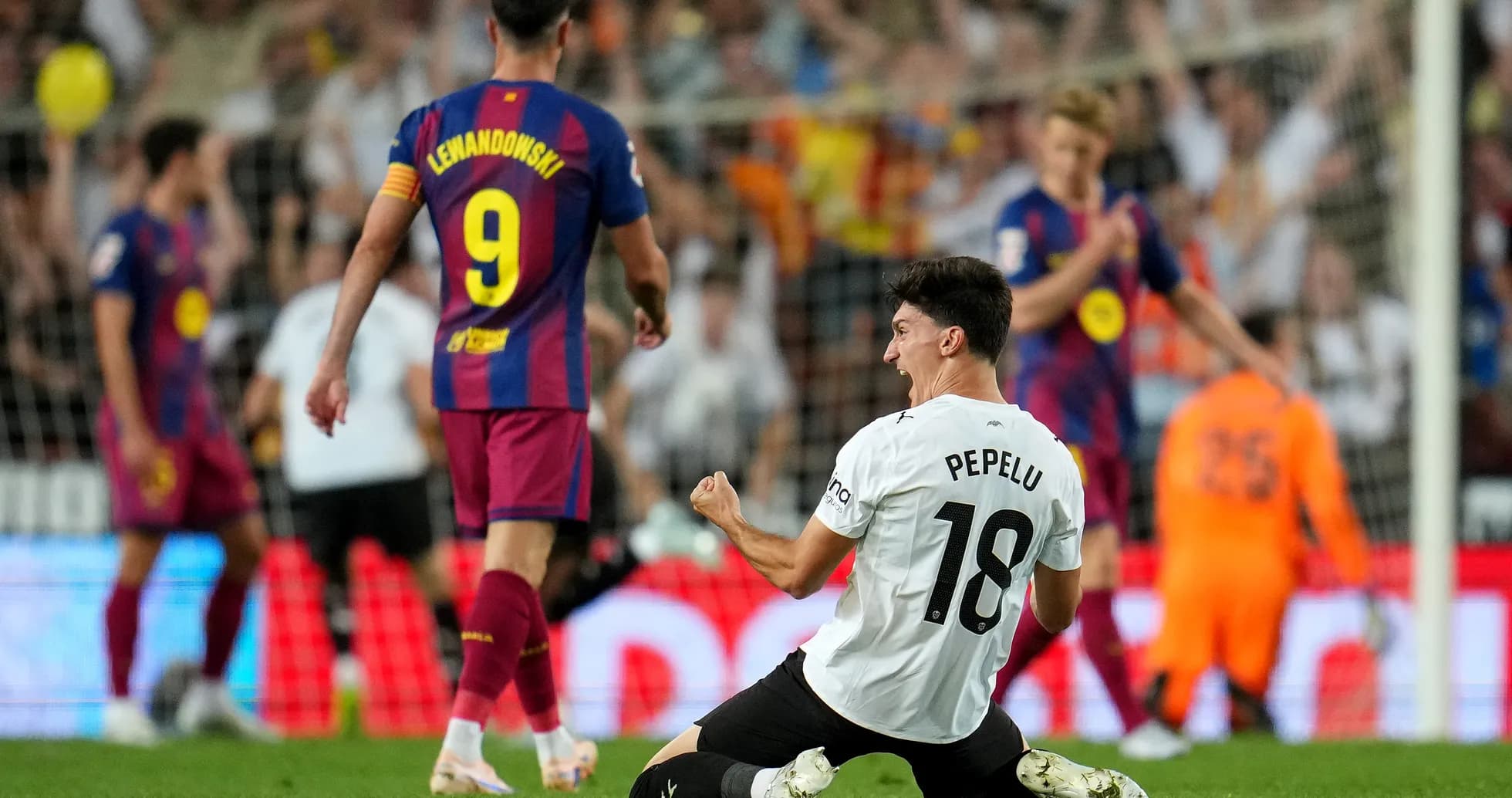
Under the late-summer glare of Mestalla, this was billed as a stress test of two very different footballing projects. By full time, the scoreboard read Valencia 0–5 Barcelona, and the gulf between a side anchored to the bottom and one sprinting clear at the top of La Liga was brutally clear.
I. The Big Picture – DNA of Two Seasons
Following this result, Valencia remain 20th with 1 point from 4 matches. Overall they have scored just 1 goal and conceded 9, giving them a goal difference of -8, exactly the figure in the standings. At home, the numbers are even starker: 3 games, 0 wins, 1 draw, 2 defeats, 0 goals for and 6 against. The season’s tactical identity is already etched in pessimistic tones – a deep 5-4-1, little attacking punch, and a side that has failed to score in all three home outings.
Barcelona, by contrast, leave Mestalla as league leaders on 12 points from 4, with a perfect record. Overall they have 17 goals for and 2 against, a goal difference of +15, correctly matching the standings. On their travels they have been devastating: 2 away wins from 2, 10 goals scored and none conceded. Their total attacking average stands at 4.3 goals per game, with 5.0 on their travels, underpinned by a defence that has allowed just 0.5 goals per game overall and 0.0 away.
The scoreline here – Valencia’s heaviest home defeat of the campaign, matching the 0-5 already recorded in their “biggest loses” profile – feels less like an anomaly and more like a logical extension of both teams’ trajectories.
II. Tactical Voids – Absences and Discipline
Carlos Corberan’s plan was always going to be built on survival rather than ambition. The absentee list stripped Valencia of depth and variety: S. Canos and L. Rioja would have offered width and ball-carrying relief; G. Rodriguez and U. Sadiq removed potential focal points to play off; J. Copete, J. De Haas, D. Foulquier and D. Lopez further thinned defensive and rotational options. For a coach already leaning into a 5-4-1 – a shape Valencia have used in all 4 league matches – this meant the same tired template, with fewer ways to change the game.
Corberan responded by crowding the back line: S. Dimitrievski behind a five of P. Maffeo, A. Martinez, M. Diakhaby, Pepelu and J. Vazquez. Pepelu, nominally a midfielder, was again dragged into the last line to plug gaps, a symbol of a squad forced to improvise rather than impose.
Barcelona were not untouched by absences. Hansi Flick travelled without F. de Jong, R. Bardghji and J. Bisiwu, but crucially his core creative axis was intact. With depth like Dani Olmo, K. Adeyemi and Gabriel Jesus on the bench, the missing names barely registered in the tactical balance.
Disciplinary trends told their own story even before kick-off. Valencia’s yellow cards this season are clustered in the 31-45 and 76-90 minute windows, each accounting for 33.33% of their cautions. It is the profile of a team that starts cautiously, then arrives late into duels as fatigue and desperation creep in. Barcelona, by contrast, concentrate their bookings between 16-75 minutes, with 50.00% of their yellows in the 46-60 spell – a side that plays on the edge during their pressing peak, but rarely in panic time.
III. Key Matchups – Hunter vs Shield, Engine Room vs Enforcer
The “Hunter vs Shield” battle at Mestalla was grotesquely one-sided on paper and even more so on grass. Heading into this game, Barcelona’s attack had already produced 17 goals overall, with Raphinha on 6 and both Lamine Yamal and Fermín on 4 apiece. Valencia’s “shield” at home had conceded 6 goals in 3 matches, averaging 2.0 per game, and had yet to score at Mestalla.
M. Diakhaby, one of La Liga’s top yellow-carded players with 2 bookings in 4 appearances, epitomised Valencia’s defensive strain. His profile – 2 tackles, 2 successful blocks, 6 interceptions and 11 duels won from 15 overall – speaks of a defender constantly fire-fighting. Against a front three of Lamine Yamal, Raphinha and A. Gordon, supported by Pedri and Rodri between the lines, that fire became an inferno.
The duel on Valencia’s left was particularly cruel. J. Vazquez and Pepelu, stepping out of his comfort zone in the back line, were repeatedly exposed by Lamine Yamal’s direct running and Raphinha’s diagonal movements inside. With Barcelona’s full-backs E. Garcia and X. Espart stepping high, Valencia’s lone outlet A. Danjuma was often marooned, forced to chase hopeful clearances rather than work in structured transitions.
In the “Engine Room”, the contrast was philosophical as much as technical. Corberan’s central quartet – D. Otorbi, F. Ugrinic, A. Dieng and J. Guerra – were tasked with compressing space, shuffling laterally and protecting the half-spaces. Their remit was largely negative: deny, delay, and hope.
Flick’s trio of Fermín, Rodri and Pedri, by contrast, orchestrated. Fermín arrived from deep, a midfielder with 4 goals and 2 assists already this season, constantly looking for third-man runs. Pedri stitched play with his 83%+ passing accuracy profile, while Rodri provided the platform for the front three to stay high. Once Barcelona established their rhythm, Valencia’s midfield line became more of a buffer than a barrier.
IV. Statistical Prognosis – What This Tells Us Going Forward
From a statistical standpoint, this result sits squarely within expectation. Valencia’s overall attacking average of 0.3 goals per game, with 0.0 at home, offered little reason to believe they would trouble a Barcelona side boasting 3 clean sheets in 4, including 2 on their travels. Conversely, Barcelona’s away average of 5.0 goals per game aligned eerily with the 0-5 scoreline.
Defensively, Valencia’s overall concession rate of 2.3 goals per game – rising to 3.0 on their travels but 2.0 at home – was never going to hold against a side that averages 4.3 goals overall and has yet to fail to score. Without any penalties missed in the league so far, Barcelona’s single spot-kick has been converted, underscoring their clinical edge.
The tactical lesson is blunt. Valencia’s five-man back line, stretched by injuries and overuse, is not enough on its own. Without a transition threat and with a midfield geared to absorb rather than contest, they are inviting pressure they cannot withstand. Barcelona, meanwhile, look every inch a title favourite: a flexible 4-3-3, multiple goal sources, and a defensive structure that has allowed just 2 goals in 4 matches.
For Corberan, the challenge now is evolution. Persisting with a pure 5-4-1 and the same personnel shuffles may simply script more nights like this. For Flick, Mestalla was less a statement than a confirmation: this Barcelona are not just winning, they are imposing their will, home and away, with numbers – and performances – to match.