.svg&w=384&q=75 "Naijagoal logo")

U.S. Soccer Faces Crucial Test Against Australia After Historic Win
The U.S. has waited nearly a century to feel like this at a World Cup. Now comes the hard part: proving it wasn’t a one-off.
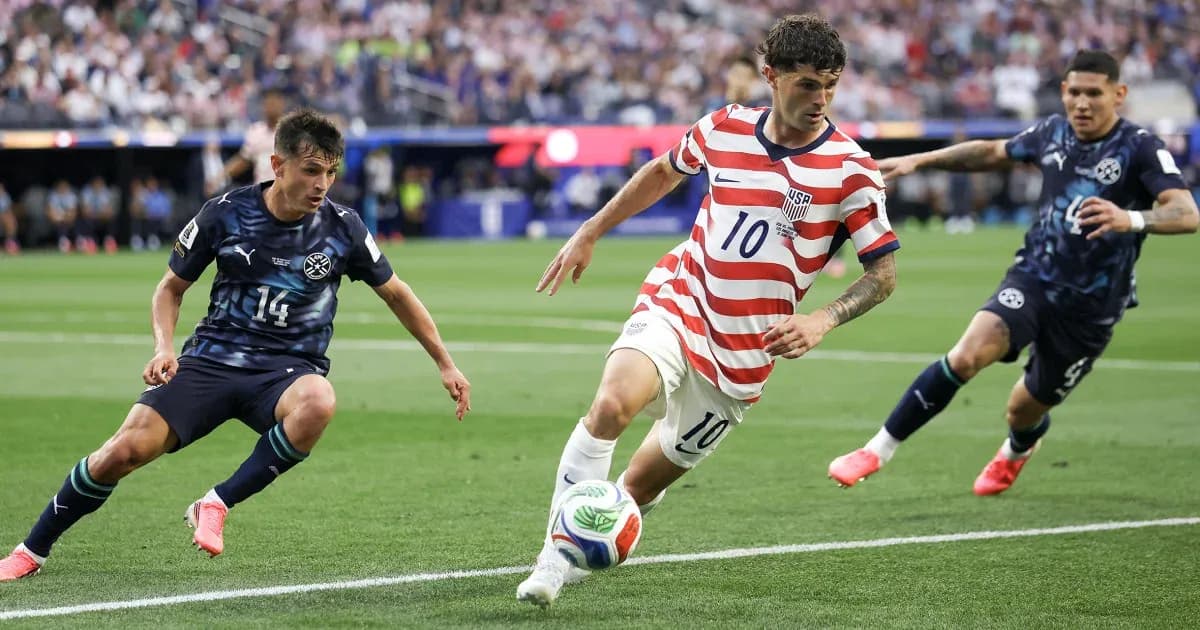
Fresh off a 4-1 demolition of Paraguay — a result that matched the largest World Cup margin of victory in U.S. history — Mauricio Pochettino’s team walks into its second group game against Australia with something it hasn’t always worn comfortably on this stage: expectation.
Beat the Socceroos on Friday, and the U.S. is through to the knockout rounds with a game to spare. Lose the edge that fueled this rise, and that momentum can evaporate just as quickly as it arrived.
Remembering the last fight
To stay grounded, the U.S. hasn’t been replaying the Paraguay goals. It’s been rewinding a far less glamorous night: a bruising friendly against Australia seven months ago.
That match didn’t count in any standings, but it felt like it did. Australia came after the U.S. from the opening whistle, turning a supposedly low-stakes evening into a scrap. The teams went into halftime level at 1-1. Inside the locker room, Pochettino snapped.
“He comes and he fights,” he told his players in a clip later released by the team, pointing to Australia’s intensity. “When are we going to fix that?”
The rant landed. The U.S. clawed out a 2-1 win, but the scoreline mattered less than the message.
Midfielder Sebastian Berhalter still hears it.
“I think one is that we’re American, we don’t take s---,” he said this week, reflecting on that night and its lasting impact. Pochettino, he added, has hammered that identity into the group — a defiant, front-foot mentality that he believes matches the country as much as the team.
“Look, this is what we do, and this is who we are, and this is what America is about,” is how Berhalter framed his coach’s approach. That edge, he said, is something Pochettino “really drills into us.”
Seven months later, the stage is bigger, the stakes heavier, but the opponent is the same. So is the warning.
From process to proof
The Paraguay performance did more than light up a scoreboard. It stamped names into the tournament.
Folarin Balogun’s two goals made him the first U.S. player since 1930 to score multiple times in a World Cup match, a statistic that underlines just how rare these kinds of nights have been for the program. The attack flowed, the press bit, and the U.S. looked, for once, like the aggressor that others had to survive.
Pochettino’s message afterward, according to striker Haji Wright, was simple: he was “proud.”
But he didn’t let anyone linger on it.
It was only the first group game. The players know better than to confuse one statement win with a completed mission.
“There’s been moments throughout the process where things weren’t going amazing,” midfielder Tyler Adams said. “Now all of a sudden, some people consider [our play] amazing, whatever it is, but we’ve stayed completely humble in our approach to every single game and trusted the process of what we’re going through.”
That “process” now faces its first real stress test of this World Cup. Because the Australia waiting on Friday is not a backdrop for another U.S. showcase. It’s a team that has every intention of shoving back.
Australia won’t blink
Australia arrives with its own momentum after a 2-0 win over Turkey, a result built on familiar traits: defensive discipline, ruthless counterattacks, and a frontline that punishes any lapse.
“They’re tough to break down, they’re dangerous on counterattacks, they have good players at the top of the pitch, and they were able to be effective and damage Turkey,” Wright said.
Then came the cautionary note, the kind that tends to stick with veterans who’ve seen tournaments tilt on attitude as much as tactics.
“I think Turkey kind of came into the game a bit overconfident,” Wright added. “And I think we won’t make that same mistake.”
That’s the trap Pochettino has been trying to spring shut all week. The U.S. has rarely walked into a World Cup group game with this kind of platform: a statement win behind it, a clear path to the knockouts in front of it, and a narrative that suddenly paints it as one of the sides to watch.
Australia, historically, loves nothing more than puncturing that kind of mood.
The Pulisic question
The one cloud over the U.S. after Paraguay came wrapped around its brightest star.
Christian Pulisic, who carved open Paraguay with his runs and passing and helped set up the first two U.S. goals, never made it out for the second half. He struggled to warm up at the break and was substituted, a jarring sight on a night when everything else seemed to be falling into place.
Pochettino later explained that Pulisic had taken a minor knock days earlier. The forward said he was kicked again in his left leg during the first half.
This week, as the team ramped up preparations for Australia, Pulisic trained off to the side, Tim Weah said. His status for Friday remains uncertain. Pochettino’s public line on Thursday was brief: “We’ll see.”
Inside the camp, hope and reassurance share the same space.
“I’m just praying to God that he feels 100% fit,” Weah said.
Adams, the captain’s voice in all but armband, chose calm over concern.
“Christian will be ready, everyone, let’s relax,” he said. “He’ll be fine.”
Whether Pulisic starts, comes off the bench, or sits out, the U.S. will be judged on something larger than one player: can it reproduce the ferocity and clarity of its opener when the game turns into a fight, not a showcase?
A chance to change the conversation
This is where World Cups often turn. Not in the glamour of a tournament debut, but in the grind of the second group match, when legs are sore, opponents are wiser, and the table suddenly has real shape.
The stakes are clear. Both the U.S. and Australia opened with wins. Victory on Friday sends the winner into the knockout round. No calculators. No waiting.
For Pochettino, this is the moment his words from that friendly in the fall either echo or fade. Australia will “come and fight” again. The question is whether this U.S. team, older now in tournament years and emboldened by its own history-making start, can show that it no longer needs a halftime rant to meet that challenge.
If the U.S. truly has turned a corner on the world stage, this is exactly the kind of night it has to own.