.svg&w=384&q=75 "Naijagoal logo")
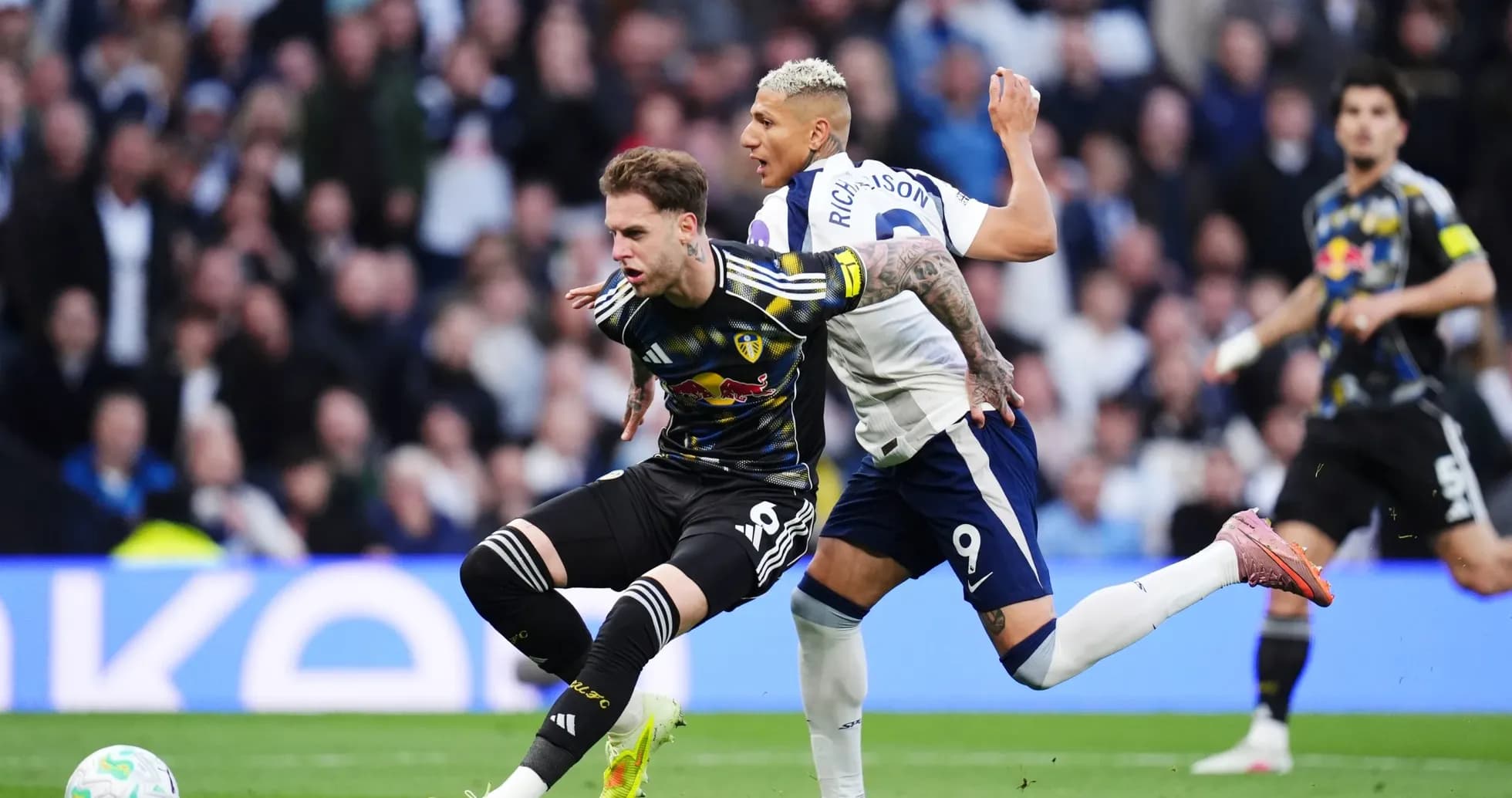
Tottenham vs Leeds: Tactical Insights from a 1-1 Draw
Under the London floodlights at Tottenham Hotspur Stadium, a 1–1 draw between Tottenham and Leeds felt less like a dead rubber in Round 36 and more like a tactical case study in two contrasting rebuilds. Following this result, a side clinging to 17th in the Premier League table had once again failed to turn territorial control into a home win, while a Leeds team sitting 14th extended a quietly resilient run with another point on their travels.
I. The Big Picture – Systems under strain
Tottenham lined up in Roberto De Zerbi’s preferred 4-2-3-1, but this was a version heavily reshaped by absences. With Guglielmo Vicario out, A. Kinsky took the gloves behind a back four of P. Porro, K. Danso, M. van de Ven and D. Udogie. J. Palhinha and R. Bentancur formed the double pivot, with an attacking band of R. Kolo Muani, C. Gallagher and M. Tel operating behind Richarlison.
The structure mirrored their seasonal identity. Heading into this game, Tottenham had used 4-2-3-1 more than any other shape (17 times), leaning on a possession-first, build-from-the-back approach. But the numbers underline a fractured campaign: overall they had played 36 league matches, winning 9, drawing 11 and losing 16. Their goal difference of -9 came directly from 46 goals scored and 55 conceded. The split between home and away was stark. At home they had only 2 wins from 18, with 21 goals for and 31 against; on their travels they were far more effective, with 7 wins, 25 goals scored and 24 conceded. The home averages told the same story: 1.2 goals for and 1.7 against per home game, compared to 1.4 scored and 1.3 conceded away.
Leeds, under Daniel Farke, arrived with a 3-5-2 that has become one of several flexible shapes this season. J. Rodon, J. Bijol and P. Struijk formed the back three, shielded by a busy midfield line of D. James, A. Stach, E. Ampadu, A. Tanaka and J. Justin. Ahead of them, B. Aaronson floated around D. Calvert-Lewin, the league’s eighth-ranked scorer this season.
Their campaign had been defined by stubbornness more than flair. Overall, Leeds had 10 wins, 14 draws and 12 defeats from 36, with a goal difference of -5 (48 scored, 53 conceded). At home they had been solid – 8 wins, 28 goals for and 21 against – but away they were draw specialists: 2 wins, 9 draws and 7 defeats, with 20 scored and 32 conceded. On their travels, they averaged 1.1 goals for and 1.8 against, a profile of a team that suffers without the ball but can still nick moments in transition.
II. Tactical Voids – The weight of absences and discipline
The team sheets were defined as much by who was missing as who played. Tottenham’s injury list read like the spine of an alternative XI: B. Davies (ankle), M. Kudus (muscle), D. Kulusevski (knee), W. Odobert (knee), C. Romero (knee), X. Simons (knee), D. Solanke (muscle) and G. Vicario (groin) were all ruled out. That stripped De Zerbi of his first-choice centre-back leader in Romero, a key creator in Kulusevski, a high-volume dribbler in Simons, and a penalty-box striker in Solanke. It forced greater responsibility onto van de Ven as the dominant defender and onto Richarlison as the primary goal threat.
For Leeds, the absentees were more about depth and variety than pure structure: J. Bogle (hamstring), F. Buonanotte (hamstring), I. Gruev (knee), G. Gudmundsson (muscle) and N. Okafor (calf) were all unavailable. Farke had to lean even more heavily on his established spine of Ampadu, Aaronson and Calvert-Lewin.
Discipline loomed in the background. Tottenham’s season-long yellow-card distribution showed a late-game spike: 25.26% of their yellows arrived between 61–75 minutes, with another 15.79% from 76–90 and 11.58% in added time (91–105). Leeds, by contrast, spread their cautions more evenly but still had a notable late tilt: 23.33% of yellows between 61–75 and 16.67% from 76–90. With Romero absent – despite his league-leading combination of 10 yellows and 1 red – Tottenham removed one flashpoint, but the overall pattern of late pressure and fatigue-induced fouls remained.
III. Key Matchups – Hunter vs Shield, Engine Room battles
The headline duel was the “Hunter vs Shield” confrontation between D. Calvert-Lewin and a Tottenham defence that has been markedly weaker at home. Calvert-Lewin entered the fixture with 13 league goals and 1 assist, built on 64 shots (32 on target). He is not just a finisher but a focal point: 444 duels contested, 174 won, and 37 fouls drawn. Crucially, his penalty profile is nuanced: he had scored 4 spot-kicks but also missed 1, so any reference to Leeds from 12 yards had to account for that blemish.
He was attacking a back line that, heading into this game, conceded 1.7 goals per match at home. Without Romero’s aggression and anticipation, van de Ven’s role expanded. The Dutch centre-back had shown his defensive range this season: 21 blocked shots, 22 interceptions and a solid duel record (199 contested, 111 won). His red card earlier in the campaign underlined the fine line he walks when defending big spaces, particularly in a high line.
On the other side, Richarlison embodied Tottenham’s attacking threat. With 10 league goals and 4 assists from 30 appearances, supported by 42 shots (24 on target), he was the natural reference point against a Leeds away defence conceding 1.8 goals per game. His work rate – 294 duels, 123 won, 25 tackles and 5 interceptions – also made him the first defender in De Zerbi’s pressing scheme.
In the “Engine Room” battle, E. Ampadu versus Tottenham’s double pivot was central. Ampadu had quietly assembled an outstanding season: 2943 minutes, 1 goal, 1 assist, 1628 passes at 85% accuracy, 78 tackles, 16 blocked shots and 50 interceptions. He is also one of the league’s card magnets, with 9 yellows, and his willingness to step out and break lines of pressure made him the natural counter to Gallagher’s forward runs and Bentancur’s tempo setting.
For Leeds, B. Aaronson offered the creative counterweight. With 5 assists, 4 goals, 32 key passes and 80 dribble attempts (28 successful), he drifted into pockets between Tottenham’s lines, trying to exploit any hesitation in the space between Palhinha and the centre-backs.
IV. Statistical Prognosis – What the numbers say about the draw
From a statistical lens, the 1–1 scoreline mirrored the underlying profiles. Both teams came in averaging 1.3 goals per match overall, and both conceded 1.5 per game across the season. Tottenham’s chronic home underperformance met Leeds’ habit of surviving away with draws, and the result slotted neatly into that equilibrium.
Tottenham’s lack of penalty involvement (0 awarded, 0 scored, 0 missed overall) contrasted sharply with Leeds’ perfect 6-from-6 record from the spot. Yet Calvert-Lewin’s individual record – 4 penalties scored, 1 missed – hinted that perfection was a collective, not purely individual, achievement. In a tight contest, a single box incident always felt like it could tilt the xG balance decisively towards Leeds.
Defensively, Leeds’ away fragility (32 conceded on the road) suggested Tottenham would generate a healthy xG, especially with Richarlison attacking the channels around Rodon and Struijk, and Porro overlapping to deliver from wide. But the home side’s season-long pattern of failing to convert territorial dominance into multiple goals at Tottenham Hotspur Stadium was never far away.
Following this result, the numbers still paint Tottenham as a side whose attacking ideas outstrip their home execution, and Leeds as a team whose structural resilience and set attacking patterns – built around Ampadu’s control, Aaronson’s movement and Calvert-Lewin’s penalty-box craft – keep them competitive in almost every game. On balance, the 1–1 draw felt like the logical outcome of two imperfect but well-defined identities colliding, with the xG story likely echoing the table: narrow margins, shared spoils, and a sense that both projects remain very much in progress.