.svg&w=384&q=75 "Naijagoal logo")

Spain's Journey to a Beautifully Structured Team
There was a time when Spain walked into every tournament convinced the trophy already had their name on it. From 2008 to 2012, that arrogance was backed by ruthless reality: two European Championships wrapped around a World Cup, a four-year spell in which La Roja turned the rest of the planet into training cones.
Then it all collapsed. The aura vanished, the restarts piled up, and a decade of failed reboots forced a proud football nation to swallow its own hype.
Now comes 2026. And the mood could not be more different.
Spain arrive in North America as reigning European champions, having cut a path through Croatia, Italy, Germany, France and England on their way to the Euro 2024 title. The swagger is back, but it’s measured. Less divine right, more quiet conviction.
This is not a team chasing ghosts of 2010. It’s a team that knows exactly what it is.
From suffocating pressure to something healthier
The old Spain lived under a “win or bust” ultimatum. Anything short of a trophy felt like failure. That suffocating weight has eased.
“The fans learned their lesson from how spoiled they were getting with all the success from 2008 to 2012,” says Spanish-American journalist and ITV World Cup presenter Semra Hunter on the Make Football Great Again podcast. The crash after 2012 hurt, and the scars changed the country’s relationship with its team.
That scepticism hit its peak just before Euro 2024. Luis de la Fuente walked into the tournament surrounded by doubters, his selections picked apart, his suitability questioned. It turned out to be the perfect fuel.
“Going into the Euros, fans were super critical of Luis de la Fuente. There was almost no hope,” Hunter recalls. The players responded with a campaign of relentless authority. “They were consistently the best team.”
The payoff is a fanbase that now believes again, without demanding blood for anything less than perfection. There is trust. There is expectation. But the old ultimatum has gone. Spain are no longer paralysed by the fear of failure.
They are energised by the possibility of more.
The fitness sweat over Yamal and Williams
If Spain are to turn that possibility into another World Cup tilt, their two most electric weapons must be ready to explode.
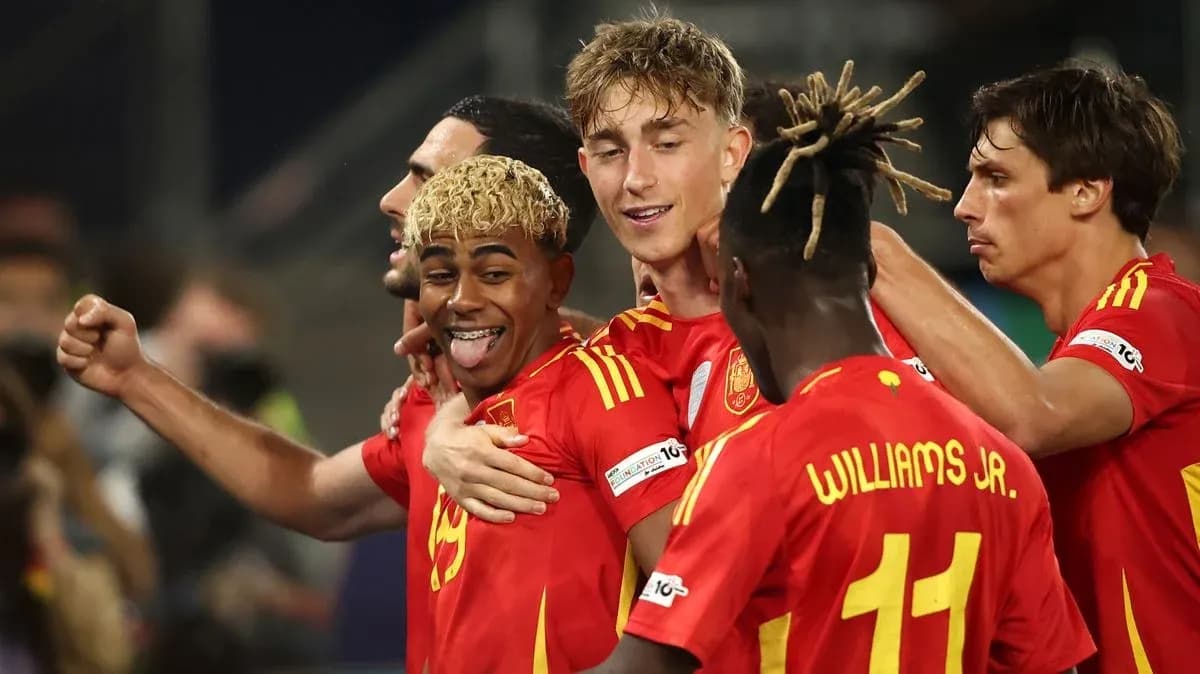
Lamine Yamal and Nico Williams have become the cutting edge of De la Fuente’s attack, a pair of wingers who stretch defences, terrify full-backs and tilt entire games on their own. Right now, both sit at the heart of a nervy fitness watch.
Yamal suffered a hamstring injury in April. At 18, he is expected to make the World Cup, but no one knows how sharp he will be when the tournament kicks off.
“They are two of the most special, unique wingers in world football at the moment and they give Spain an edge they wouldn’t have without them,” Hunter says. Yamal, in particular, has started to drift into that hybrid role that defined Lionel Messi’s early years as a false winger: “He’s a destabilising force… capable of conjuring up a moment of brilliance when the going gets tough.”
On the other flank, Williams – arguably Spain’s standout performer at Euro 2024 – also picked up a hamstring problem in May. The early signs are more reassuring.
“Thankfully, that one doesn’t seem to be as bad, and he should be back to fitness to start training,” Hunter notes.
Spain’s structure means they can cope without them in isolated games. Over a month-long World Cup, though, with knockout ties decided by a single flash of genius, those two feel essential. “They really need both at full tilt to go all the way,” Hunter insists.
A midfield that runs the show
If the wings provide the chaos, the centre of the pitch supplies the control. Spain’s midfield remains a luxury suite.
Rodri anchors everything, the Manchester City metronome now the undisputed reference point for both club and country. Around him swirl Barcelona’s Pedri, Gavi and Dani Olmo, Arsenal’s Martin Zubimendi and Mikel Merino, and PSG’s Fabian Ruiz. It is a group that could field two international midfields on its own.
Within that wealth, two names are ring-fenced.
“As long as Rodri and Pedri are fit and firing, they are non-negotiable starters,” Hunter says. Rodri dictates tempo and territory. Pedri gives Spain the subtlety between the lines, the angles and disguise that turn possession into incision.
From there, De la Fuente can tailor the rest. “Gavi provides more of the bite, the aggression, and the physicality,” Hunter explains. “Dani Olmo is someone who can break through the lines, score goals, and practically play as a forward.”
Not everything has gone their way. Barcelona’s Fermin Lopez, who produced 30 goal contributions this season, has been ruled out with a broken foot after surgery. It is a significant blow to Spain’s depth and to a player many expected to explode on the international stage.
“Fermin Lopez is a big loss. He’s somebody who probably could have been a breakout player for Spain,” Hunter says.
Yet the talent pool is deep. Spanish players, as ever, bring versatility. Zubimendi stands ready as a direct understudy to Rodri, and De la Fuente still finds himself “completely spoiled for choice.”
The old wound that never quite heals
Amid all that abundance, one weakness continues to glare.
Spain still do not produce the classic, ruthless No.9 that so many of their rivals rely on. The kind who lives in the six-yard box and turns half-chances into goals. It has been that way since the days of David Villa and Fernando Torres.
“Our biggest weakness is so obvious for me – we haven’t had a proper, lethal ‘fox in the box’ striker who can put balls away first touch since the days of David Villa and Fernando Torres,” Hunter admits. “No disrespect to Alvaro Morata but Spain just doesn’t produce that kind of player. It’s all about midfielders.”
Real Sociedad’s Mikel Oyarzabal, the man who scored the winner against England in the Euro 2024 final, is expected to lead the line. Intelligent, technically gifted, tactically disciplined – he fits Spain’s collective approach. But he does not frighten defences in the way a prime Villa once did.
The question is whether the system can once again compensate for the absence of a killer in the box. Euro 2024 suggested it can. A World Cup, with its different rhythms and margins, will ask again.
A nation of football philosophers
If Spain lack one archetype of player, they more than make up for it on the touchline. The country continues to export some of the most influential coaches in the modern game: Pep Guardiola, Mikel Arteta, Unai Emery, Xabi Alonso, Andoni Iraola. That conveyor belt is no accident.
“In Spain, football is a language,” Hunter explains. From childhood, players are taught the game as a puzzle to be solved, not just a contest to be won. Systems, structures, rotations – the whiteboard is part of the culture.
“Everybody fancies themselves a football philosopher in Spain, really. There’s so much romance about it,” she says. Guardiola and Xabi Alonso were “already managers on the pitch when they played.”
The ethos is clear: the collective over the individual, the group above the star. “They focus on the collective, on being collaborative, on the whole being more important than the individual. They’re very humble, they’re hardworking people. And I think that is reflected in their management style – and the players’ playing style too.”
De la Fuente fits that lineage. His Spain is not built around one talisman but around interlocking roles, shared responsibility and positional intelligence. The manager is not a celebrity frontman. He is the architect.
The road through North America
Spain’s path begins with a group that, on paper, they should control: Cape Verde, Saudi Arabia and Uruguay.
“They should get through relatively comfortably,” Hunter predicts. Cape Verde, debutants on this stage, and an organised Saudi Arabia side are obstacles Spain are expected to clear.
Uruguay are different. “Uruguay will be the biggest test,” she warns. “They are intense, aggressive, streetwise, and technically more talented than people give them credit for. If they want to rough up Spain, they certainly can.”
That matchup feels like an early litmus test. Can this Spain side impose their structure and rhythm on a team designed to disrupt it? Can they live with the physical duels without losing their own identity?
Hunter’s faith is unwavering. “I see them getting seven to nine points, topping the group and advancing. Quite honestly, I think they will make it all the way to the final.”
Pressed to nail her colours to the mast, she does not hesitate.
“I think it’s going to be Spain to win it.”
From the entitlement of the golden era to the scars of the fall and now this leaner, more grounded version, La Roja arrive in North America not as myth, but as machine. Beautifully structured. Deep, versatile, tactically obsessed.
The world worked out how to stop Spain once. The real question now is whether anyone has solved the blueprint for this new version.