.svg&w=384&q=75 "Naijagoal logo")

South Africa's Historic World Cup Journey: A New Era Begins
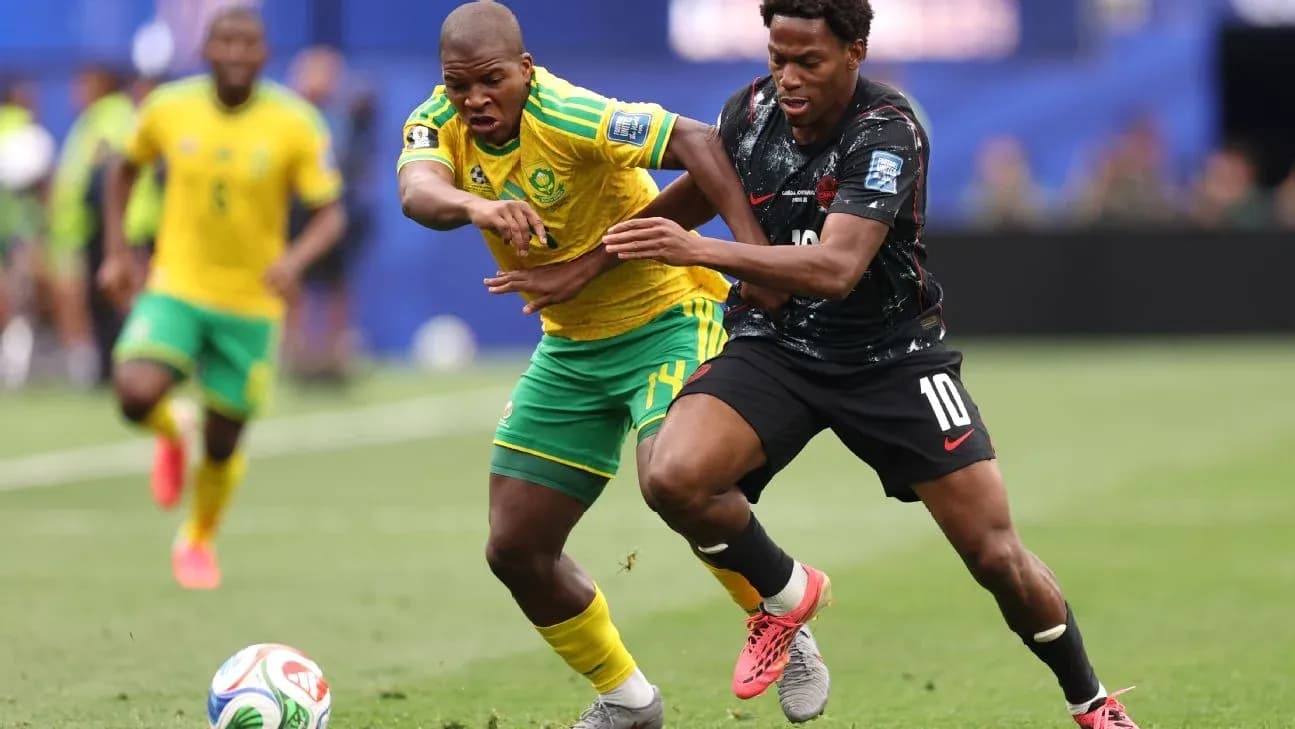
South Africa’s World Cup ended with heads in hands and a 1-0 defeat to Canada in the round of 32. The pain was raw, the silence heavy. Sixteen years they had waited to return to this stage, only to fall by a single goal.
Yet as the dust settles, it’s impossible to call this campaign a failure.
Bafana Bafana walked into uncharted territory with their first-ever appearance in the knockout rounds. They walked out having redrawn the map of what South African football can be.
A defence to build a decade on
If there is one department that should let South Africans sleep easily, it is centre-back.
At this World Cup, Mbokazi and Okon did more than just start. They owned the heart of the defence. They looked like they belonged on this stage from the first whistle, and by the time South Africa bowed out, Mbokazi had staked a claim as one of the standout centre-backs of the entire tournament.
That matters. Tournaments like this expose weak links. South Africa’s central defence never looked like one.
Behind them, there is depth that previous generations could only envy. Olwethu Makhanya, Khulumani Ndamane, Tylon Smith, Malibongwe Khoza, Aden McCarthy and others are already pushing from beneath, ready to step in if injury, form or time catches up with either “TLB” or Okon.
Whoever occupies the Bafana dugout for the next World Cup cycle will not be scrambling for centre-backs. They will be choosing between them.
Mofokeng, the talent waiting to explode
If there was a lingering frustration for many fans, it sat around the shoulders of Relebohile Mofokeng.
The Orlando Pirates attacking midfielder did not enjoy the kind of trust from Hugo Broos that a vocal section of the public felt he deserved in 2026. His minutes were limited, his influence sporadic.
Then came that performance in the 1-0 win over South Korea.
On that day, Mofokeng looked like he had kicked down the door to the global stage. He handled the pace, the pressure, the quality of the opposition. He did not look overawed; he looked at home.
And he is only 21.
Project him forward four years. Or to 2030, when he will be entering his prime. If he gets close to his ceiling, the next Bafana coach will have a genuine game-changer on their hands, the kind of player you keep hidden until the right moment and then unleash as an ace.
Reports have placed him on the verge of a move to Royale Union Saint-Gilloise in Belgium. If that deal is confirmed, it will give him exactly what he needs: a tougher, more demanding platform without throwing him into chaos. From there, his name can travel far beyond South African borders.
Homegrown, and good enough for the world
One of the quiet triumphs of this World Cup for South Africa was what it said about the level of the domestic game.
Several of Bafana’s most influential performers have spent their entire careers in the South African Premiership. No European academy. No glamour move abroad. Just years of hard, local football.
Teboho Mokoena of Mamelodi Sundowns bossed midfield zones with authority. Thalente Mbatha of Orlando Pirates matched the tempo and intensity of world football without blinking. On the flanks, the Sundowns fullback pair of Khuliso Mudau and Aubrey Modiba ran themselves into the ground, defending with grit and driving forward with conviction.
Behind them all, Ronwen Williams stood as captain, goalkeeper and last line of resistance. He made crucial saves, marshalled his back line and reminded the world why his reputation has grown so large despite never leaving South Africa, first with SuperSport United and now with Sundowns.
Of course, it would help the national game if some of the brightest young stars tested themselves abroad. New environments, new styles, new pressures: all of that sharpens a player. But this World Cup proved something important for any kid kicking a ball on a dusty pitch in Soweto, Gqeberha or Polokwane.
You do not have to leave home to become a serious footballer. The path from the Premiership to the global stage is real, and it works.
Maseko, from the brink to a nation’s heartbeat
No story captured the emotional core of this campaign quite like Thapelo Maseko’s.
Hugo Broos had seen something in him early. The winger scored his first goal for Bafana at the 2023 Africa Cup of Nations (played in early 2024), a 20-year-old stepping into the spotlight.
Then his career stalled.
After moving from SuperSport United to Mamelodi Sundowns, Maseko slipped down the pecking order. Under Miguel Cardoso, who took charge of Sundowns in December 2024, he rarely featured. Too often, he found himself with the reserves, watching instead of playing.
By January 2026, his frustration had spilled into the open. On social media, he spoke about losing his love for football. For a young player, those are chilling words.
Then came the loan to AEL Limassol in Cyprus. That move changed everything.
Away from the glare, he rebuilt his rhythm, his confidence, his joy. By March, he was back in the Bafana squad. This month, he delivered the moment that will live in South African football folklore.
His goal against South Korea did not just win a match. It pushed South Africa into the World Cup knockout rounds for the first time in their history. One strike, and a country’s long-held ceiling shattered.
Maseko’s journey from the reserves to that defining finish offers more than a tactical lesson. It offers hope. Careers can be rescued. Belief can return. Sometimes, the player who looks lost in January becomes the hero of July.
Money, survival and a chance to reset
Away from the pitch, the South African Football Association walked into this World Cup under a cloud.
SAFA’s finances had become a national talking point. Players were reportedly paid late after the previous year’s African Nations Championship. Operating expenses kept outstripping revenue. The word “crisis” hovered over every discussion.
This tournament has not magically solved that. It has, however, bought time.
Simply by reaching the group stage, SAFA were due at least $9 million in performance-based payouts, excluding preparation fees. By pushing into the round of 32, Bafana added another $2 million, taking the total to $11 million.
That is not a luxury windfall. It is a lifeline.
The team’s performances have also changed the conversation around sponsorship. It is one thing to pitch a struggling, absent World Cup team to potential partners. It is another to present a side that has just made history, played with personality and lit up a nation.
Deals that might have felt out of reach a year ago suddenly look possible.
This new money will not erase past mismanagement or years of structural neglect. It will not fix youth systems overnight or build training centres by itself. But it can provide a safety net, a buffer against collapse, and the foundation for something more ambitious.
That “more” is now SAFA’s challenge.
They cannot afford to stay in survival mode, lurching from one crisis to the next. The task is to convert this World Cup run into a plan: for development, for infrastructure, for coaching, for continuity.
South Africa arrived at this World Cup as a team many expected to simply make up the numbers. They leave as knockout-round participants, with a hardened defence, a rising playmaker, a homegrown core that belongs at this level, and a winger whose story captured a country’s imagination.
The question now is not whether this was a one-off moment of pride.
It is whether South African football has the courage and competence to turn it into the start of its brightest chapter yet.