.svg&w=384&q=75 "Naijagoal logo")

Socceroos Unite Australia in Historic World Cup Match
Australia used to stop for a horse race. On Friday, it stopped for a stalemate.
Across the country, the Socceroos’ tense, goalless scrap with Paraguay brought the working day to a halt, laptops shoved aside as a nation held its breath. A 0-0 that felt anything but empty. A point that pushed Australia into the World Cup knockout phase for the second tournament running – and turned an ordinary winter afternoon into something close to a civic event.
A nation clocks off
In the inner west of Sydney, the Golden Barley filled early. Not with evening drinkers, but with people in hi-vis, office shirts and retro gold jerseys, all trying to pretend they were still at work.
For once, they could. This was history: the first Socceroos World Cup match played entirely within Australian working hours.
Jamie and Rick Hayman, small business owners, weren’t about to miss it. Rick, who runs a local construction company, had his work admin open, staff around him, but his eyes locked on the screen.
He has followed the Socceroos “forever”. Lately, he’s noticed something different.
“It unites the community,” he said. “That’s what you notice. Pubs get filled up, there’s all the talk around town, it’s really good to see.”
In front of him, right on the television’s front row, sat four old friends. One of them, Nick, cradled a Guinness and wore an original 1974 Socceroos jersey – a threadbare, living reminder of the first time Australia ever reached a World Cup.
He and his partner, Robyn, have done the hard yards over the years: alarms at 2am, 4am, bleary-eyed kids on couches, the ritual of football in the dead of night. They almost miss it.
“We were just saying this morning, we used to wake up in the middle of the night, it used to be really good,” Nick said, laughing. “It’s a unique experience. A family experience.”
This time, the family experience came with sunlight and bar snacks.
Rain, nerves and a howling dog
Down the road at the Vic on the Park, the mood swung between party and panic.
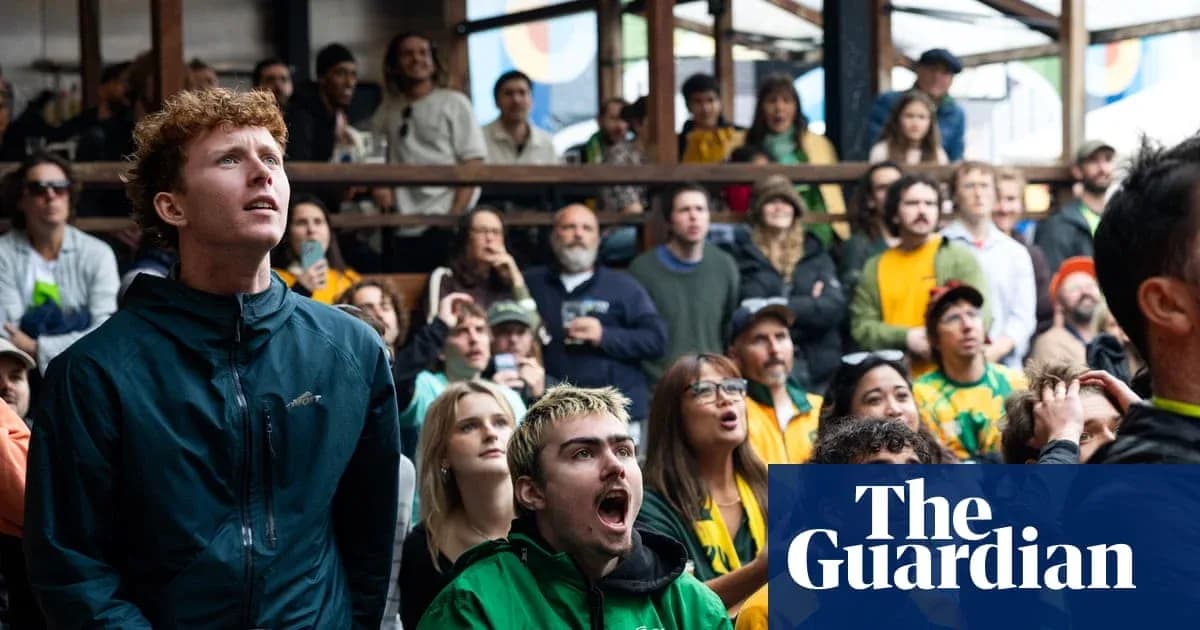
Hundreds crammed into the beer garden and bar, jammed shoulder to shoulder, a sea of yellow jerseys and plastic ponchos. When the rain swept through in the first half, jackets and Socceroos scarves doubled as makeshift umbrellas. People cursed the weather, then roared at the next Australian attack.
Eighty minutes gone. Still no goal. The noise dipped, then rose again as a few “Aussie, Aussie, Aussie” chants cut through the tension. A dog in the front bar joined in with a long, anxious howl, as if it understood the stakes.
As the clock crawled through added time, the fear finally gave way to something else: belief that the point would hold. A bald man with a stick-on Australian flag tattoo on his cheek grabbed his friends and pulled them into a hug as the final whistle blew. No goals, but a moment that felt like one.
Around them, people swapped stories. Some had booked annual leave the moment the fixtures dropped. Others had improvised.
Sophie and her son Orson, a year 11 student, had already ridden the emotional rollercoaster at the Vic when Australia lost 2-0 to the USA early last Saturday morning. This time, Orson skipped the last day of term. Sophie worked quietly off her phone, half on emails, fully on the match.
“This is of national importance,” she said. “I really want Oscar to hear a goal in the pub, just to hear us lift.”
Orson, who dreams of becoming a football coach, watched the crowd more than the clock. For him, the afternoon meant something beyond the scoreline.
“Football’s growing,” he said. “It’s been brilliant, so cool to see so many people supposed to be working coming to support their country.”
Federation Square turns into a cauldron
In Melbourne, the country’s unofficial fan zone did what it always does. It overflowed.
By 10am, Federation Square had hit capacity. Victoria Police put the crowd at 7,500, most of them having arrived hours earlier to claim a patch of concrete with a view of the big screen.
With the tension of the match came its own subculture. Groups of teenagers launched high-stakes games of bottle flip, celebrating each successful landing with the kind of wild, tearful cheers usually reserved for last-minute winners. Others bragged loudly about having “wagged” school to be there, or about parents who had waved them out the door with a shrug and a “go on then”.
When the national anthem rang out, seven flares lit up the square. Smoke, colour, chaos – and then the inevitable consequence. A 16-year-old was arrested. Later, police said three teenagers were issued penalty notices for riotous behaviour and moved on.
Every now and then, an unseen surge rippled through the packed square, sending people stumbling forward. Once they steadied themselves, the crowd wheeled as one, hunting for the culprit, and a single, crude chant rang out in unison. It was raw, unfiltered, and very much alive.
Watching it all with a more measured eye was former Socceroo Craig Foster. For him, this wasn’t just a party; it was a statement about the team’s evolution.
He called it a “near perfect game” for Australia.
“The squad depth has been demonstrated,” he said. “They’ve done exactly what was required … Australia is managing well, learning very quickly, and it’s a beautiful day anytime the Socceroos get through to knockout rounds.
“We are here. We’re still in this tournament, and we’re fighting all the way. There’s nothing better in life.”
On the other side of the barricades, teenager Ali Abolhasani and his friend were having a very different kind of afternoon. They described being swept off their feet in the crush, hitting the ground, losing their shoes, and not really caring.
Asked how he felt after the match, Abolhasani didn’t hesitate.
“Amazing.”
“I can’t wait to come back next week,” he said. “We did an all-nighter, we couldn’t sleep because we knew we’d make it … We’ll do it again.”
Capital fever
Even Canberra, often slow to catch a sporting wave, was caught up in it.
In Garema Place, more than 500 fans gathered around a modest two-screen setup that felt far too small for the size of the crowd. People craned their necks, shifted from foot to foot, swapped spots so kids could see. The picture wasn’t perfect; the mood was.
Among them stood ACT senator David Pocock, watching the same feed as everyone else, swept up in the same tension.
He spoke about what the Socceroos represent in a week when football had been debated inside parliament as well as on terraces.
“The Socceroos, as it’s been talked about this week in parliament, represents what is so great about Australia,” he said. “We do have so many people from diverse backgrounds coming together, and you see the way that that resonates across the country.”
On Friday, that resonance sounded like a nation exhaling at full-time. No last-gasp winner. No net-busting volley for the ages. Just a hard-earned point that carried Australia through, and a reminder that sometimes the story isn’t in the scoreline at all.
It’s in the packed pubs, the missed classes, the lost shoes, and the simple, shared certainty that this team is worth downing tools for in the middle of the day – and will be again when the knockout rounds begin.