.svg&w=384&q=75 "Naijagoal logo")
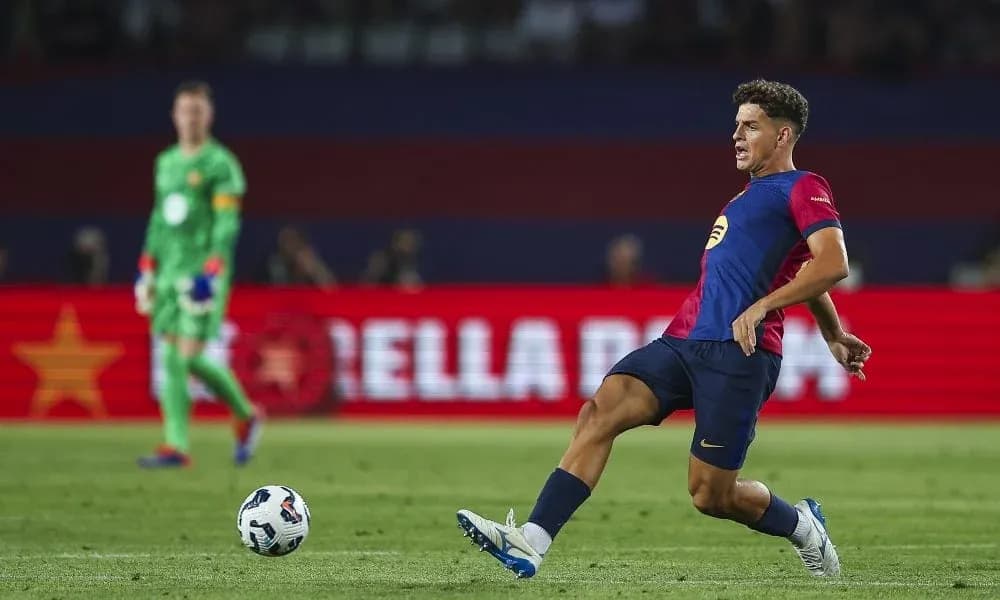

Sergi Dominguez: From Barça Prospect to Dinamo Zagreb Star
La Masia rarely lets a good story go to waste. Some talents rise straight into the Barcelona first team. Others have to leave to grow. Sergi Dominguez belongs firmly in that second category – and he is turning his detour into a statement.
From Barça prospect to Dinamo pillar
Last summer, Dominguez walked away from Barcelona for €1.2 million, a quiet move in a noisy market. A 21-year-old centre-back heading to Dinamo Zagreb, a league few in Spain watch weekly, sounded like a step into the shadows.
It has been anything but.
In just one season, Dominguez has become one of the standout defenders in the Croatian league. He helped Dinamo complete the domestic double – league and cup – and earned a place in the division’s Team of the Season. Not bad for a player who thought his future lay in the Spanish second tier.
“I finished the season with Barcelona and the idea was to leave on loan or permanently, but I never thought I would end up in Croatia. I thought I would play in the Spanish second division,” he told SPORT, still sounding a little surprised at how quickly his path has changed.
The move came to life through a familiar voice. Albert Capellas, once a key figure at La Masia and now at Dinamo, helped open the door to Zagreb. The project, the style, the chance to play every week – it all aligned for a defender who needed minutes more than promises.
Dreaming in Blaugrana
Dominguez may be thriving abroad, but he has never pretended that Dinamo is the final destination. He speaks openly, almost stubbornly, about what he wants.
“My ultimate goal is to come back home and play for Barcelona. Hopefully it can happen. It’s difficult, but I’ll try. I still have time,” he said, leaving no room for doubt about where his heart is.
Dani Olmo’s story sits in the back of his mind as proof that this route can lead home again. Olmo left Barça for Dinamo, exploded in Croatia, moved to RB Leipzig, and then earned his way back to Barcelona.
“I spoke to him before coming here. Dani came here, then went to Leipzig and then returned to Barcelona. That’s why I thought about him because, in the end, my dream is to play at home again,” Dominguez explained.
For a generation raised at La Masia, “home” is not a metaphor. It is the Camp Nou, the Ciutat Esportiva, the dressing room corridors, the same passing patterns drilled into them from childhood. Leaving does not erase that. It tests it.
Barcelona football, in Zagreb blue
What has eased the transition is how familiar the football feels. Dominguez did not swap Barça’s positional play for long balls and chaos. Dinamo, he insists, play a brand of football that still feels like La Masia.
“Dinamo’s playing philosophy and Barcelona’s are very similar. Almost identical: 4-3-3, playing out from the back, high pressing.
“Obviously there are differences in the facilities and the budget, but Barcelona are, in my opinion, the best team in Europe,” he said.
The environment might be different. The demands on him are not. In Croatia, he has had to grow in areas that matter for any modern centre-back who dreams of returning to the elite.
“I’ve improved without the ball. I’ve gained experience in duels, in terms of aggression and positioning. It’s a tougher league in that respect,” he admitted.
La Masia gives players a technical base. The Croatian league has given Dominguez scars, timing, and a sharper edge in one-v-one situations. That blend is exactly what top clubs look for.
Watching Cubarsi and Lamine from afar
Dominguez follows Barcelona from a distance, and he does so with the pride of an older brother watching younger siblings take over the house.
“What Pau Cubarsi and Lamine Yamal have done isn’t normal. It’s crazy. Cubarsi, at 19 years old, was one of the best players in Spain and at the World Cup.
“Lamine has also played an important role. Every time he gets the ball, it feels like something is going to happen,” he said.
Those are not empty compliments. They are the words of someone who shared dressing rooms and training pitches with them, who knows how rare it is to dominate so young at that level.
He would love to stand on the opposite side of them one day, under Champions League lights.
“It would be funny, above all, to play against Barcelona. I’d be facing friends of mine and all the members of the coaching staff that I know,” he admitted, half smiling at the idea.
Imagine it: Dominguez in Dinamo blue, trying to stop Lamine on the touchline and Cubarsi pinging passes from the other half. For him, that would be more than a tie. It would be a reunion.
A clause, a window, and a test
Barcelona did not completely close the book when they sold him. They inserted a sell-on clause, a small but significant sign that they did not want to lose sight of his progress. If Dominguez continues on this trajectory, that detail could matter.
For now, the equation is simple. If he wants Barcelona to call, he has to keep giving them reasons. Another strong season in Croatia, more leadership at the back, more evidence that he can anchor a defence that builds from deep and defends big spaces.
The path has been drawn before: leave, grow, return stronger. Olmo proved it can work. Dominguez is trying to write the defender’s version of that story.
The dream is clear. The question now is whether his performances can turn that dream into a decision Barcelona cannot ignore.