.svg&w=384&q=75 "Naijagoal logo")
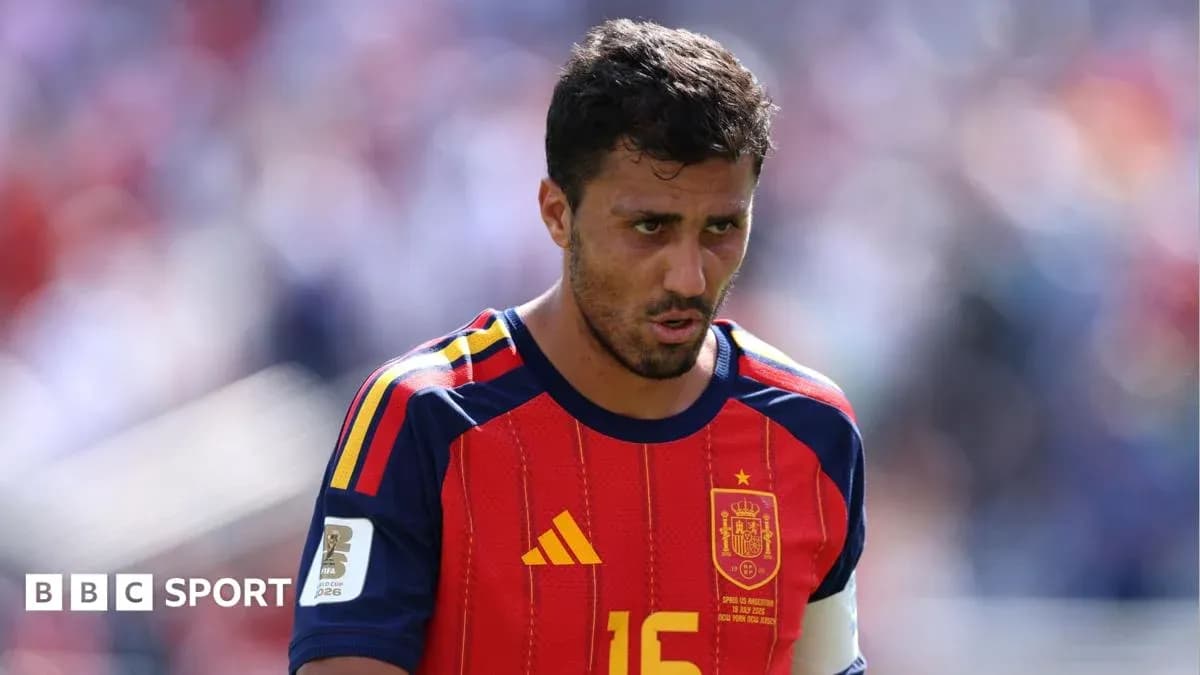

Rodri to Undergo Back Surgery as City Starts New Era Under Maresca
World Cup champion. Golden Ball winner. Ballon d'Or holder. And now, back on the operating table.
Manchester City’s new manager Enzo Maresca confirmed that Rodri will undergo surgery on a back problem on Monday, drawing an abrupt medical line under what should have been the perfect summer for the Spain captain.
The 30-year-old has just led his country to World Cup glory, dictating games on the biggest stage and walking away with the Golden Ball as the tournament’s outstanding player. For Spain, he looked untouchable again. For City, the story has been far more complicated.
Rodri’s last two club seasons were shredded by injury. An anterior cruciate ligament problem ruled him out for the bulk of the 2024-25 campaign, and a series of setbacks last season meant he was in and out of the side, never allowed to build the rhythm that once made him the metronome of Pep Guardiola’s great teams.
At the World Cup, he looked like the old Rodri: sharp, dominant, decisive. City fans could finally believe their midfield anchor was back to his best.
Then came Maresca’s first press conference.
“Now, [he has] surgery on Monday. Then he needs a holiday, he needs to rest and recover and then he will be back with us,” the Italian said, setting out a clear but open-ended roadmap. Operation. Rest. Recovery. Return. No dates. No guarantees.
Maresca refused to put a timeline on Rodri’s comeback. The new manager knows his first season at Etihad Stadium will be judged on results, but he also knows he cannot afford to rush the player who, when fit, knits the entire side together.
The uncertainty over his fitness has coincided with familiar noise off the pitch. Reports in the past week have linked Rodri with a move to Real Madrid, the kind of speculation that tends to swirl around a player who has just conquered the world with his country.
Maresca brushed that aside with the ease of a coach who understands the market and the media.
“Around big players there are always speculations so I am not worried about that,” he said. “I think it is normal, also because they [Spain] won the World Cup and because he is one of the best players. I think every manager wants to have Rodri because he is a top player.”
The message was simple: interest is inevitable, concern is not. City see Rodri as central to their plans, not as a prize to be cashed in.
For now, though, the club must live without him again. Maresca’s tactical blueprint, his attempt to evolve a side that has already dominated English football, will have to be drawn up initially without the man who best understands the geometry of a midfield.
City have navigated stretches without Rodri before, but rarely with this much at stake for both player and manager. The back surgery is designed to fix a lingering issue, not patch it. If it works, Maresca could inherit the fully restored version of the player who just ruled the World Cup.
If it doesn’t, the new City era begins with its most reliable pillar still on unstable ground.