.svg&w=384&q=75 "Naijagoal logo")

Rangers' Last-Minute Victory Sparks Hope Amid Celtic Challenge
Four minutes. That was the gap between a mutinous Ibrox and a stadium shaking with relief.
As the board went up for stoppage time, Rangers were staring at a damaging draw against St Mirren, boos already swirling and hundreds of fans streaming towards the exits. Derek McInnes’ team had lost their grip, lost their rhythm and, by the sound of it, were close to losing the crowd.
Then Bojan Miovski arrived.
A neat, composed finish turned a grim afternoon into a release valve. One swing of his boot and the noise flipped from fury to euphoria, the kind of wild celebrations usually reserved for silverware, not a 1-0 league win in early season.
It felt bigger than that because it was.
A season teetering on the brink
While Rangers toiled, Celtic were doing what Celtic do in Perth, beating St Johnstone 1-0 to keep their own 100% Premiership record intact. For long spells at Ibrox, the table loomed large: drop points here and McInnes’ side would fall seven adrift of the champions after just six games.
The narrative would have been brutal. A disjointed second half, a restless home crowd, and a gap that already looked ominous heading into back-to-back derbies against Martin O’Neill’s Celtic – first Sunday’s Premier Sports Cup quarter-final, then the trip to Celtic Park in the league a week later.
Miovski’s goal didn’t just bank three points. It kept the season from feeling like it was slipping away before autumn had even settled in.
The numbers give McInnes some protection. Six wins from seven. Four victories on the spin. Unbeaten in five at Ibrox since that damaging defeat by Hibernian, a result that intensified scrutiny after the club’s exit from Europe.
“If you strip it back, six wins out of seven, four straight wins,” the former Heart of Midlothian head coach could rightfully point out. “We have not lost a goal apart from an own goal.”
Strip it back, yes. But the story on the pitch is more complicated.
From battering to brittle
A month ago, Rangers tore St Mirren apart in the League Cup, a 5-1 thrashing that hinted at a ruthless, attacking side in the making. Since then, four straight wins have all come by a single goal. The edge is duller, the margins finer.
McInnes knows this is still a work in progress. His rebuilt squad has yet to find a consistent cutting edge.
“I thought we got what we deserved, granted St Mirren had a 20-minute period in the second half when they were better than us,” he told BBC Scotland. “They played with a bit more belief and came after us and we were guilty of so many poor decisions.
“But I thought the performance for the first hour was really strong, particularly the first half, where we absolutely battered St Mirren.
“I was really pleased with the performance, but at 0-0, as an opposition manager, when you’ve been put through the ringer and you know you haven’t been punished for it, it does give you power and belief that you can get something from it.”
That was exactly the tension inside Ibrox. Rangers’ first-half aggression and intensity, the chances carved out, all threatened to evaporate into one of those afternoons that lingers for weeks.
Former Rangers midfielder Andy Halliday saw both sides of it.
“I thought in the first half Rangers were really good,” he told BBC Radio Scotland’s Sportsound. “They have shown a vast improvement off the ball over the last three or four games.
“They played with a lot of aggression, a lot of intensity and they’ve created an abundance of chances in the first half as well, but they just don’t seem to have that ruthlessness in the top end of the pitch.”
Then came the slide.
“I don’t particularly agree with Derek McInnes’ assessment of the second half. I thought St Mirren had much more than a 20-minute period. Rangers just lost all control and got a bit desperate.
“They got a wee bit too forceful too early, but take nothing away from them – the forcefulness worked in the end with the direct ball getting them the goal.”
Celebrations, context and a thin attack
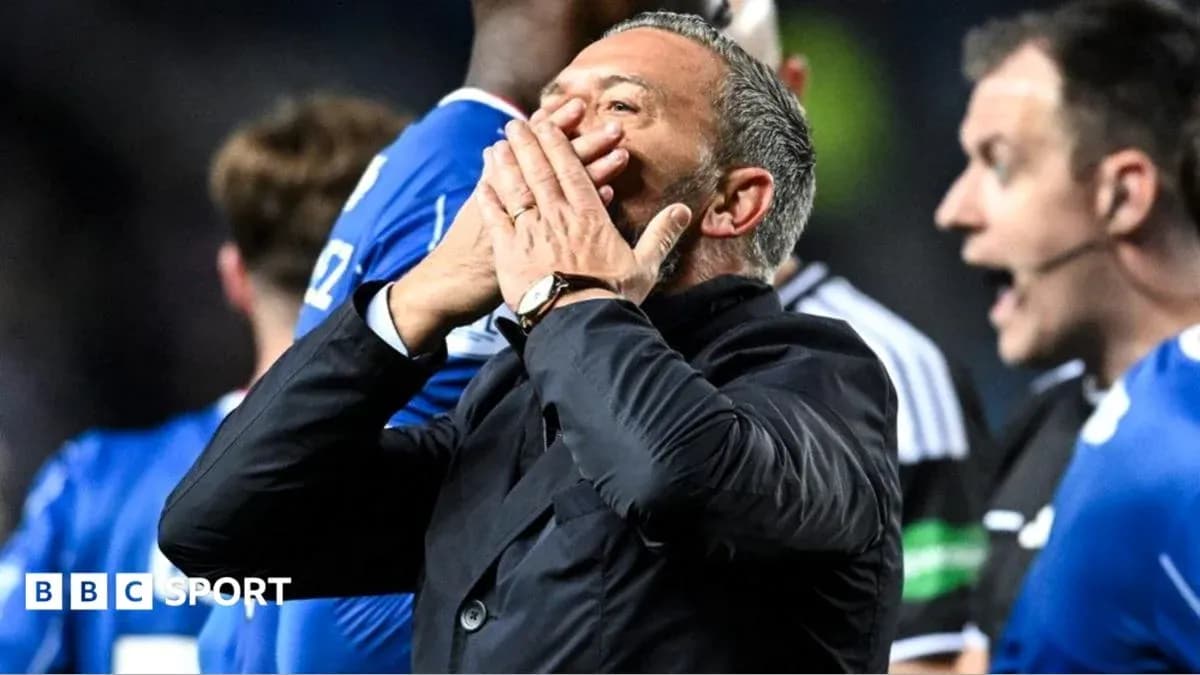
The celebrations at full-time – players roaring, staff embracing, fans staying to soak it in – raised eyebrows in some corners. McInnes was having none of that.
“Last-minute winners are great for players, coaches and fans,” he said. “We’d rather not be in that position, but credit to the players for keeping going.
“There are obviously loads we have to improve on, but we have to meanwhile keep winning and we have to keep improving if we are to achieve anything this season.”
The manager’s attacking options have been shredded. Long-term injuries to Youssef Chermiti and summer signing Lawrence Shankland have stripped away his first-choice strike pairing. The news that Japanese winger Daisuke Yokota now needs groin surgery, only weeks after arriving, twists the knife.
Into that vacuum has stepped Miovski, a player who had slipped all the way to fifth-choice and looked, not long ago, like a man heading for the exit.
“It just shows you what football is like and how quickly it can change,” Halliday said. “It looked like he was out of the picture two or three weeks ago and it looked like he was going to be on his way in the transfer window, but he’s come up with a massive goal.”
Halliday still does not expect the forward to start against Celtic, but he accepts the landscape has shifted. “He’s certainly more in the picture after a goal like that.”
McInnes has so far leaned on Ryan Naderi and Kevin Kelsy, the big-money summer arrival from Portland Timbers. Miovski has been the man on the fringes, waiting.
“It is just typical of football that a few weeks ago Bojan would have seemed so far out of it,” McInnes said. “But, when you actually strip it back, his goals per minutes in the Premiership is up there with Lawrence Shankland.
“So I was delighted when I inherited someone like Bojan who knows his way about the Scottish Premiership and is a goalscorer and, played in the right manner and with the right partner, is capable of scoring goals.”
A fragile platform before Celtic
So where does that leave Rangers as Celtic loom twice in eight days?
On paper, in decent shape: winning games, defending solidly, hauling themselves away from the early-season wobble. On the pitch, less so: relying on late drama, short on fit forwards, and still searching for fluency over 90 minutes.
The roar that greeted Miovski’s strike was about more than a goal. It was about staying in the title conversation, keeping belief alive and buying a little time for a team still finding itself.
Now comes the real test: can that four-minute rescue act be a turning point, or will it prove to be just a stay of execution against the champions who are already setting the pace?