.svg&w=384&q=75 "Naijagoal logo")

PSG Triumphs in UEFA Champions League Final: A Deep Dive into Audience Engagement
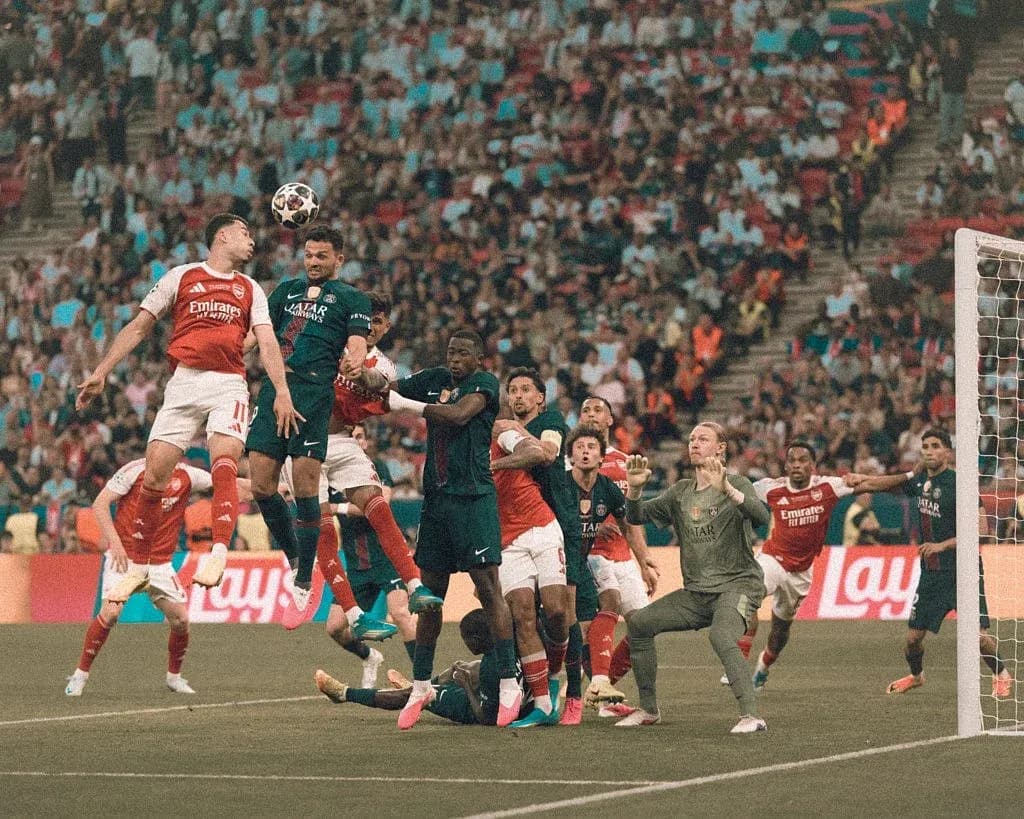
On a warm night in Budapest, PSG kept their hands on the UEFA Champions League trophy. Arsenal pushed them to penalties, dragged them through a 1-1 draw at Puskás Aréna, then watched the holders edge a 4-3 shootout. On the pitch, it was high drama. Off it, the numbers told a different kind of story – one about how football is watched, how brands are seen, and how a losing team can still win the commercial battle.
A final watched in secret – and at scale
Across four key markets – the UK, France, Hungary and the United States – the final drew a combined audience of 33.7 million. That headline figure looks healthy. The real shock lies underneath.
In the UK alone, an estimated 16.2 million people watched via illegal streams. Not just a sizeable slice of the pie – the biggest single audience source of the entire night. Those unofficial viewers outnumbered the 12.9 million who tuned in through all official platforms across all four markets combined.
The game wasn’t free-to-air in the UK. Millions simply refused to accept missing the biggest club match in Europe and went looking for other routes. They found them.
The UK delivered the largest total audience at 19.4 million. Of that, 16.2 million watched illegally, 3.0 million came through TNT Sports and HBO Max, and 0.2 million were estimated to have watched out of home. France followed with 9.5 million viewers across M6 and Canal+. The US, where interest in football has been buoyed by a World Cup-tinted summer, added 4.8 million through CBS, Univision and Paramount+.
Then there were the fans who wanted more than a sofa and a screen. YouGov Profiles data suggests just under 500,000 Arsenal and PSG supporters packed into bars and pubs across London and Paris. Another 61,035 filled Puskás Aréna itself. One match, three cities, a global audience – and a clear reminder that the traditional broadcast model is under heavier pressure than ever.
Arsenal lose the cup, Emirates win the camera
On the scoreboard, Arsenal fell short. On the broadcast, their sponsor didn’t.
YouGov Sport’s Brand Exposure analysis shows Emirates – emblazoned across Arsenal’s shirts – enjoyed 2 hours, 52 minutes of on-screen exposure and a Brand Impact Score (BIS) of 3.54. PSG’s front-of-shirt sponsor, Qatar Airways, registered 1 hour, 54 minutes with a BIS of 3.25.
That gap is not a quirk. It reflects where the camera lingered when the game caught fire.
Arsenal’s players appeared more often in key sequences: attacks built from deep, desperate defensive interventions, close-ups of reactions, replays of near-misses. Each cutaway, each slow-motion replay, each shot of a player doubled over in exhaustion carried the Emirates logo with it.
Emirates also edged Qatar Airways head-to-head on the finer details. A higher BIS for Emirates (3.54 vs 3.22) came from slightly larger logo size, stronger screen prominence, more frequent solus branding and less surrounding clutter from competing sponsors. Longer average exposure per appearance only deepened the impact.
For anyone signing off multi-million shirt deals, that matters. Arsenal’s defeat did not stop Emirates from extracting greater value from the night. A losing performance, if it is dramatic enough and central enough to the story, can deliver more commercial return than the trophy lift.
Forty-two billion impressions from one match
The final didn’t stop when the last penalty hit the net. It simply moved platforms.
Across the 48 hours spanning 30–31 May, the Champions League showpiece generated more than 40,500 social media posts, 13,700 videos and 24,500 online articles. The result: 42 billion potential impressions, 1 billion video views and 10 billion in potential readership.
PSG, champions on the pitch, also dominated the digital noise. The club’s official social channels alone produced 8.6 billion impressions and 418.6 million video views. Arsenal’s official accounts delivered 3.7 billion impressions and 49.7 million video views.
Output volume told in the end. PSG simply pushed out more content, more often, and reaped a much broader reach. The victory parade extended into timelines and newsfeeds worldwide.
When fans love the club, they lift the sponsor
The night’s impact ran deeper than logos and views. It touched what fans actually think of the brands on their shirts.
Using YouGov BrandIndex, Recommendation levels for Emirates among Arsenal supporters in the UK and Qatar Airways among PSG supporters in France were compared with their respective general populations. In both cases, club fans were significantly more likely to recommend the sponsor than the broader public.
The bond between club and sponsor, often dismissed as corporate wallpaper, showed real weight.
Around the time of the final, Emirates recorded an increase in Recommendation among Arsenal supporters. Qatar Airways, by contrast, maintained consistently strong Recommendation levels among PSG fans throughout the measured period. The Arsenal uplift cannot be pinned solely on 90 minutes and a shootout – multiple factors shape brand perception – but the timing underlines how a single, emotionally charged event can move the needle.
Through YouGov Sport’s BIS‑X framework, those shifts in sentiment are treated as part of the sponsorship value story. Exposure on screen is one thing; how warmly fans feel about the brand is another. When both rise together, the partnership’s impact multiplies.
For Emirates, the combination was powerful: more visibility during the final and a stronger push in fan advocacy. The airline didn’t just appear more often. It resonated more deeply.
Beyond counting eyeballs
This final laid bare a simple truth: counting who watched is no longer enough.
Audience totals, logo minutes, social impressions – each metric explains only one slice of sponsorship performance. When they are stitched together with brand health and fan sentiment, a fuller picture emerges: who watched, how they watched, what they saw, and how they felt about the brands woven into the spectacle.
In a media landscape fractured by paywalls, illegal streams and endless scrolling, that kind of clarity is no luxury. It is the difference between a sponsorship that merely shows up and one that truly lands.
Budapest crowned PSG as champions of Europe again. The data crowned something else: a future in which the real winners are the clubs and brands that understand every layer of the audience they just thrilled.