.svg&w=384&q=75 "Naijagoal logo")
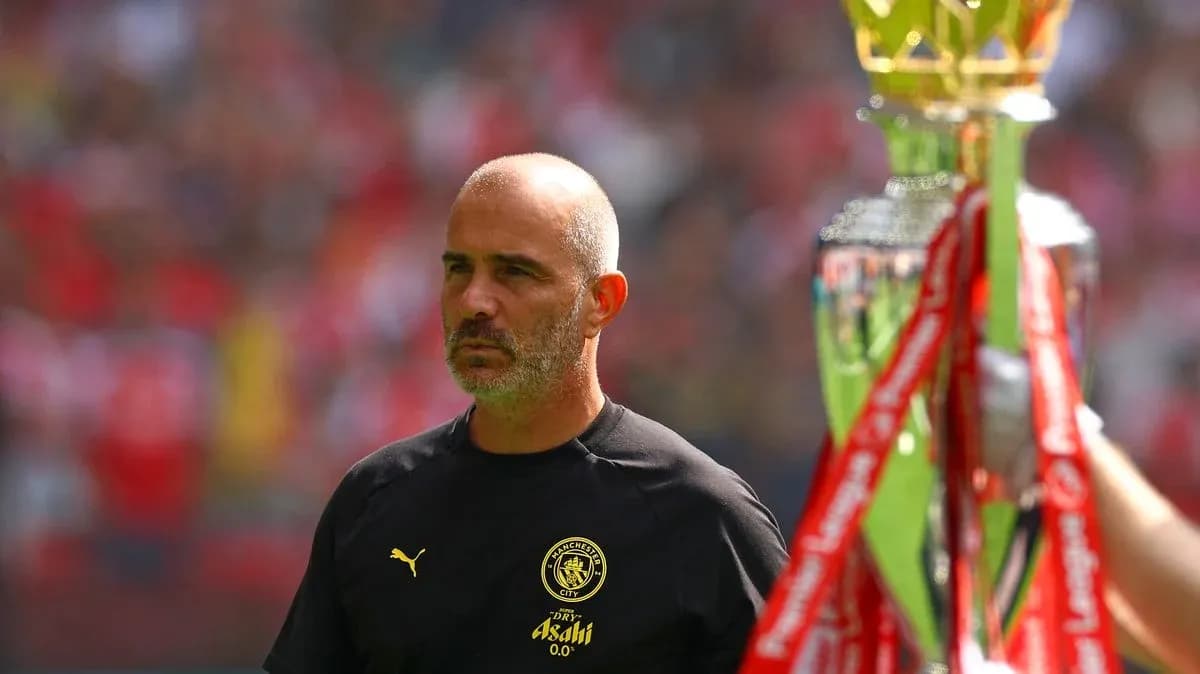

Maresca’s Manchester City Faces First Major Test Against Arsenal
For three weeks, Enzo Maresca’s Manchester City had looked like a neatly sketched blueprint coming to life. Patterns were clear, roles defined, the Asia tour offering reassuring evidence that life after Pep Guardiola could still be ordered and precise.
Then Arsenal happened.
At Wembley, City looked nothing like the carefully drilled side of pre-season. They were disjointed, oddly configured, and, at times, alarmingly easy to play through. For a club used to being greater than the sum of its parts, this was the opposite: big names on the pitch, little cohesion on the grass.
Yes, Arsenal are a level above the opposition City faced in July. That matters. But this felt like more than just a step up in quality. It felt like a manager veering away from his own early principles.
Starters thrown in cold
The first jolt came with the team sheet. Erling Haaland, Elliot Anderson, Nico O’Reilly and Jeremy Doku all started, despite only just returning from their holidays. It looked like a manager desperate to win a trophy in his first outing under the English spotlight.
There were fresher, more integrated players available. Maresca chose the ones who’d barely trained.
Afterwards, he pushed back on the idea that this was a gamble for the sake of silverware. For him, it was conditioning.
The best way to get them ready for Bournemouth and the early Premier League fixtures, he argued, was to start them, give them a proper warm-up, then take them off around the hour mark rather than throw them into an unfamiliar role as impact substitutes. The plan, he said, was premeditated: start, then withdraw. The Community Shield as a fitness tool, not a must-win.
On paper, it makes sense. On the pitch, it left City looking like a team still stuck in pre-season mode while Arsenal played as if the campaign had already started.
Anderson marooned, Kovacic exposed
Nowhere did the disconnect show more clearly than in Anderson’s role. Only days earlier, Maresca had been explicit: the former Nottingham Forest man is a No.6 or a No.8. That’s where he’s at home. That’s where he’ll be used.
At Wembley, he was shunted to the right in a loose, floating position that suited neither him nor the structure behind him. Anderson had the odd bright moment – two sharp deliveries into the box for Haaland and Doku hinted at his attacking range – but he never looked settled.
His redeployment had a knock-on effect. With Anderson wide and roaming, Mateo Kovacic was left as the lone holding midfielder, and Arsenal swarmed all over him. The Croatian is tidy and brave, but isolated as the single pivot he spent long spells firefighting rather than dictating.
The surprise wasn’t that City struggled. It was that Maresca had spent weeks laying out a clear positional framework, only to rip it up for his first serious examination.
Right-back rethink bites
The selection at right-back jarred as well. Matheus Nunes has effectively been anointed as first-choice there, to the point that City have cooled plans to bring in direct competition during this window. Yet he did not start.
Instead, Abdukodir Khusanov endured a difficult afternoon, part of a back line that never looked entirely comfortable. Against a slick, confident Arsenal, the uncertainty showed.
Taken together, those two calls – Anderson out of position and Nunes on the sidelines – made City’s task considerably harder. They also cut against the grain of what Maresca has been preaching since he walked through the door: clarity, structure, repetition.
The logical conclusion? This is unlikely to be the template. Anderson in his natural role and Nunes reinforcing the defence should make City look far more like the side Maresca has been trying to build.
Grealish returns to the shop window
If Anderson on the right and Khusanov at full-back were tactical surprises, Jack Grealish’s appearance was a different kind of twist.
The £100m winger spent last season on loan at Everton. He missed the summer tour. City have been open to moving him on before the window closes. On that basis, his introduction for the second half felt unexpected.
Those minutes might arguably have been more useful for someone like Rayan Ait-Nouri, who needs rhythm and understanding within this system. Instead, Grealish got the stage – and used it well enough to remind everyone he’s still a serious player.
For City, that cameo serves a dual purpose: match fitness for a high-earning asset, and a timely reminder to any interested clubs that he can still influence games at the top level. If a deal is to be done, Wembley will not have harmed the chances.
Flunked test, or part of a longer game?
As a first major examination, this was a fail. City were second best, the tactical plan misfired, and Maresca walked away with more questions than answers about how quickly his ideas can take hold – and whether they will be sharp enough to sustain a Premier League and Champions League challenge.
Yet some of the decisions were so at odds with his earlier work that they hint at something else: a manager treating the Community Shield as a live laboratory rather than a defining statement.
That approach carries a cost. Defeat to Arsenal, and the manner of it, has triggered swift, loud judgments about Maresca’s City and what they might become without Guardiola’s guiding hand.
The truth is, 90 minutes in August rarely tell the whole story. The real verdict will come when Bournemouth arrive and the league campaign begins to bite. Is this the start of a slow unravelling, or just an awkward, experimental prelude to a more coherent era?