.svg&w=384&q=75 "Naijagoal logo")
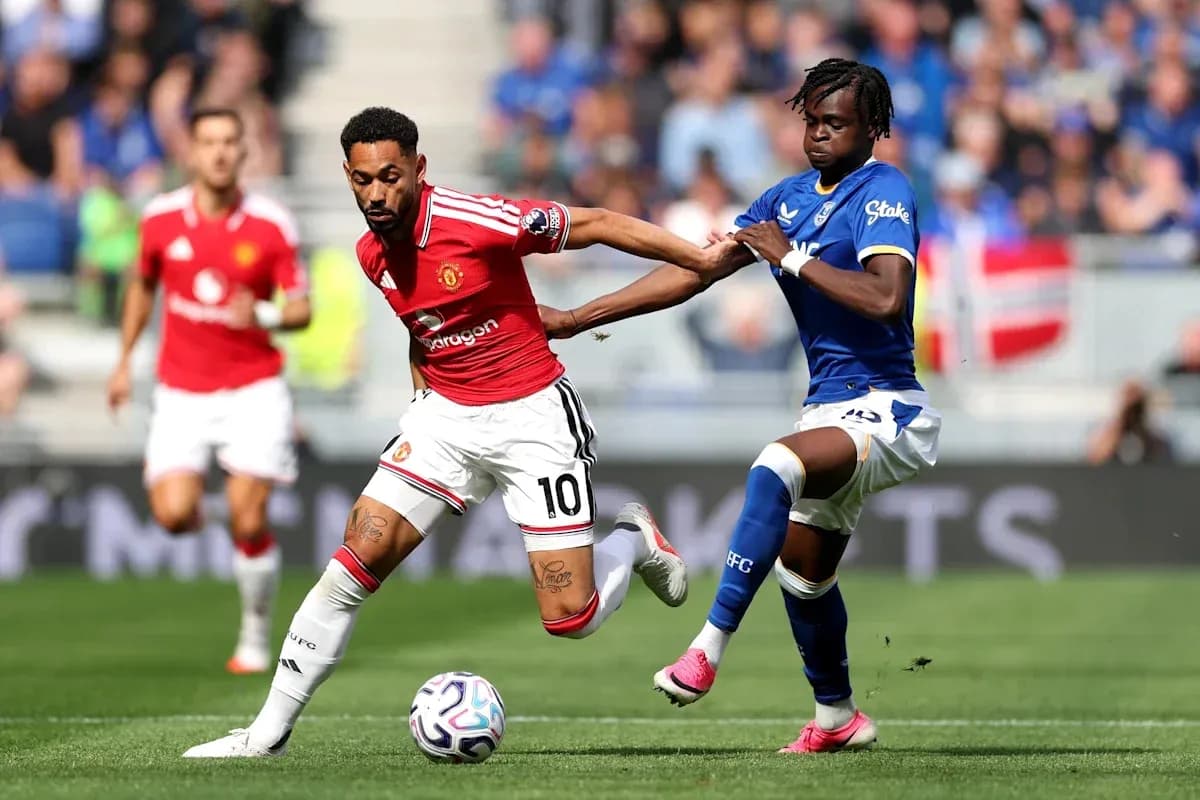

Manchester United's Defensive Woes Lead to 2-2 Draw at Everton
Manchester United did almost everything at Goodison Park. Except finish the job.
They built attacks, twice went in front, and for long stretches looked the sharper, more inventive side. Yet when the game demanded composure – in the box, on the ball, and in their own area – United blinked. Again.
Attacking ideas, missing edge
Going forward, the structure worked. United’s three creative forwards stitched together some slick moves and repeatedly dragged Everton out of shape. They found pockets, they slipped passes, they created angles.
What they didn’t consistently find was a real penalty-box presence.
Too often, promising sequences fizzled out because no one attacked the right space at the right time. Crosses flashed through the six-yard box with no final touch. Cut-backs begged for a striker to arrive half a second earlier.
Benjamin Sesko’s late header – a towering finish that looked like the 88th-minute winner – hinted at what this side lacks when he isn’t fully fit. His return to something close to sharpness offers one obvious solution. Bryan Mbeumo stepping back into a central striker role is another. Both options at least promise the kind of penalty-area movement this team cries out for.
Out wide, the absence of Amad on the right is starting to bite. The alternatives don’t convince. Shea Lacey has talent but not yet the experience for this level of responsibility. Matheus Cunha on the right wing doesn’t seem to be part of the plan either, leaving that flank short of a natural, reliable outlet.
United still scored twice – both times from restarts, both times showing cleverness and intent. But for all the nice patterns, there was never the sense that Everton were being suffocated. United threatened. They didn’t ruthlessly punish.
And when you don’t kill games, you leave the door open.
A back line that can’t shut the door
For the third game running, United conceded twice. Hull City, Ipswich Town, Everton. Six goals shipped to three sides that hardly strike fear into Europe. That’s not a blip. That’s a problem.
This time, it came against an Everton team that has laboured in attack. United still found a way to let them back in. Twice.
Luke Shaw actually produced his best performance of the season at left back. He overlapped Marcus Rashford with purpose, delivered dangerous crosses – including the one Sesko buried late on – and chipped in with important blocks. Yet his afternoon still carried a costly lapse.
On 83 minutes, with United 1-0 up and seemingly managing the game, Shaw drifted too far inside. Tyrique George, left with room to operate, punished the mistake with a vicious strike into the near-post top corner. Arne Lammens got a hand to it and might feel he should have done better, but the shot still tore past him.
That wasn’t an isolated error. Harry Maguire, Lisandro Martinez and Diogo Dalot all struggled. As a unit, they allowed Everton far too many looks.
Maguire was inches away from gifting a goal when Thierno Barry rose unmarked in the 42nd minute, only to head over from a position he should have scored from. Dalot, under no real pressure in first-half stoppage time, cleared the ball straight to Jarrad Branthwaite, who fired tamely at Lammens. Later, a mishit Dalot cross in midfield sparked a scramble, leaving Shaw and Martinez chasing Brennan Johnson before they just about forced the ball over the bar.
The pattern repeated after the break. United led 1-0 for much of the second half but retreated. They sat deep, surrendered possession and allowed Everton to build wave after wave of pressure. Instead of hunting the ball, they waited for trouble.
It arrived. Twice, from distance, and both times with United slow to react.
After George’s equaliser, Michael Carrick turned to his bench, sending on Noussair Mazraoui at left back and Leny Yoro on the right. The changes didn’t stabilise anything. They made it worse.
In the 90th minute, Mazraoui lost George again, allowing him another crack at the near post. Lammens saved and the flag went up for offside, but the warning was clear. United didn’t heed it.
Five minutes into stoppage time, with United clinging to a 2-1 lead, Hayden Hackney drifted past Yoro too easily down the right. His cut-back found Kiernan Dewsbury-Hall, Mazraoui’s attempted clearance fell straight to Ainsley Maitland-Niles, and the Everton man unleashed a stunning, Puskás-level strike into the top corner.
From 2-1 up in the 88th minute to 2-2 in the 95th. Another lead gone. Another defensive collapse laid bare.
Fullbacks exposed, questions mounting
The theme is becoming impossible to ignore. United’s back four doesn’t look stable, and the fullback positions sit at the heart of it.
Shaw still has quality on the ball and in his delivery, but the recovery speed that once masked positional slips has faded. When United push numbers forward, he can be caught in no-man’s-land. Dalot faces similar issues on the opposite flank. When both fullbacks advance, the centre-backs are left covering huge areas, vulnerable to direct balls into the channels and quick counters.
Better sides will see this and target it relentlessly. Hit United wide. Turn the fullbacks. Drag the centre-backs into foot races they don’t want.
Carrick’s substitutions at fullback against Everton didn’t work, but the deeper question lingers: would leaving Shaw and Dalot on have changed the outcome, or simply delayed the inevitable? The structure, not just the names, looks fragile.
Matthijs de Ligt is edging closer to his first appearance since November 2025, a significant boost on paper. His presence should add leadership and aerial dominance. Yet even that raises another question: how much difference can one centre-back make if the system in front and around him still leaves the back line exposed?
Ayden Heaven’s name will start to come up more often. If the current options keep leaking chances, Carrick may have little choice but to test the youngster in meaningful minutes.
Because right now, it hardly seems to matter who plays. United concede.
A lopsided rebuild
There are positives. The midfield looks more modern, more secure on the ball. The attack, with the right combinations, can carve teams open. United can score, and they will score this season.
But the squad feels lopsided. The summer’s energy went into reshaping the middle of the pitch. The back line, especially the fullbacks, never received the same level of attention. The imbalance shows every week.
Unless Carrick finds a tactical fix – a tweak in the line, a different pressing scheme, extra protection from midfield – United risk becoming that most frustrating of teams: entertaining, free-scoring, and constantly undermined by their own defending.
The Champions League looms this week. Against Europe’s elite, the margins shrink and the punishment grows harsher. If Everton can drag two goals out of this back line, what happens when the stakes rise and the opponents are ruthless?