.svg&w=384&q=75 "Naijagoal logo")
Mallorca vs Villarreal: A Tactical Analysis of the 1-1 Draw
Under the midday sun at Estadi Mallorca Son Moix, Mallorca and Villarreal shared a 1-1 draw that said very different things about each side’s season. Following this result, the table snapshot still has Mallorca sitting 15th with 39 points, while Villarreal remain in 3rd on 69 points, their Champions League push intact but not accelerated.
The game followed the script of their seasonal DNA. Mallorca, whose overall goal difference of -9 comes from scoring 43 and conceding 52, leaned into what has kept them afloat: strong home form and a willingness to suffer. At home this campaign they have taken 8 wins and 6 draws from 18 matches, scoring 28 and conceding 21; a home profile of 1.6 goals for and 1.2 against per game that is far healthier than their away self.
Villarreal arrived as one of La Liga’s most balanced heavyweights. Overall they have 65 goals for and 40 against, a goal difference of +25 that underpins 21 wins from 35 matches. On their travels they have been solid rather than dominant: 7 away wins, 5 draws and 6 defeats, with 24 goals scored and 25 conceded, an away average of 1.3 goals for and 1.4 against. That slight defensive softening away from home framed the story of the afternoon: a high-powered attack meeting a rugged home specialist.
Tactical Voids – absences that bent the shapes
Mallorca’s team sheet carried scars. A whole layer of defensive and structural depth was missing: L. Bergstrom, M. Joseph, J. Kalumba, M. Kumbulla, A. Raillo and J. Salas were all ruled out through various injuries, while Pablo Maffeo sat suspended for yellow cards. That cluster of absences forced Martin Demichelis to lean on a 4-3-1-2 that put responsibility on those who remained fit.
Without Raillo’s leadership and Maffeo’s aggressive right flank, the back line of L. Roman behind M. Morey Bauza, M. Valjent, O. Mascarell and J. Mojica had to be both conservative and brave. Mascarell’s deployment as a defender underlined the shortage of centre-backs, while the midfield trio of Samu Costa, S. Darder and M. Morlanes had to screen more space than usual.
Villarreal had their own notable absence: J. Foyth, out with an Achilles tendon injury. Marcelino still kept faith with his season-long 4-4-2 template, trusting S. Mourino and R. Marin at centre-back, flanked by R. Veiga and S. Cardona. In midfield, T. Buchanan and A. Gonzalez stretched the width, with S. Comesana and T. Partey forming a double pivot, and A. Perez partnering T. Oluwaseyi up front.
Disciplinary trends from the season added another layer of tension. Mallorca’s yellow-card profile spikes between 46-60 minutes at 22.08%, then again late with 15.58% in both 76-90 and 91-105. Villarreal are even more combustible late: 25.00% of their yellows arrive between 76-90, and they have red cards clustered at 31-45 (33.33%) and especially 76-90 (66.67%). It was the kind of matchup where the final quarter of an hour was always likely to feel like a tightrope.
Key Matchups – Hunter vs Shield, and the engine room
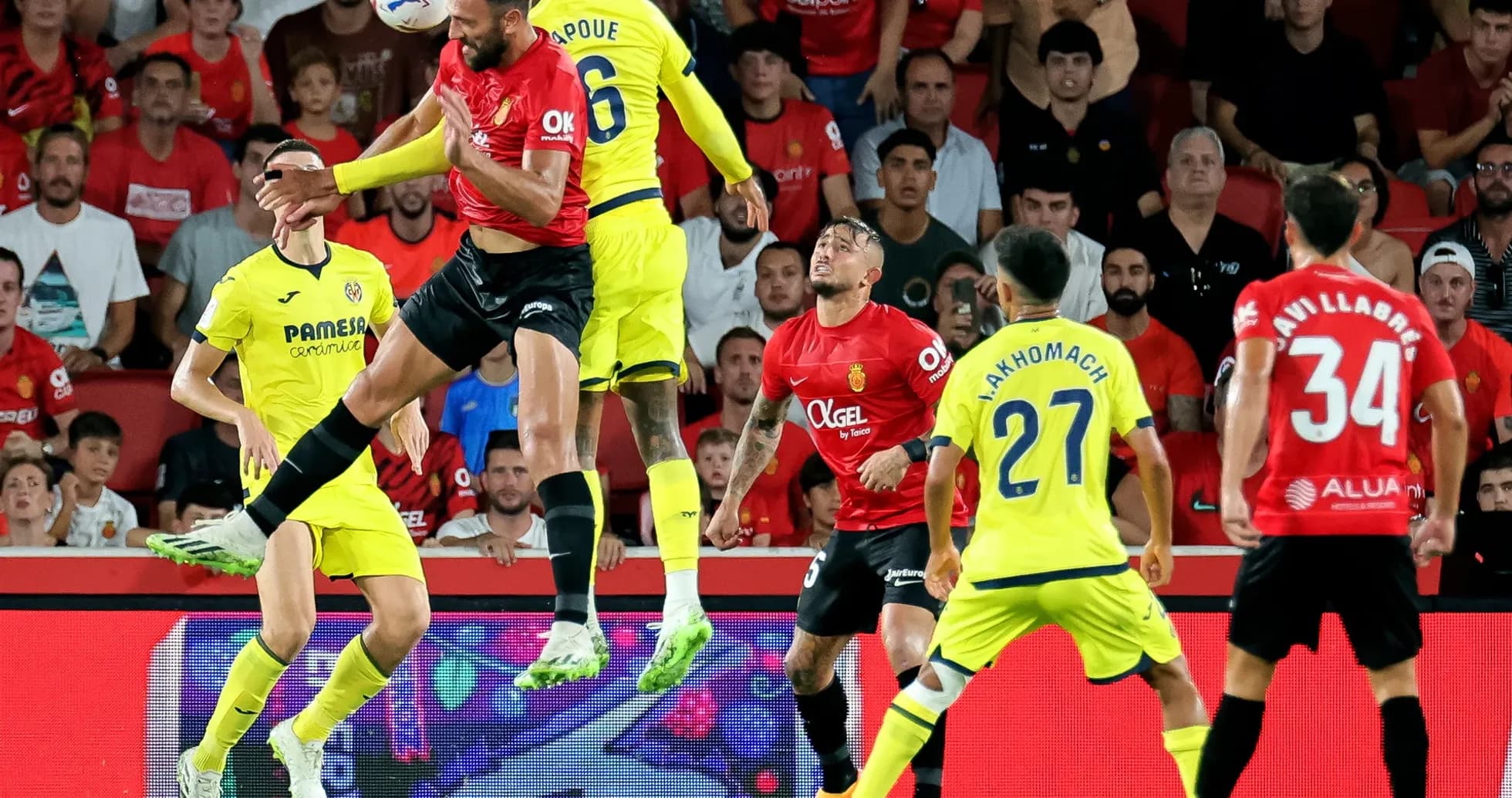
Hunter vs Shield began with one name: V. Muriqi. Heading into this game, he had been one of La Liga’s most ruthless finishers with 22 league goals and 1 assist from 34 appearances. His profile is that of a relentless focal point: 85 shots, 47 on target, 416 duels contested and 214 won. He is a penalty threat too, with 5 scored but 2 missed – a reminder that Mallorca’s spot-kick edge is not flawless, even if as a team they have converted all 5 penalties this league season.
Muriqi’s battle was primarily with S. Mourino and R. Marin. Mourino, one of the league’s leading card-magnets with 9 yellows and 1 yellow-red, is an aggressive defender: 98 tackles, 9 blocked shots, 28 interceptions and 179 duels won from 319. His willingness to step in front of the striker and to engage physically was Villarreal’s main “Shield” against Mallorca’s “Hunter”. Every aerial ball into Muriqi became a test of timing and temperament, especially with Mourino’s disciplinary line so fine.
Behind Muriqi, P. Torre operated as the link in the 4-3-1-2, trying to exploit the half-spaces around S. Comesana and T. Partey. Comesana is the metronome-enforcer hybrid in Villarreal’s engine room: 1,169 passes at 82% accuracy, 45 tackles, 15 blocked shots and 30 interceptions. He also arrives late in the box, with 3 goals and 6 assists. His duel with Samu Costa shaped the midfield’s temperature.
Samu Costa, one of the league’s top yellow-card collectors with 10 bookings, is Mallorca’s heartbeat and battering ram in equal measure. Across the season he has 7 goals and 2 assists, 62 tackles, 13 blocked shots and 25 interceptions, plus 400 duels contested and 207 won. He draws 66 fouls but commits 61, living on the edge of control. His task was to disrupt Comesana’s rhythm without gifting Villarreal dangerous set-pieces.
On the Villarreal side of the attacking ledger, the bench told its own story. G. Mikautadze, with 11 goals and 5 assists, and Alberto Moleiro, with 10 goals and 4 assists, waited as impact options, alongside N. Pépé, one of La Liga’s leading creators with 6 assists and 8 goals. The fact that Villarreal could introduce that level of firepower from the sidelines underlined the structural gap between 3rd and 15th, even if the scoreline ended level.
Statistical Prognosis – xG logic and defensive steel
Even without explicit xG values, the season data sketches the expected pattern this draw roughly followed. Villarreal, averaging 1.9 goals overall and 1.3 on their travels, are built to generate sustained chances. Mallorca at home average 1.6 goals for and 1.2 against, suggesting that a 1-1 or 2-1 type game sits in the statistical sweet spot.
Defensively, Villarreal’s overall average of 1.1 goals conceded per match, compared to Mallorca’s 1.5, implies that over a long run of fixtures the visitors would typically edge both xG for and xG against. Yet Mallorca’s home resilience – only 21 goals conceded in 18 home games – narrows that gap significantly when the islanders play in Palma.
Layer in discipline, and the late-game picture becomes clear. Mallorca’s yellow surge between 46-60 minutes and Villarreal’s heavy card load between 61-90 suggest that the match was always likely to grow more broken and transitional after the break, lowering the quality of chances but increasing the volume of chaotic moments. In that environment, a side with a dominant target man like Muriqi and a bruising ball-winner like Samu Costa can drag the contest into their preferred territory.
Following this result, the numbers still say Villarreal are the superior long-term proposition. Their +25 goal difference, their 14 home wins and their deep bench of creators like Pépé, Mikautadze and Moleiro are Champions League credentials. But at Son Moix, Mallorca’s home identity – compact, combative, and built around Muriqi’s gravity – proved enough to bend the statistical prognosis into a stalemate that feels like a small victory for the side in 15th, and a missed opportunity for the team in 3rd.