.svg&w=384&q=75 "Naijagoal logo")

Liverpool Ownership Shake-Up: Bezos and Bhatia Join Forces
Liverpool are on the brink of one of the most eye-catching ownership shake-ups in modern football – and this time the money is coming from the very top of the global rich list.
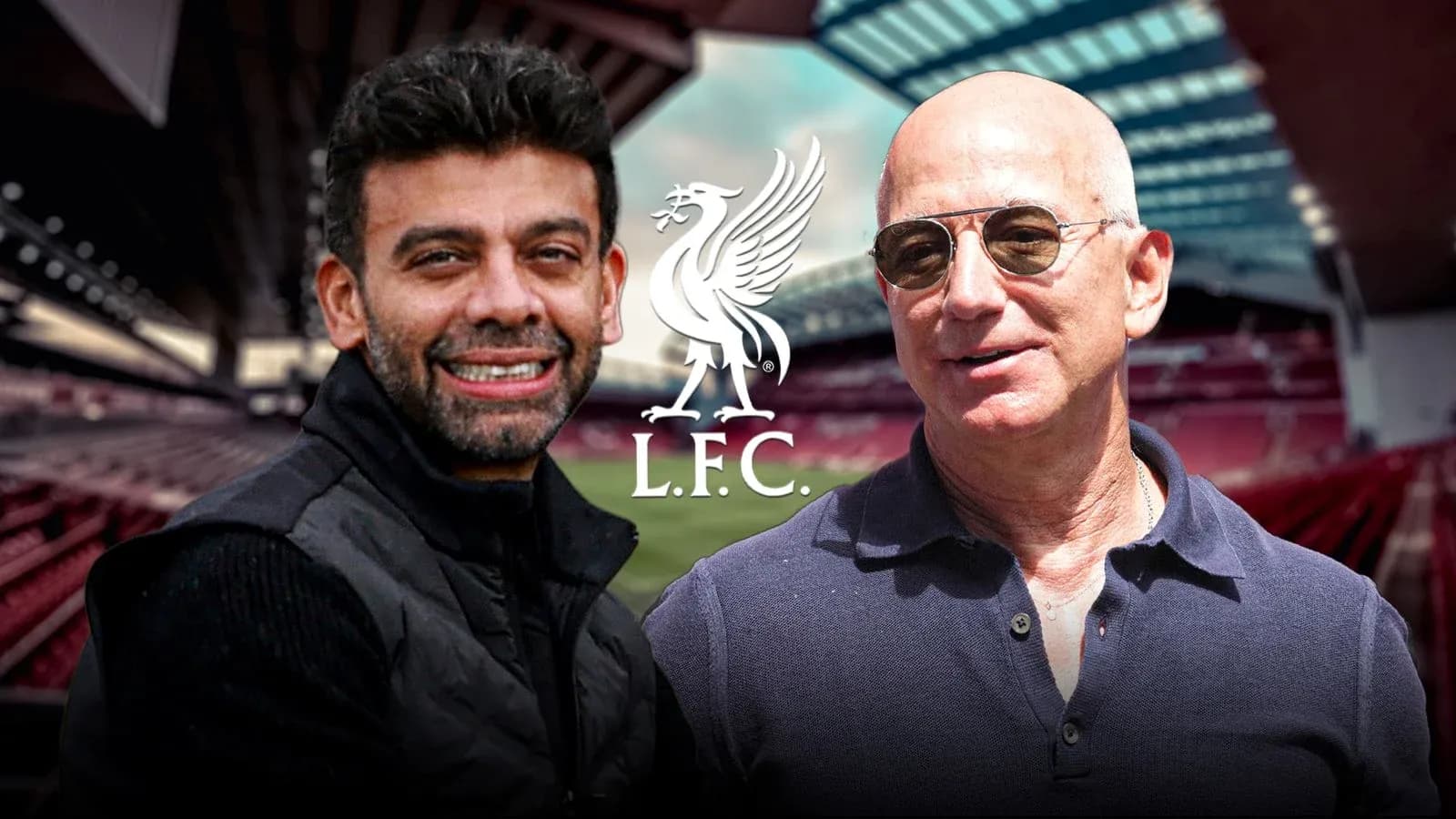
Fenway Sports Group (FSG) are set to sell a significant minority stake in the club to a heavyweight consortium fronted by former QPR co-owner Amit Bhatia and featuring Amazon founder Jeff Bezos and Facebook co-founder Eduardo Saverin, according to Sky News. The group is closing in on roughly a one-third share of Liverpool, in a deal that would value the club at around £4.4bn ($6bn).
For a club once saved from the brink for £300m, this is a different universe.
Bezos, Bhatia and a new kind of power at Anfield
Jeff Bezos needs little introduction. The Amazon founder, whose personal fortune Forbes pegs at around $281bn (£209bn), is the third-richest person on the planet. He built Amazon from a garage in Seattle in 1994 into the defining e-commerce giant of the age, then pushed into space with Blue Origin and media with Nash Holdings, the vehicle that owns The Washington Post.
He has long been linked with American Football franchises, including reported interest in the Washington Commanders and Seattle Seahawks, but he has never taken a major stake in a sports team.
That is about to change.
Alongside him stands Amit Bhatia, a different kind of power broker. The 46-year-old British Indian entrepreneur cut his teeth in investment banking and now runs AyBe Capital, a multi-asset investment firm with interests stretching across technology, media, property and real estate, consumer retail and health.
Bhatia’s family connections are formidable. He is married to Vanisha Mittal Bhatia, daughter of steel magnate Lakshmi Mittal, whose estimated £23.2bn fortune makes him one of the world’s richest men. Earlier this year, Mittal acquired a 75 per cent stake in IPL side Rajasthan Royals, extending the family’s reach into elite cricket.
Bhatia himself is no stranger to football’s boardrooms. At just 28, he joined QPR’s board and became vice-chairman in 2007 after the Mittal family bought a 20 per cent stake, joining Bernie Ecclestone and Flavio Briatore at Loftus Road. He later served as QPR chairman from 2018 to 2023, remaining as a director and co-owner until this week, when he transferred his shareholding to majority owner Ruben Gnanalingam.
His sporting portfolio does not stop there. Through AyBe Capital, Bhatia has invested in TGL, the tech-infused golf league fronted by Rory McIlroy and Tiger Woods, and in Switch Hitter, Kevin Pietersen’s media brand delivering exclusive cricket content.
This is the man now fronting a move into Anfield.
A £4.4bn valuation and a changing financial map
The numbers are stark.
FSG, then known as New England Sports Ventures, paid £300m for Liverpool in October 2010 after a chaotic spell under Tom Hicks and George Gillett. The club they acquired was drifting. The one they are now partially selling is the fourth most valuable football institution on the planet.
The incoming consortium’s proposed deal values Liverpool at around £4.4bn ($6bn). That figure would place this transaction among the richest in football history, even if it stops short of a full takeover.
For FSG, the profit is eye-watering. Even with only a percentage stake on the table, they stand to crystallise an enormous return while retaining overall control.
This is not a fire sale. It is a calculated cash-in at the top of the market.
Why FSG are opening the door
FSG have never hidden the fact that they were open to fresh investment. In 2022 they signalled a willingness to bring in new money, and a year later they sold a small stake to Dynasty Equity, who injected £164m in a deal valuing the club at more than $4.5bn.
Liverpool’s resurgence under their stewardship is undeniable. Premier League, Champions League, Club World Cup, FA Cup, Carabao Cup, UEFA Super Cup – every major trophy has found its way back to Anfield in the FSG era.
You could argue the mission, as they saw it, has largely been accomplished: restore Liverpool to the elite, modernise the club, rebuild the stadium and training ground, and turn a distressed asset into a global powerhouse.
Now, with valuations soaring and competition for talent intensifying, FSG appear ready to let in new capital without surrendering the keys.
Who actually owns Liverpool now?
FSG remain the controlling owners of Liverpool, but the cap table has grown more crowded over the past few years.
RedBird Capital and Arctos Sports Partners already hold minority stakes. Dynasty Equity sit in the background as passive investors after their 2023 injection.
The Bezos–Bhatia–Saverin consortium would be the most high-profile addition yet, but it would not dislodge FSG from the top of the pyramid. This is a reshaping of the shareholder base, not a revolution in the boardroom.
At least not yet.
Saverin returns to the Premier League stage
Eduardo Saverin, 44, is no stranger to English football’s top table either. The Facebook co-founder was part of a consortium that assembled a bid for Chelsea during the 2022 auction triggered by sanctions on Roman Abramovich after Russia’s invasion of Ukraine. That attempt fell short.
Now he is back, this time aligned with Bezos and Bhatia in a move that, if completed, will give him a foothold at Anfield instead of Stamford Bridge.
The identities of the other investors in the syndicate remain under wraps for now. Given the scale of the numbers involved, they are unlikely to be small players.
When will it happen?
There is no fixed deadline on the deal, but the process has accelerated quickly since first being reported at the end of last month. An announcement could come as early as this week, though talks might stretch into next week.
The momentum is clear. The structure is clear. The exact timing is not.
What is certain is the direction of travel: Liverpool, once a symbol of English football’s working-class roots, is about to welcome some of the most powerful capital on earth into its ownership structure.
The question now is not whether Anfield will feel the impact of that wealth, but how quickly – and how far – it will change the way Liverpool compete in a game increasingly ruled by billionaires and sovereign funds.