.svg&w=384&q=75 "Naijagoal logo")

Liverpool's Clinical Edge Over Ipswich in Premier League Clash
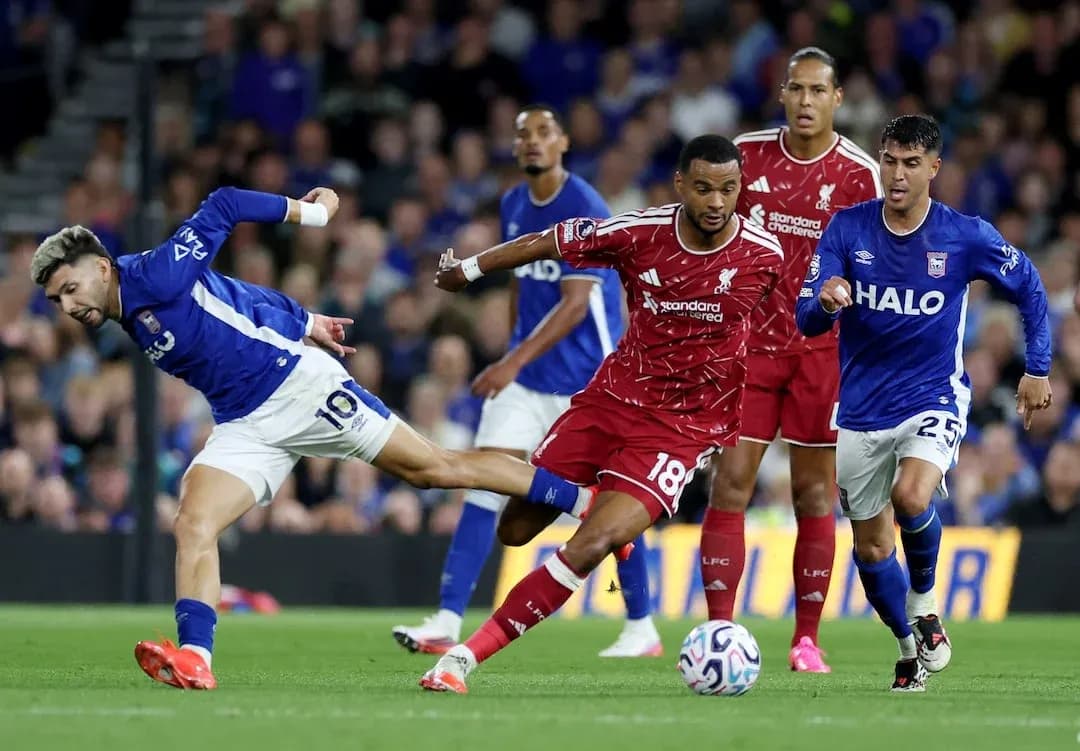
Portman Road under the Friday night lights has rarely felt this starkly divided. On one side, a newly returned Ipswich side learning Premier League reality at speed; on the other, a Liverpool team under Andoni Iraola already humming with structure and menace. The 2–0 away win, sealed by a ruthless first-half display, crystallised the early-season trajectories suggested by the numbers.
Heading into this game, Ipswich were 14th with 3 points from 3 matches, their overall goal difference at -4, born of 4 goals scored and 8 conceded. At home they had been competitive but fragile: 2 home matches, 1 win and 1 defeat, 2 goals for and 3 against. Liverpool arrived in Suffolk in a very different mood: 6th with 5 points from 3 matches, unbeaten overall with 1 win and 2 draws, scoring 6 and conceding 4 for a positive goal difference of 2. On their travels they had already shown steel, with 1 win and 1 draw away, 4 goals scored and just 2 conceded.
Both managers doubled down on a 4-2-3-1, but the shapes told very different stories. Gary O’Neil’s Ipswich used K. Scherpen behind a back four of D. O’Shea, I. Diop, J. Greaves and L. Davis. In front, the double pivot of S. Lukić and E. Palacios was tasked with shielding and launching, while the line of three – A. Fatawu wide right, J. Enciso central, D. Maeda off the left – supported lone forward Emersonn.
Iraola mirrored the structure but not the intent. Alisson Becker was protected by a back line of R. Araújo, J. Jacquet, V. van Dijk and M. Kerkez, with D. Szoboszlai and A. Mac Allister as the controlling axis. Ahead of them, Víctor Muñoz and F. Wirtz flanked C. Gakpo, who floated between lines, while A. Isak led the line as the league’s in-form finisher.
The absentees shaped both benches and plans. Ipswich were without A. Matusiwa, J. Philogene and J. Taylor, stripping O’Neil of a ball-winning midfielder, a direct wide threat and additional depth. For a side that had already conceded 8 goals overall, losing Matusiwa’s defensive presence was particularly damaging against a Liverpool team that thrives between the lines. Liverpool’s list was longer – C. Bradley, F. Chiesa, H. Ekitike, J. Gomez and G. Leoni all missing – but their depth softened the blow. The back line was reconfigured, yet with Van Dijk marshalling and Kerkez and Araújo both comfortable in duels, the structure held.
The disciplinary profiles of these sides hinted at the tone. Ipswich’s yellow cards this season have clustered heavily just before the break: 75.00% of their bookings have come between 31–45 minutes, with another 25.00% from 46–60. That mid-game stress window, where concentration and legs waver, was always likely to be probed by Liverpool’s surges. Liverpool’s yellows are more evenly spread but spike after half-time: 40.00% of their bookings have arrived between 46–60 minutes, with 20.00% in the opening 15 and another 20.00% late from 76–90. It paints a picture of a side that plays on the edge in their pressing triggers, especially just after the restart.
The “Hunter vs Shield” duel was always going to centre on A. Isak. Heading into this fixture, he had 3 goals in 3 appearances, from 7 shots with 5 on target, underpinned by a 7.77 average rating. Ipswich, by contrast, had allowed 8 goals in 3 matches overall, with a particularly alarming 5 conceded on their travels and 3 at home. Their overall average of 2.7 goals conceded per game, and 1.5 at home, suggested that a clinical striker would find opportunities.
Isak’s movement, drifting off the shoulder of Diop and Greaves, repeatedly dragged Ipswich’s line into uncomfortable territory. With no dedicated destroyer like Matusiwa in front of them, Lukić and Palacios were often pulled sideways by Szoboszlai and Mac Allister, leaving the central lane for Wirtz and Gakpo to feed their number nine. It was a textbook case of Liverpool’s offensive peak overlapping with Ipswich’s defensive void.
In the “Engine Room” duel, C. Gakpo and J. Enciso represented contrasting creative hubs. Gakpo arrived as the league’s leading provider, with 3 assists and 1 goal from 3 appearances, 8 key passes and an 84% pass accuracy. Enciso, for Ipswich, had quietly become their main conduit: 2 assists in 3 games, 83 passes at 87% accuracy, and 4 key passes, while also contributing 2 tackles, 2 blocks and 3 interceptions. Yet where Gakpo operated in a high-functioning structure with Szoboszlai and Mac Allister recycling relentlessly, Enciso often found himself isolated, receiving between Liverpool’s lines with few progressive options as Ipswich struggled to play through the press.
Out wide, A. Fatawu’s duel with Kerkez was a bruising subplot. Fatawu had 1 assist this season, 7 successful dribbles from 15 attempts and 44 total duels with 21 won – evidence of a winger who relishes confrontation. But he was up against one of the league’s more combative full-backs. Kerkez, who had already collected 2 yellow cards and appeared in both the yellow and red card leaderboards, brought aggression and timing: 6 tackles, 3 blocked shots and 2 interceptions heading into this match. His willingness to step high and foul if needed helped stifle Ipswich’s most direct outlet, even at the risk of another booking.
Statistically, the broader patterns always leaned red. Ipswich’s overall scoring rate of 1.3 goals per game, boosted by a 2.0 average on their travels, had not been matched at home, where they managed just 1.0 goal per match and had already failed to score once. Liverpool, by contrast, were steady and repeatable: 2.0 goals per game overall, 2.0 at home and 2.0 away, with only 1.3 goals conceded on average and just 1.0 away. They had already kept one clean sheet on their travels and had converted their only penalty of the campaign, underlining both composure and efficiency in key moments.
Following this result, the narrative hardens rather than shifts. Ipswich remain a side whose 4-2-3-1 is brave but under-protected, particularly without key midfield screeners, and whose disciplinary spikes around half-time hint at stress under sustained pressure. Liverpool look every inch a structured, high-ceiling contender: a settled shape, a prolific spearhead in Isak, and a creative hub in Gakpo that consistently turns territory into chances.
On the balance of squad profiles, tactical matchups and seasonal numbers, a controlled Liverpool win always felt the likeliest outcome. The 2–0 scoreline at Portman Road simply put a clinical edge on what the data had already been whispering.