.svg&w=384&q=75 "Naijagoal logo")

Nottingham Forest vs Tottenham: A Tactical Stalemate
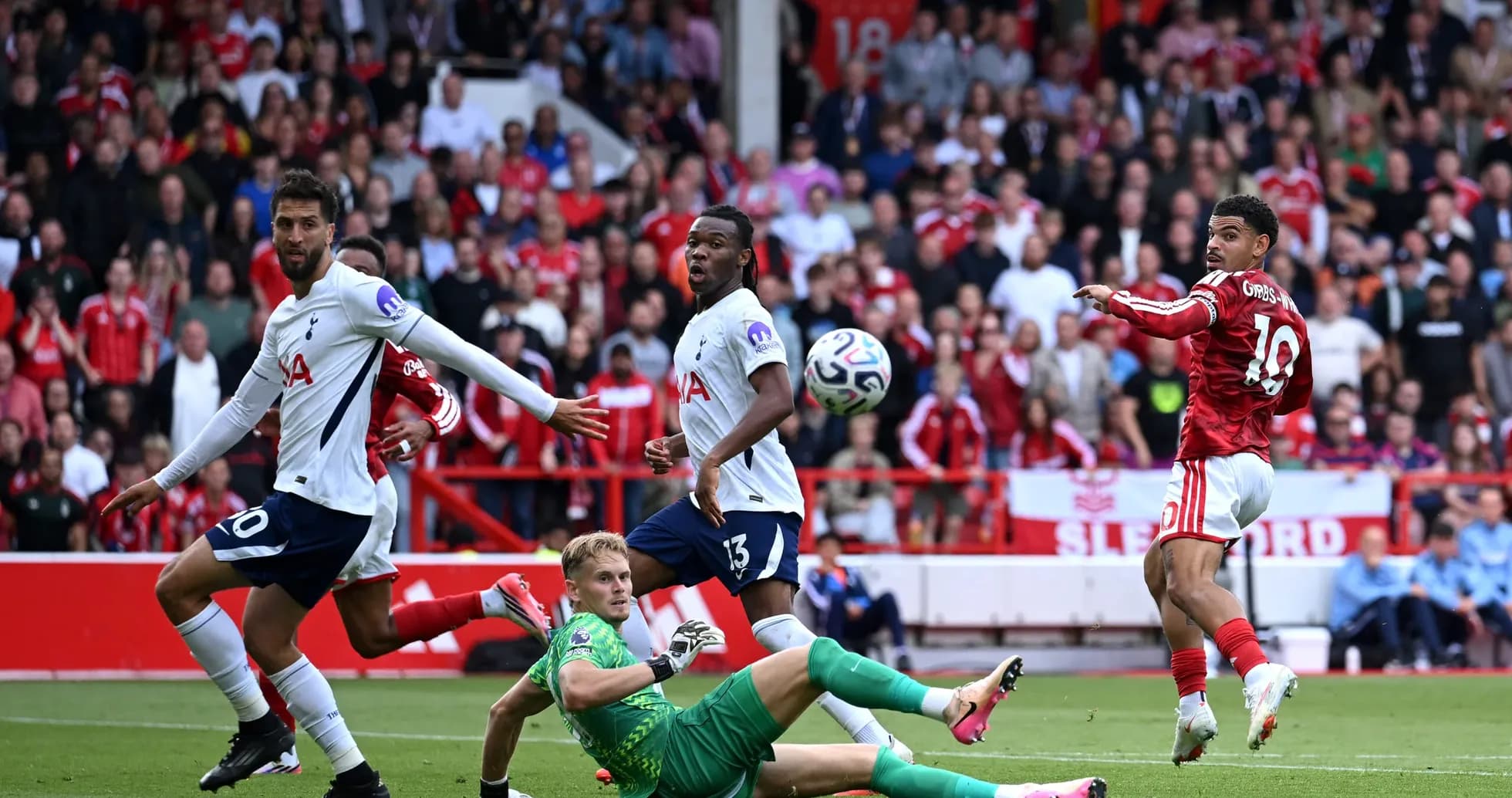
The City Ground under grey September skies, Nottingham Forest and Tottenham walking out level in anxiety as much as in points. This was Round 3 of the Premier League season, a meeting between a Forest side trying to grow into Oliver Glasner’s structure and a Tottenham team under Roberto De Zerbi still searching for their first league goal. It finished 0–0, and yet the goalless scoreline only hints at the tactical story beneath it.
I. The Big Picture – Two teams searching for identity
Heading into this game, Forest sat 16th with 2 points from 3 matches. Overall they had scored 2 and conceded 3, giving them a goal difference of -1, with a clear split in their attacking output: 0 goals at home, 2 on their travels. Their defensive record was quietly solid at the City Ground – 1 goal conceded in 2 home games – but the attack had yet to ignite in front of their own fans.
Tottenham arrived in even more fragile shape. They were 18th with just 1 point from 3 games, and a goal difference of -5 (0 scored, 5 conceded overall). At home they had lost 2–0; away they had taken a solitary point but still failed to score, conceding 3 across two away fixtures. De Zerbi’s side carried the ball-playing structure, but not yet the cutting edge.
On paper, it was a clash of Forest’s emerging 3-4-2-1 against Tottenham’s familiar 4-2-3-1. In practice, it became a test of which new project could impose its rhythm without losing defensive control.
Forest’s 3-4-2-1: the layered press
Glasner stayed loyal to the three-at-the-back system that has defined Forest’s early season. Matz Sels anchored the side behind a back three of Jair, Nikola Milenković and Murillo. Ahead of them, the wing-backs Ola Aina and Neco Williams flanked a double pivot of Xaver Schlager and James McAtee, with Dan Ndoye and Morgan Gibbs-White supporting lone striker Liam Delap.
The structure is designed to compress the middle third. Schlager and McAtee can step out to press Tottenham’s double pivot, while Gibbs-White and Ndoye lock onto the Spurs full-backs and centre-backs in the first phase. Delap, as the central reference, works the channels and contests long clearances when Forest are forced deeper.
Forest’s season numbers underline the logic. Overall they had averaged 0.7 goals for per game, but that is split starkly: 0.0 at home versus 2.0 away. The City Ground Forest is more cautious, more compact. Defensively, they had conceded 1.0 goals per game overall, but only 0.5 at home – evidence that the back three plus double pivot are doing their job in front of their own crowd.
The card data adds another layer to Forest’s tactical identity. Their yellow cards have been concentrated in the 46–60 minute window (50.00% of their cautions), with additional spikes in the 16–30, 31–45 and 76–90 ranges (each 16.67%). That profile suggests a side that ramps up aggression straight after half-time and again in the closing stages, when pressing and counter-pressing intensity is highest.
Within that, two individuals shape the squad’s competitive edge. Gibbs-White, already on 1 goal and 1 assist in the league, is the creative hub. In 3 appearances and 270 minutes, he has taken 7 shots (2 on target), played 81 passes with 82% accuracy, and contributed 4 tackles, 1 block and 1 interception. He is not just a No.10; he is the first presser and a key ball-winner in the second line.
Behind him, Aina brings controlled aggression. Across 3 games and 219 minutes, he has 7 tackles and 2 interceptions, and has committed 4 fouls while drawing 3. He has already collected 2 yellow cards, underlining his role as Forest’s primary disruptor on the flank. In Glasner’s system, his willingness to step high to meet Tottenham’s wide players is essential, but it also walks a disciplinary tightrope.
Tottenham’s 4-2-3-1: possession without punch
Tottenham’s shape was familiar but their personnel told a story of absence. With Dejan Kulusevski (knee injury), James Maddison (knock), Wilson Odobert (knee injury) and Xavi Simons (knee injury) all missing this fixture, De Zerbi had to rewire his attacking structure. A. Kinský started in goal behind a back four of Pedro Porro, Jan Paul van Hecke, Micky van de Ven and Destiny Udogie. Sandro Tonali and Rodrigo Bentancur formed the double pivot, with Sávio, Conor Gallagher and Mathys Tel supporting Omar Marmoush up top.
The system still aims to build patiently, with Tonali and Bentancur orchestrating from deep and the full-backs stepping high. But the season data is stark: heading into this game, Tottenham had 0 goals for across 3 matches, both at home and on their travels. Their overall attacking average was 0.0 goals per game. Defensively, they had conceded 1.7 goals per game overall, split as 2.0 at home and 1.5 away.
The injuries to Maddison and Kulusevski strip Spurs of two primary zone-14 creators. In their absence, Gallagher’s energy and Sávio’s dribbling become the main tools for breaking lines, but neither offers Maddison’s passing range or Kulusevski’s half-space gravity. That forces more responsibility onto the full-backs and pivots to progress play.
Discipline-wise, Tottenham’s yellow cards are evenly spread: 25.00% in each of the 0–15, 31–45, 46–60 and 76–90 windows. They start aggressively, maintain it through both halves, and finish with the same edge. Udogie and Mateus Fernandes exemplify that balance: each has 1 yellow card in 3 appearances, combining strong duelling numbers (Udogie with 14 duels, 7 won; Fernandes with 13 duels, 6 won) with a readiness to commit tactical fouls (3 and 5 fouls committed respectively).
II. Tactical voids – the weight of absences
The most glaring voids were in Tottenham’s attacking midfield. Without Maddison, Kulusevski, Odobert and Simons, De Zerbi lost variety between the lines: no elite set-piece delivery from Maddison, no left-footed infield threat from Kulusevski, no direct dribbler like Odobert, no all-round dynamism from Simons. That forced Spurs to lean on Gallagher as a high-running connector and on Tel and Sávio to provide penetration from wide and half-spaces.
Forest’s only listed absentee, N. Savona (knee injury), did not alter the core structure. Glasner could field his preferred back three, his first-choice wing-backs and his main creative axis in Gibbs-White. The continuity of selection helped Forest maintain their defensive cohesion, especially at home where they had already kept 1 clean sheet from 2 matches and conceded just 1 goal.
III. Key matchups – Hunter vs Shield, Engine Room battles
Hunter vs Shield: Gibbs-White vs Tottenham’s back four and double pivot. With Tottenham yet to concede fewer than 1 goal per game on average overall, their defensive numbers (5 conceded in 3) suggested vulnerability, especially when the midfield line is bypassed quickly. Gibbs-White’s 8 dribble attempts with 4 successes and his 1 key pass this season highlight his ability to destabilise that block.
Forest’s “shield” was the trio of Milenković, Murillo and Jair against Marmoush and the rotating trio behind him. Tottenham’s complete lack of goals, both home and away, meant any defensive lapse could be decisive. The Forest back three, supported by Schlager’s screening, were tasked with turning Tottenham’s sterile possession into harmless circulation.
In the engine room, Schlager and McAtee against Tonali and Bentancur was the tactical hinge. Tottenham needed their double pivot to dictate tempo and find Sávio and Tel between lines; Forest needed their pair to break those rhythms and spring transitions. With Forest’s yellows heavily clustered straight after half-time, that 46–60 minute zone was always likely to be the period when the midfield battle became most ferocious.
IV. Statistical prognosis and tactical verdict
On the numbers, this fixture always leaned low-scoring. Forest had failed to score in both home games so far, and Tottenham had failed to score in all three of their league matches. Forest’s home defensive average of 0.5 goals conceded per game met a Tottenham attack averaging 0.0 goals overall. Conversely, Tottenham’s away defensive average of 1.5 goals conceded per game was up against a Forest attack that had been productive only on their travels.
Forest’s single penalty this season was converted, with 1 taken and 1 scored and no misses, so there was no penalty fragility to exploit. Tottenham, with no penalties taken or missed, offered no data in that phase either.
In pure statistical terms, the most likely pattern was exactly what unfolded: a tight, controlled game where Forest’s structure and home defensive record blunted a Tottenham side stripped of its primary creators, and where both managers prioritised stability over risk. The City Ground saw no goals, but it did see two evolving projects reveal their current ceilings: Forest as a disciplined, if blunt, collective; Tottenham as a possession side still searching for a cutting edge and waiting for their missing artists to return.