.svg&w=384&q=75 "Naijagoal logo")

Jude Bellingham Reflects on Heartbreaking World Cup Semi-Final Loss
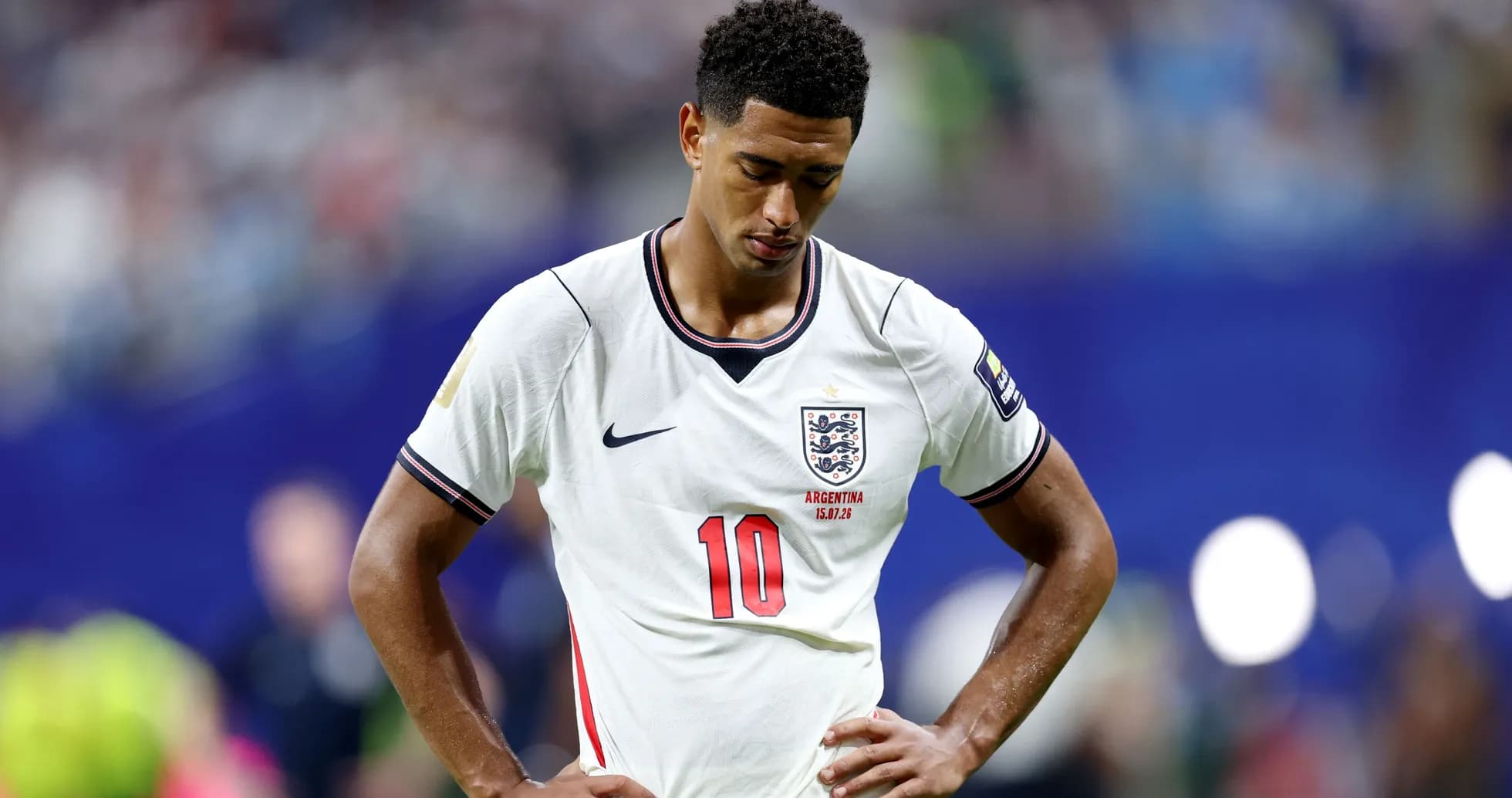
Jude Bellingham stood in front of the cameras with red eyes and a broken voice, trying to explain the kind of defeat that never really makes sense. Argentina had turned England over at the death, 2-1, ripping away a first World Cup final since 1966 in the final breaths of a semi-final that will sting for years.
For Bellingham, it felt like the moment everything came crashing in at once. A draining, uneven season with Real Madrid. The agony of losing the Euro 2024 final. Now this – another near-miss on the biggest stage, another summer of what-ifs for a player who had dragged England forward all tournament.
Seven goal contributions. A stunning brace against Norway in the quarter-final. He had played like a man determined to bend the narrative of English football to his will. But under the lights, after Argentina’s late winner, he looked like any other 23-year-old trying to make sense of heartbreak.
“I think we can take a lot of experience from this, but it is so gutting,” he admitted, his words heavy rather than rehearsed. “I wanted to be a part of an England squad that finally done it and got it over the line. To be here, telling the fans the same things they've heard for years, it's really gutting.”
He paused, searching for something to offer a nation that has heard every post-tournament promise in the book.
“I wish I could give one more win or two more wins, but at the moment, my head is a bit fuzzy with disappointment, so I'm sorry.”
No slogans. No spin. Just a player who had given everything and still come up short.
Tuchel’s gamble backfires
On the touchline, Thomas Tuchel wore the defeat differently. Where Bellingham showed raw emotion, the England manager showed responsibility.
England had led through Anthony Gordon, their early advantage feeding into the sense that this might finally be the year. They had Argentina at arm’s length, the game under a degree of control. Then came the switch.
Tuchel moved his side into a back five, a decision designed to close the spaces but which instead opened the door. England retreated. Argentina surged.
“We decided to go to a back five because the gaps were far too open,” Tuchel explained afterwards. Argentina, he said, “played with more risk, played with more rhythm and played with the feeling maybe that they had nothing to lose any more, which freed them up and pulled us back.”
The dynamic flipped. England, suddenly, were the ones gripped by fear.
“Because we obviously played suddenly with a feeling that we had a lot to lose,” Tuchel added. “Of course the responsibility is on the coach and if it doesn’t go well it’s easy to say it was wrong.”
The pressure finally told. Argentina sensed the anxiety, pushed higher, and England’s passive shape invited them on. By the time the winner went in, the outcome felt horribly inevitable.
Tuchel knew where the blame would land. On the substitutions. On the system change. On the sight of a team that had led a World Cup semi-final and then shrunk into itself.
Backed to stay, burdened to deliver
The inquest will be fierce, but Tuchel’s position, for now, is not. Inside the FA there is no appetite for upheaval. Chief executive Mark Bullingham has given his backing to the former Chelsea and Bayern Munich manager, and the plan remains clear: Tuchel will lead England into a home European Championship in 2028.
Tuchel, for his part, is not looking for the exit.
“We keep on going with the contract until the home Euros,” he said, making it plain he has no intention of stepping aside.
That continuity brings its own weight. This is not a project starting from scratch. It is a team that has been on the brink again and again, only to watch the trophy lifted by someone else. The expectation will not soften. The questions will not either.
A hollow final act
Before any grand rebuild, there is the small matter of Saturday: a third-place play-off against France. On paper, a chance to secure England’s best World Cup finish in 60 years. In reality, a game that will feel like a consolation prize no one really wants.
For Bellingham and his teammates, a bronze medal will not erase the image of Argentina celebrating or the sound of the final whistle cutting through their World Cup dream. It will not change the fact that, once again, England stood close enough to touch history and still walked away empty-handed.
The road now stretches towards 2028 and a home tournament that will define this generation. The scars from this night will travel with them. The question is whether they harden into something stronger, or simply become another chapter in a story England know far too well.