.svg&w=384&q=75 "Naijagoal logo")

Argentina's Tactical Control Over England in Semi-Final
England’s 1-2 defeat to Argentina at Mercedes-Benz Stadium was defined by a clash of structures and control: Thomas Tuchel’s 4-2-3-1 tried to compress and counter, while Lionel Scaloni’s 4-4-2 gradually strangled the game through possession, territory, and late, decisive changes. The statistics underline that this was an Argentina-controlled semi-final, with England briefly in command after the hour but ultimately overwhelmed by Argentina’s superior volume and quality of attacks.
Tuchel’s 4-2-3-1 was clearly designed for vertical efficiency rather than long spells on the ball. England finished with just 36% possession and 324 total passes, but a high 84% pass accuracy (272 accurate), showing that when they did have the ball, they largely avoided waste. The double pivot of Declan Rice and Elliot Anderson sat in front of a back four of Reece James, John Stones, Marc Guéhi and Djed Spence, protecting central spaces and inviting Argentina wide. Ahead of them, Morgan Rogers and Anthony Gordon flanked Jude Bellingham as the central creator behind Harry Kane.
The attacking pattern was straightforward: win the ball in mid-block, play quickly through Bellingham’s feet, then release Gordon and Rogers into the channels. England produced only 5 total shots, with 2 on goal and 2 inside the box, but those limited attacks were relatively clean, reflected in an expected goals value of 0.53. The key execution of this plan came on 55 minutes, when Gordon’s goal from a Rogers assist capped one of the rare sequences where England broke Argentina’s first line and attacked an unset defence.
Defensively, England’s structure held for long stretches. They conceded 15 shots (7 inside the box) but managed to block 2, with the back four staying narrow and forcing Argentina to combine around the edges. The foul count – 11 for England – suggests a disciplined rather than reckless approach, though Anderson’s first-half yellow card for “Foul” at 37' underlined the physical cost of repeatedly stepping in to break Argentina’s rhythm. Out of possession, the front four often dropped into a 4-4-1-1, with Bellingham screening passes into Lionel Messi and Rice tracking runners from deep.
In goal, J. Pickford (England) was central to keeping the game alive into the final minutes. He made 3 saves, and the goals prevented figure of 0.02 indicates that, while he did his job, Argentina’s best chances were eventually finished rather than spectacularly repelled. His work was mostly about dealing with accumulated pressure rather than isolated one-on-ones, as Argentina’s territorial dominance mounted.
Scaloni’s Argentina began in a 4-4-2 that morphed into a possession-heavy, flexible shape. With 64% of the ball and 590 total passes at an outstanding 91% accuracy (537 accurate), they controlled tempo and location. Leandro Paredes and Enzo Fernández anchored central midfield, with Alexis Mac Allister and Giuliano Simeone providing width and half-space occupation. Messi and Julián Álvarez formed the front pair, constantly rotating between dropping off and pinning the back line.
Argentina’s attacking metrics illustrate sustained pressure: 15 total shots, 5 on goal, 7 from inside the box, and 3 blocked. Their xG of 1.84 shows that the 2-1 scoreline was a fair reflection of chance quality. Early on, England’s compactness limited clean looks, but as the game wore on, Argentina’s circulation and patience wore down the block. Frequent switches from left-back Nicolás Tagliafico and right-back Nahuel Molina stretched England horizontally, creating the pockets Messi and Fernández needed between the lines.
The turning point was Scaloni’s aggressive substitution wave from 64' onwards. Nicolás González (IN) came on for Paredes (OUT) at 64', pushing Argentina into a more attacking posture. Then at 72', Gonzalo Montiel (IN) for Molina (OUT), Rodrigo De Paul (IN) for Simeone (OUT), and Nicolás Otamendi (IN) for Lisandro Martínez (OUT) collectively rebalanced the team: fresh legs in midfield, renewed energy in wide areas, and a more direct threat in the right channel. Finally, Lautaro Martínez (IN) for Tagliafico (OUT) at 81' tilted the structure into a front-loaded shape, with Messi now orchestrating behind multiple runners.
From that point, Argentina’s pressure became constant. England’s late changes – Ezri Konsa (IN) for Gordon (OUT) at 72', Dan Burn (IN) for James (OUT) and Nico O'Reilly (IN) for Rice (OUT) at 82', then Ivan Toney (IN) for Stones (OUT) and Marcus Rashford (IN) for Spence (OUT) at 90' – suggested a move first towards shoring up the flanks and then a last throw of attacking height. But those changes disrupted England’s earlier defensive cohesion without generating a proportional attacking threat.
E. Martínez (Argentina) had a comparatively quiet but efficient night, making 1 save. The goals prevented metric of 0.02 mirrors Pickford’s, indicating that most of England’s limited threat either missed the target or was of manageable quality. Argentina’s back line, reorganised with Otamendi introduced, coped well with crosses and late direct balls.
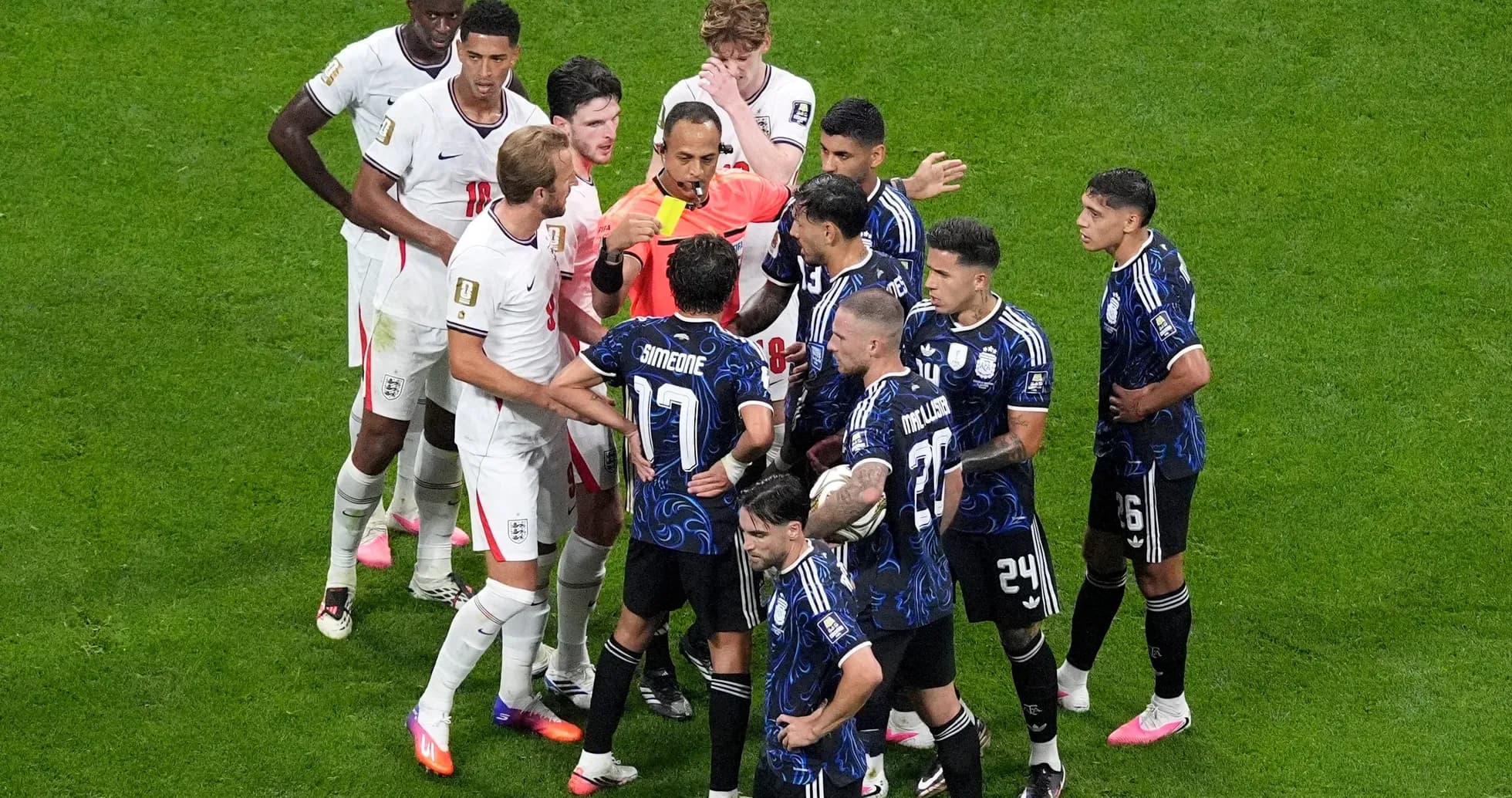
Discipline also tells a tactical story. Argentina committed 15 fouls and collected 3 yellow cards – Lisandro Martínez for “Foul” at 42', Cristian Romero for “Foul” at 51', and Rodrigo De Paul for “Argument” at 90+4' – reflecting an aggressive, front-foot defensive style, especially as they chased and then protected the lead. England’s single booking, Anderson’s “Foul”, highlights a more conservative foul profile but also hints at their reduced ability to disrupt Argentina’s rhythm once fatigue set in.
Statistically, Argentina’s dominance was comprehensive: more possession (64% to 36%), more total shots (15 to 5), more shots on goal (5 to 2), and a significantly higher xG (1.84 to 0.53). They also won the territorial battle through 6 corner kicks to England’s 1 and forced more offsides (3 to 1), indicating a higher defensive line and more sustained attacking presence.
England’s game plan was coherent but fragile: compact block, efficient passing, and selective counter-attacks. It worked long enough to produce a lead, but the numbers show they could not sustain attacking output or resist Argentina’s mounting volume. Argentina’s structural flexibility, bench impact, and technical control turned the semi-final decisively in their favour in the final minutes.