.svg&w=384&q=75 "Naijagoal logo")

Joachim Klement's World Cup Prediction Model: A Football Oracle
Paul the Octopus needed nothing more than a tank and a couple of mussel boxes to become a global sensation in 2010. Eight arms, eight correct calls, and he was crowned football’s first true oracle.
Fourteen years on, the game’s most reliable fortune-teller might just be a German economist with a spreadsheet.
The economist who can’t stop being right
Joachim Klement, a strategist at investment bank Panmure Liberum, has built a World Cup prediction model that has done what no pundit, supercomputer or sea creature has managed over time: it has nailed the winner three tournaments in a row.
- Germany in 2014.
- France in 2018.
- Argentina in 2022.
Three World Cups, three correct champions. A 100% hit rate since he first ran the numbers. Now his latest forecast points towards the Netherlands, who would become the fourth straight side to turn Klement’s theory into reality if they lift the trophy in July.
For someone who describes himself as a “pessimist” and never set out to make money or spare fans from heartbreak, the whole thing has become a slightly surreal burden.
“This started as an exercise in showing the world a hubris of economists who think they can forecast stuff that they actually have no clue about,” Klement said. “And now it's become an exercise in how, if you're lucky often enough, people will think you're a guru.”
The guru label is the last thing he wanted. But the model keeps winning.
A map of the whole tournament
Klement’s work does not stop at naming a champion. His model traces the shape of the entire 48-team tournament, spitting out a bracket that reads like a scriptwriter’s outline.
There is a shock early on: Japan to knock out Brazil in the second round. A heavyweight falling to a rising force from Asia, the kind of twist that usually lives in the realms of fantasy until it happens on a humid night in a neutral stadium.
Scotland, by contrast, are dealt a more familiar fate. The numbers say they will not escape the group stage, another campaign cut short before the real drama begins.
England, as ever, are dragged deep into the story. Klement’s projections have them reaching the semi-finals, only to run into an old scar. Portugal, the team that ended English hopes in 2006, are tipped to do it again, two decades on. The model does not specify how, or whether penalties will again haunt them, but the echo is hard to miss.
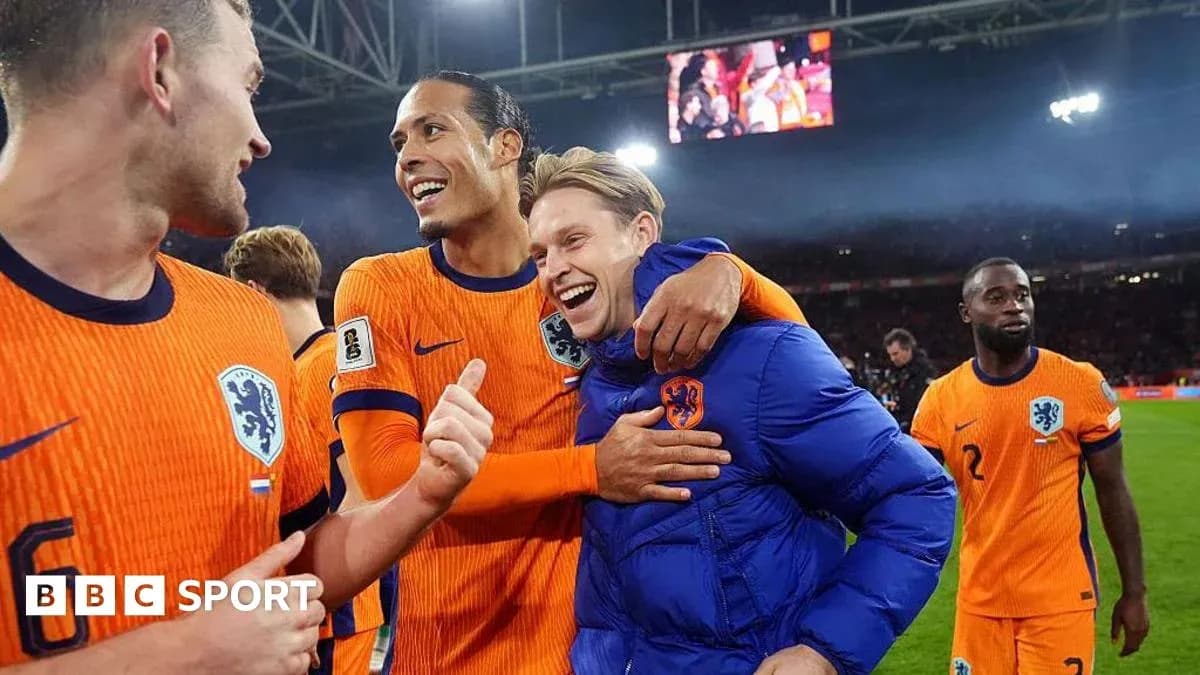
The Dutch, though, are the headline. For Klement’s streak to stay alive, the Netherlands must navigate the chaos and climb the steps in July with the trophy in their captain’s hands. If they do, the myth around the model hardens. If they fall, the spell breaks.
Science, systems… and sheer luck
Underneath the theatre, Klement’s work is rooted in what he calls “systemic” factors. Population size. National wealth. Climate. Fifa world rankings. The kind of macro variables that shape the strength of a football nation over years, not weeks.
Those elements matter. They tilt the odds. They help explain why certain countries live permanently in the latter stages while others punch above their weight just once a generation.
But Klement is the first to insist that his apparent omniscience is built on shaky ground.
“The other 50% is luck,” he says.
That luck lives in the tiny details that define knockout football. A striker’s touch on the day. A defender’s mistimed tackle. A referee’s angle on a sliding challenge. The thud of the ball against the post instead of the net.
“Every match – especially when you have these high-quality teams playing against each other that are very similar in skills and quality – it really depends on the form of the day, a ref call, a piece of luck in the sense of hitting the post versus the ball going in. Things like that are completely unpredictable.”
His forecast has become a quadrennial ritual, eagerly shared and dissected, its following growing with every correct call. Yet the man behind it keeps waving a warning flag: treat this as a curiosity, not a crystal ball.
A distraction in a turbulent world
For Klement, who has lived in the UK for a decade, the World Cup model is a side project, a mental escape from a world that feels permanently on edge.
Each cycle, as the tournament approaches, he steps away from the grind of markets and macro data and dives into football’s numbers instead. The 2026 edition, he says, will land in a particularly fraught moment.
“In particular in 2026, when there are so many crises, wars and things going on, it is something that makes me feel good and hopefully the readers feel good and gives them a little bit of a distraction from all the kind of bad stuff that is going on in the world.”
Football, in his hands, becomes a statistical daydream. A way to think about something joyful and unpredictable, even as he tries to quantify it.
Office bets and rising pressure
The more he gets right, the heavier the next prediction feels.
Inside his London office, colleagues now treat him as a kind of in-house oracle, peppering him with questions that would make most quants blink. What does an ACL injury to Dutch and Tottenham midfielder Xavi Simons do to the Netherlands’ chances? How does that tweak the probabilities? Does the model still like Oranje?
They are half-joking, half-serious. The bets are real.
“I've got several colleagues who bet some money on the Netherlands in response to me publishing that note,” he said.
So as the tournament edges closer and the Dutch are anointed by the numbers, Klement is bracing himself. If the Netherlands crash out early, the run ends, the mystique evaporates – and the Monday-morning mood at Panmure Liberum could be frosty.
“And if the Netherlands get eliminated from the World Cup, I think the next day I have to work from home.”
Three perfect calls have turned a modest thought experiment into a global curiosity. Now the question hangs over this summer: will the model stay flawless, or will football finally remind the economist that, in the end, the game doesn’t care about anyone’s forecast?