.svg&w=384&q=75 "Naijagoal logo")
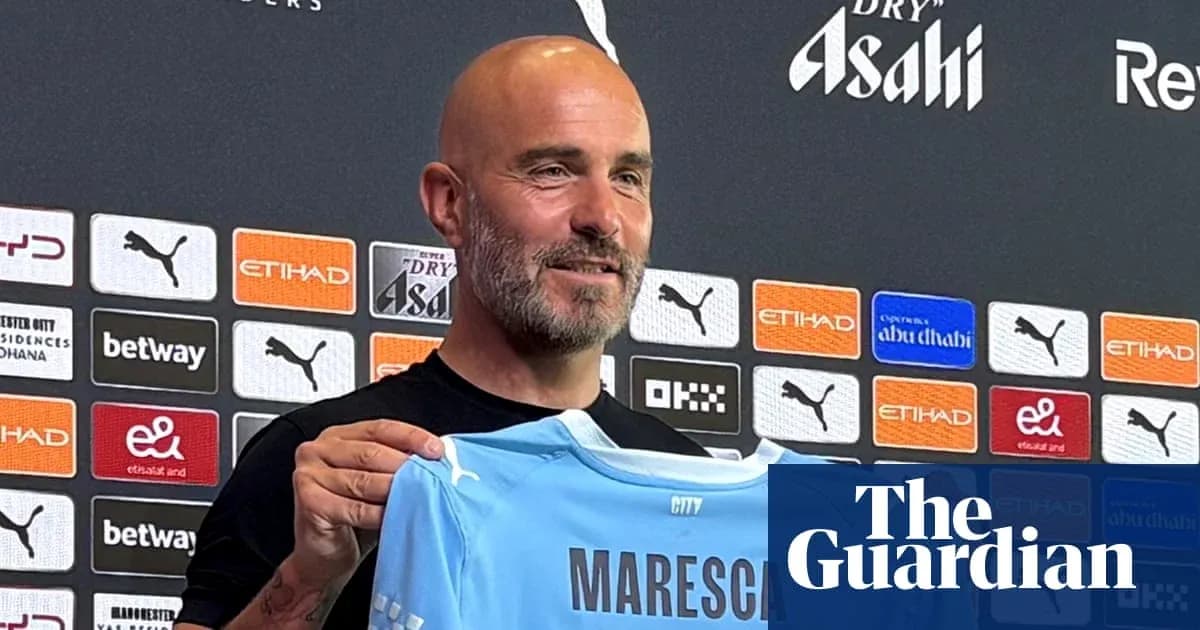

Enzo Maresca Embraces Challenge as Manchester City Head Coach
Enzo Maresca did not try to downplay the scale of what he has walked into. Sitting in front of the cameras for the first time as Manchester City head coach, he called following Pep Guardiola “a privilege” – and then immediately acknowledged the ghosts that hover over anyone who dares replace a dynasty.
He has seen this film before. Everyone has.
Living in the shadow of Pep
Maresca inherits a club shaped in Guardiola’s image over a decade of relentless winning: 17 major trophies, a defined style, a culture that now feels inseparable from the Catalan’s name. At City, Guardiola is not just the most successful manager in their history; he is the reference point for everything.
“Privilege” was Maresca’s word, and he meant it. The club chose him, an Italian coach whose ideas City know well from his previous spell on the staff and whose work elsewhere has marked him out as a purist. He has long called Guardiola “probably the best coach in the world in the last 20, 25 years”. Now he is the man asked to extend that legacy rather than be crushed by it.
The warning signs are everywhere. Maresca brought them up himself.
Ferguson, Wenger and the cautionary tales
When Sir Alex Ferguson stepped down in 2013 after 26 and a half years, Manchester United handed the keys to David Moyes. The decline was immediate and brutal. Arsenal’s long goodbye to Arsène Wenger ended in 2018, and Unai Emery walked into a club still emotionally and structurally tied to one man. Both successors struggled. Both became case studies in how hard it is to follow an era, not just a manager.
“It’s a challenge. It’s nice,” Maresca said, leaning into the reality rather than dodging it. History tells him that when a manager spends so long at one club, the next man “always struggled a little bit. After Sir Alex, after Arsène.”
He knows the stakes. He also believes City are built differently.
A club built on continuity
Maresca kept coming back to one word: organisation. In his eyes, that is City’s great advantage as they move from Guardiola to a new chapter.
“The organisation is the main thing,” he said. City have had just three managers in 17 years – Roberto Mancini, Manuel Pellegrini and Guardiola. In modern football, where the dugout can turn into a revolving door, that sort of continuity is rare. “This is not normal. It doesn’t happen often,” Maresca pointed out.
The message was clear: this is not a club ripping everything up and starting again. This is a club that believes its structure can carry a new coach, not the other way round.
“I’m confident that we can do a great job,” he said. “We can continue to do the job that has been done since Roberto was here, then after Manuel and for 10 years Pep.” The plan is evolution, not revolution.
Early setback: Rodri to undergo surgery
Maresca’s first major decision, though, will be made without one of his most important players. He confirmed that Rodri will undergo back surgery on Monday, ruling the midfielder out of the start of the season.
For a side so heavily reliant on the Spaniard’s control and intelligence at the base of midfield, it is a significant blow. Rodri has become one of City’s most irreplaceable figures, the metronome and safety net in one.
His status naturally attracts attention. With Real Madrid considering a move, Maresca was asked whether the 30-year-old’s long-term future remains at the Etihad.
He did not flinch. Big players attract noise; that was his starting point. “Around big players there is always speculation,” he said. “I’m not worried about that.” Spain’s recent World Cup triumph, with Rodri as the standout performer or close to it, has only sharpened that interest. “I think every manager wants to have Rodri because he’s a top player,” Maresca added.
For now, surgery comes first. Then holiday. Then rest. Only after that will Rodri rejoin City and the new project.
Uncertain futures: Grealish and Trafford
Maresca’s first squad will not be exactly the one he sees this week. The transfer window is open, and he knows what that means.
James Trafford, currently City’s second-choice goalkeeper and someone Maresca knows well from his time with the club’s Under-23s in 2020-21, is attracting interest from Leeds. Jack Grealish, back from a loan spell at Everton, also sits in that grey zone between planning board and departure lounge.
“Jack, at the moment, he’s a Man City player,” Maresca said, making it clear he will treat him as such until told otherwise. His stance is simple: if a player belongs to the club, it is his duty to coach him. What happens after that will be dictated by the market and the club’s decisions.
On Trafford, the message was similar. Maresca knows him, trusts his character, but will not pretend he can control the window. “When the transfer window is open now, January, anything can happen,” he said. “At the moment, he’s one of our keepers.”
Walking the tightrope
This is the reality Maresca steps into: a club used to winning, a squad in slight flux, a generational coach now part of the past rather than the present. He has chosen not to hide from the comparisons with Ferguson and Wenger’s successors, or the scale of Guardiola’s shadow.
Instead, he leans on City’s structure, on continuity, on the belief that this is an organisation that outlasts any one man – even one as transformative as Pep.
The privilege is his. The risk is his. The question now is whether he can turn that challenge he calls “nice” into a new era, or whether he will become another name on the long list of men who found out just how hard it is to follow a legend.