.svg&w=384&q=75 "Naijagoal logo")

Egypt Triumphs Over Australia in Historic World Cup Knockout
In the end, it came down to a teenager, a crossbar and a continent’s worth of noise.
Australia and Egypt had gone the distance in Dallas, two nations chasing their first-ever men’s World Cup knockout win, and still they could not be separated. So Tony Popovic reached for his final card. Off came Patrick Beach, on came Mathew Ryan – a veteran goalkeeper dropped into the drama purely for penalties.
It was a bold move. It almost worked. It also left Australia shattered.
A shootout under fire
The penalties were taken in front of the Egypt end, a wall of sound and whistling hostility. Harry Souttar stepped up first for the Socceroos and smashed his effort over the bar, a defender’s nightmare under the harshest spotlight. Instantly, Australia were chasing.
Every kick after that felt like a test of nerve. Five in a row found the net, Salah among them, rolling in his effort with icy calm that belied the hamstring strain he had dragged into the tournament. Then came 18-year-old Lucas Herrington, shoulders squared, run-up steady. His shot crashed against the bar and flew away, the kind of miss that lives with a player.
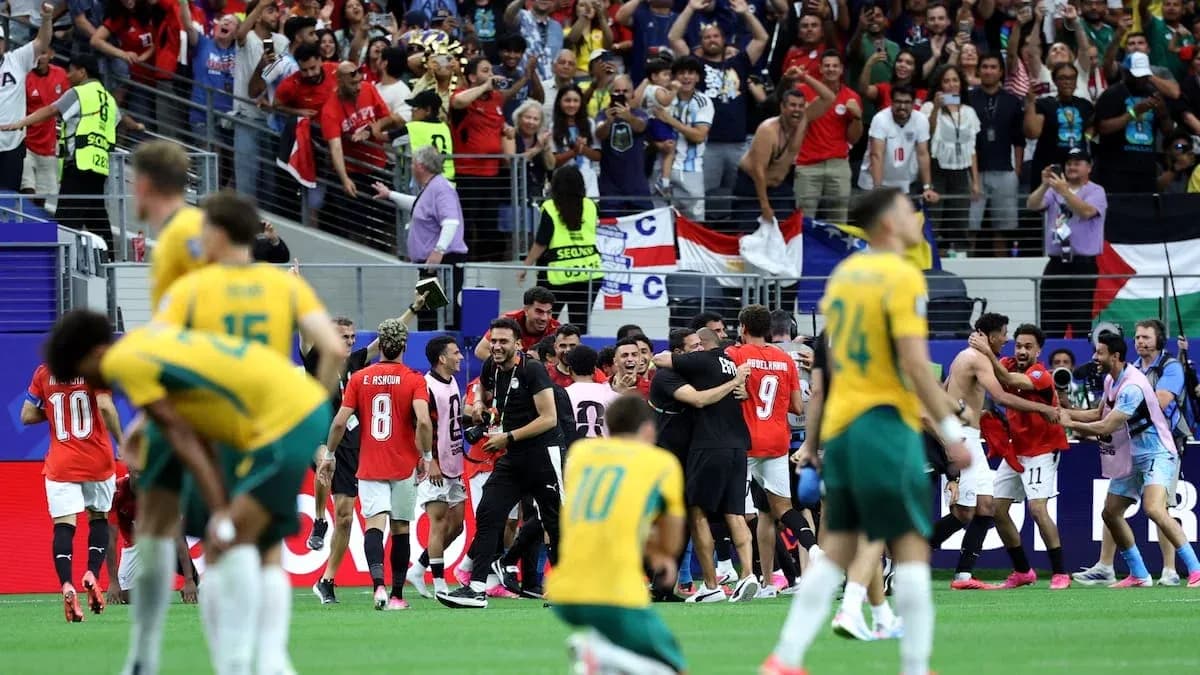
Abdelmaguid did not blink. He buried his penalty, sent Egypt through, and sent Salah to his knees in tears of joy as Australian players slumped around him, barely able to process how close they had come.
Egypt strike first, against the grain
This was never a game that flowed. It was tight, physical, and often scrappy, a contest of collisions and half-chances under the roof of the Dallas Cowboys’ air-conditioned home, where 70,000 watched history trying to happen.
Australia actually started brighter. Inside five minutes Cristian Volpato, the late convert from Italy to the green and gold, rattled the top of the crossbar with a fierce drive. It was a warning that rattled Egypt’s back line, who had already shown nerves in the group stage despite a landmark 3-1 win over New Zealand.
Then, almost out of nowhere, Hossam Hassan’s side struck.
Nestory Irankunda switched off at the back post, Emam Ashour did not. Karim Hafez swung in a teasing cross, Ashour ghosted in unmarked and guided his header home after 13 minutes for his second goal of the tournament. Against a team that had scored only twice in the group phase, that early breakthrough felt heavy.
Australia huffed and probed but offered little end product. Their first shot on target did not arrive until 10 minutes before the interval, Aziz Behich driving tamely at Mostafa Shoubir. The goalkeeper gathered comfortably, watched by a father who knew the stage well: Ahmed Shoubir had stood in goal for Egypt at the 1990 World Cup.
At the other end, Salah was a muted figure. The 34-year-old, still nursing that hamstring, drifted on the fringes of an attritional first half, unable to shake free of close attention or to inject his usual electricity.
The half ended with a thud. Jordan Bos, one of the quickest players at this World Cup, was sent spinning by a flying challenge from Rabia. He stayed down. He did not return. Kai Trewin replaced him at the break, a significant blow to Australia’s outlet on the flank.
Australia drag themselves back
Seconds after the restart, Egypt should have killed the contest. Omar Marmoush, the Manchester City attacker, slid in at close range and somehow guided the ball wide. It was a glaring miss and a turning point.
Australia, emboldened, pushed higher. Egypt’s coach had warned about the Socceroos’ physicality, and the equaliser came from exactly that kind of pressure. An in-swinging free-kick was hurled into the box, bodies crashed together, and Mohamed Hany, straining under contact, could only divert the ball into his own net with a desperate header.
It was his second own goal of the tournament. It dragged Australia level and cracked open a match that had been slipping away from them.
From there, the tension thickened. Salah remained on the edges of the action but finally began to stitch a few moves together. Deep into added time at the end of the 90, he was involved in the build-up as Ramy forced Beach into a superb, athletic save, the Australian keeper flinging himself across goal to claw the ball away and drag the tie into extra time.
Egypt finished normal time in control. Australia, legs heavy, clung on.
Extra time and the long walk
Extra time brought more toil than beauty. Egypt pushed, Australia retreated, both sides acutely aware of the stakes. Salah, on his weaker right foot, lashed one effort well over early in the additional 30 minutes, the shot of a man still feeling his way back to full sharpness.
The minutes drained away. Tackles flew in. Cramp set in. Neither side could find the decisive moment. Penalties loomed, then arrived, dragging the night into its cruel final act.
Popovic made his call, sacrificing Beach – who had kept Australia alive with that stoppage-time save – for Ryan’s experience in the shootout. It was a decision that spoke of trust in big-game nous over rhythm.
The margins were brutal. Souttar’s miss. The unerring accuracy of Salah. Herrington’s bar-rattler. Abdelmaguid’s ruthlessness.
For Egypt, it was a breakthrough night: a first World Cup knockout win, a new chapter for a team long burdened by near-misses on the global stage. For Australia, it was another reminder of how thin the line can be between a famous victory and the long, lonely walk back to the dressing room.