.svg&w=384&q=75 "Naijagoal logo")
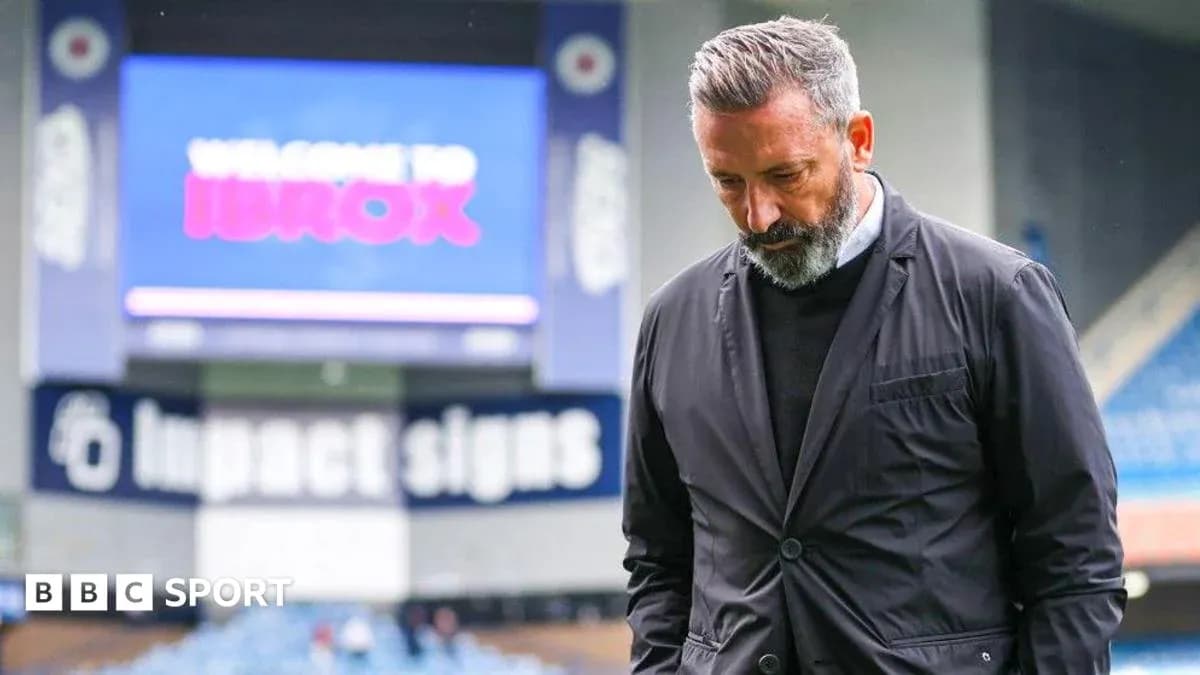

Derek McInnes Takes Control at Rangers: A New Era Begins
Derek McInnes has never hidden what Rangers means to him. When he walked into Tynecastle last May and called Hearts “everything I wanted”, it sounded heartfelt. It probably was. But football moves at a speed that makes old promises look quaint.
Thirteen months on, one season into a project that came within three minutes of the title, he has walked out on Hearts to take the job he always seemed destined for at Ibrox.
Once Rangers made their move, there was no real sense of jeopardy about the deal. This was not a courtship, it was an inevitability finally landing. The only question was timing.
You might expect Tynecastle to be in uproar, but the mood is more shrug than street protest. There will be anger in pockets, of course, yet the wider support never truly believed McInnes was theirs for the long haul. He was the man who almost delivered the greatest day in Hearts’ modern history, but he was never “one of them”. Not in the way legacy managers are forged. Not with Rangers hovering in the background, the job that keeps coming back into the conversation like a song on repeat.
Everyone knew he would go there one day. Sooner or later, the call was always coming.
A manager out of step with Hearts’ new world
McInnes did an outstanding job in Edinburgh. He took a club that had reimagined itself through data and structure and drove it to the brink of a title on a fraction of the budget of their rivals. He adapted, he compromised, he worked within a model shaped so heavily by Jamestown Analytics.
But he was never entirely at ease with it.
This is a manager who values control. At Kilmarnock and, most notably, at Aberdeen, he ran football operations with a firm hand on the wheel. At Hearts, the power lines were different. Recruitment leaned heavily on numbers. Playing time for certain signings came with an expectation attached. The authority he had grown used to was diluted by algorithms and performance dashboards.
At Rangers, that changes.
McInnes walks into Ibrox with the promise of something close to full command of the football department. His decisions, his players, his vision. No data team querying why one of “their” signings is stuck on the bench. No favoured targets binned because they don’t light up a metrics report. No obligation to polish players simply because their Jamestown profile glows.
Rangers is now his train set. A powerful one, loaded with resources he has never previously had at his disposal. The owners have already spent heavily in their short time in charge and are ready to go again this summer, likely in a serious way. For a manager who almost stole the title on buttons, that is a lure that barely needs explaining.
Control and cash. For McInnes, this was an easy decision in the cold reality of elite football.
Power, pressure and a furious demand for titles
With that control comes a brutal clarity: next season, nothing short of the Premiership title will be tolerated.
Rangers fans are past the point of patience. Danny Rohl tried and failed, and there is no great nostalgia for his tenure after a third-place finish. Philippe Clement improved that to second, yet the support could not wait to move on from him either.
McInnes knows the terrain. He understands that at Ibrox, words evaporate quickly. He is a persuasive communicator, but he will be judged on the only currency that matters in Govan – silverware, and specifically the league trophy.
There is an angry edge to the Rangers support now, a gnawing frustration at watching others set the pace. Any attempt at rational explanation – budget gaps, transition phases, bad luck – will not save him if the title eludes them again.
He arrives as the obvious choice. He knows the club, knows the league, knows the scrutiny. He is tactically sharp – the Rangers hierarchy saw that up close when his Hearts side caused them so much trouble last season. He is tough, self-assured and comfortable in front of a microphone. At a club where the manager must be as big as the institution’s own shadow, McInnes has the presence to fill the role.
The nearly man with a point to prove
His record, though, tells a story that still needs a final chapter.
At Aberdeen, Hampden became almost a second home. League Cup finals in 2013-14, 2016-17, 2018-19. A Scottish Cup final in 2016-17. He built teams that were consistent, competitive, always there or thereabouts when the prizes were handed out.
Celtic repeatedly blocked his path. That was no disgrace. Yet the list of other cup exits is long and uncomfortable: Dundee United, Hibs, St Johnstone, Dundee, Hearts, Motherwell, Hearts again, St Mirren, Motherwell again, United again. While he chased the big two, others quietly collected medals.
Since McInnes last lifted a major trophy with a Premiership club, a roll call of sides outside the Old Firm have enjoyed their moment with the Scottish Cup or League Cup: St Johnstone, Inverness, Hibs, St Johnstone again, Aberdeen, Ross County, St Mirren. Managers such as Tommy Wright, John Hughes, Alan Stubbs, Callum Davidson – twice – Jimmy Thelin, Jim McIntyre and Stephen Robinson have all etched their names into Scottish football history.
McInnes, for all his longevity and consistency, still carries that “nearly man” tag. Always close. Rarely crowned.
That is what makes this move so compelling. At Ibrox, there is nowhere to hide. His duels with Martin O’Neill’s Celtic in the past hinted at a coach capable of standing in the fiercest of fires. Now he faces a new era of that rivalry, and a battle with whoever steps into his old office at Tynecastle.
Hearts, in the end, were a bridge. The job he wanted then, not the one he has wanted all his life. The stepping stone has served its purpose.
Now comes the defining test. At Rangers, Derek McInnes finally has the stage he has waited for. The question is no longer whether he would ever get it.
It’s whether he can live up to it.