.svg&w=384&q=75 "Naijagoal logo")
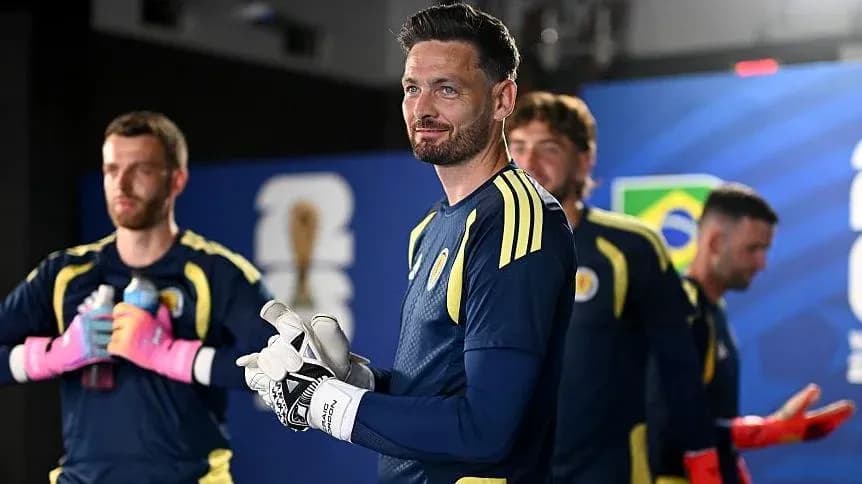

Craig Gordon’s Remarkable Return to Football
Craig Gordon has finally called time on his playing career, and the tributes will roll in for his medals, his longevity, his saves. But to understand the scale of what he did, you have to start with the sound no footballer ever forgets: bone snapping.
Four years ago, the former Celtic, Hearts and Sunderland goalkeeper suffered a double leg break. At 39. An age when most keepers are already easing themselves out of the firing line, he was suddenly staring at a mountain that many in their prime struggle to climb.
Rory Loy knows that mountain well. Speaking on the BBC's Scottish Football Podcast, the ex-striker laid it out with the bluntness of someone who has lived the same nightmare.
“I did the same thing, but I did it when I was 20, 23,” Loy said.
The comparison matters. At 23, a player’s body still feels elastic, the mind wired to fight back, the career arc pointing upwards. Recovery is brutal, but the horizon is long.
Gordon didn’t have that luxury. He had years, not decades, left in the game. Yet he chose the hardest route: surgery, rehab, the lonely hours in the gym, the endless tests of nerve and pain threshold. Then, after all of that, the final leap of faith — throwing himself into tackles, one-on-ones, 50-50s, knowing exactly what had happened the last time.
Loy did not dress up the reality. “Trust me, I know how difficult it is to come back from that injury, psychologically as well as physically. It's not easy. The shin bone just snaps basically. So it needs to heal and then obviously your whole biomechanics, the way you walk, the way you move, the way you do everything, it just changes.”
That’s the part supporters rarely see. Not just the scar, but the rewiring. The way a player plants his foot. The way he lands. The way he trusts – or doesn’t trust – his own body.
“So I needed orthotics in my shoes basically to change and adapt to the way I now move differently and there's just so many different layers to it,” Loy added. Every step becomes a conscious act. Every movement, a calculation.
Gordon went through all of that in his late thirties, then came back not just to play again, but to reach a World Cup finals with Scotland and close out his international career on the biggest stage. That is not a comeback; it is a defiance of logic.
“For him to go through that type of thing at the age he was at and still have the motivation to come back and play football just sums up the type of mindset he had,” Loy said.
It’s the word that keeps returning with Gordon: mindset. The clean sheets and the medals are the evidence; the mindset is the engine that drove them.
Because even stripped of the injury story, his level stood on its own. “Away from all of that, the level of goalkeeping and saves he had was incredible,” Loy concluded.
In the end, that’s how Gordon leaves the stage: not as a cautionary tale about a broken leg, but as a goalkeeper who refused to let that break define him – and instead used his final years to write one of the most resilient chapters Scottish football has seen.