.svg&w=384&q=75 "Naijagoal logo")
Bayern München vs Paris Saint Germain: Tactical Analysis of 1–1 Draw
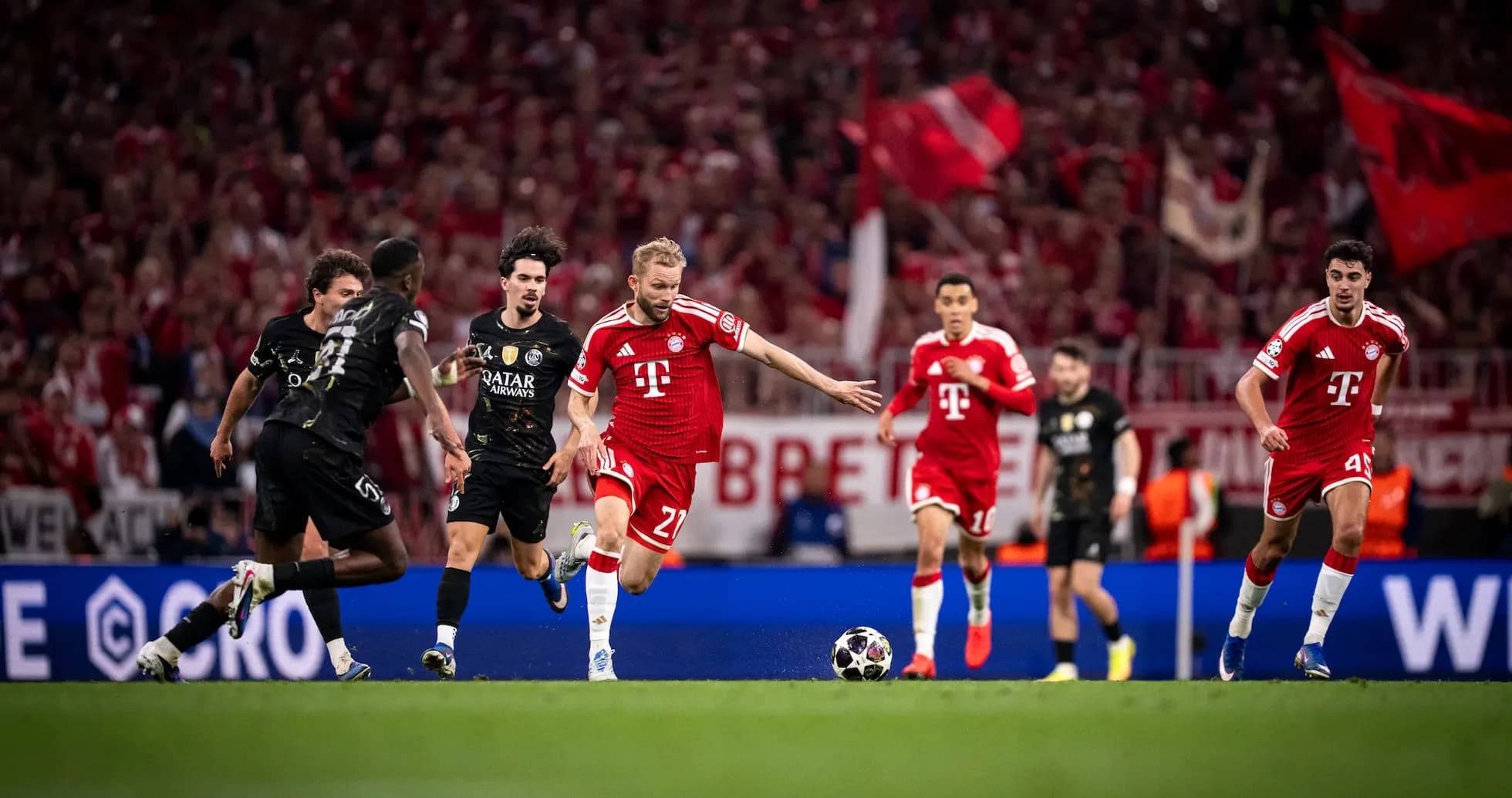
Bayern München and Paris Saint Germain played out a finely balanced 1–1 draw at Allianz Arena in this UEFA Champions League semi-final, a match defined by Bayern’s territorial dominance against PSG’s ruthless early punch and compact defensive structure. PSG led 1–0 at half-time and were within seconds of taking that advantage back to Paris, only for Harry Kane’s 90' equaliser to reward Bayern’s sustained pressure and 66% possession. Vincent Kompany’s 4-2-3-1 controlled the ball and territory, but Enrique Luis’s 4-3-3 counter-attacking blueprint repeatedly threatened in transition, reflected in a near-level xG (1.4 vs 1.03) despite the possession disparity.
Disciplinary log (chronological, all cards)
- 8' Nuno Mendes (Paris Saint Germain) — Foul
- 33' Jonathan Tah (Bayern München) — Argument
- 45+3' Khvicha Kvaratskhelia (Paris Saint Germain) — Time wasting
- 78' Luis Díaz (Bayern München) — Argument
- 86' Marquinhos (Paris Saint Germain) — Foul
- 90+7' Joshua Kimmich (Bayern München) — Argument
Card totals: Bayern München: 3, Paris Saint Germain: 3, Total: 6.
Scoring sequence and event flow
PSG struck immediately. On 3', O. Dembele attacked the right half-space from Enrique Luis’s high front three, combining with K. Kvaratskhelia. Kvaratskhelia’s involvement as provider underlined PSG’s intent to isolate Bayern’s full-backs; Dembele’s “Normal Goal” gave PSG a 1–0 lead from their first meaningful attack.
Early discipline reflected the tactical tone. At 8', Nuno Mendes was booked for “Foul” as he aggressively stepped out of the back four to confront Bayern’s wide rotations. Bayern’s frustration with PSG’s game management surfaced at 33', when Jonathan Tah received a yellow for “Argument”, signalling growing irritation at the tempo and refereeing rather than a specific defensive action.
On 45+3', Kvaratskhelia was booked for “Time wasting”, PSG already leaning into a protect-the-lead posture before the break. The half-time score was 0–1, consistent with the early goal and PSG’s compactness.
The second half was shaped by substitutions and Bayern’s mounting pressure. At 65', B. Barcola (IN) came on for O. Dembele (OUT), adding fresh legs to PSG’s right side in transition. Bayern responded at 67' with A. Davies (IN) for J. Stanisic (OUT), an attacking full-back swap, followed at 68' by Kim Min-Jae (IN) for J. Tah (OUT) to refresh the defensive line.
PSG’s double change on 76' further recalibrated their block: L. Hernandez (IN) came on for D. Doue (OUT), and L. Beraldo (IN) came on for F. Ruiz (OUT), trading attacking width and a ball-playing midfielder for greater defensive solidity. Bayern’s emotional temperature rose at 78', when Luis Díaz was booked for “Argument” as Bayern intensified appeals and protests.
Kompany doubled down on attacking thrust at 79': N. Jackson (IN) came on for J. Musiala (OUT), adding a more direct forward profile. On 85', L. Karl (IN) replaced D. Upamecano (OUT), an unusual late defensive reshuffle likely driven by physical management. Simultaneously, PSG introduced S. Mayulu (IN) for N. Mendes (OUT), shifting their left side toward energy and defensive coverage.
PSG’s back line then came under severe strain, and Marquinhos’s 86' yellow for “Foul” captured a late, last-ditch phase of defending. Deep into stoppage time, Joshua Kimmich was booked at 90+7' for “Argument”, capping a night of vocal Bayern protest.
The crucial equaliser arrived at 90': Harry Kane converted a “Normal Goal”, assisted by A. Davies. The left-back’s introduction had been aimed precisely at this outcome: high, aggressive overlapping from the left, delivering into central zones for Kane. The match finished 1–1.
Tactical breakdown and personnel
Kompany’s 4-2-3-1 was ball-dominant by design. With Joshua Kimmich and A. Pavlovic as the double pivot, Bayern built patiently through the centre, funnelling attacks into the advanced trio of M. Olise, J. Musiala and Luis Díaz behind Kane. Bayern’s 570 total passes at 87% accuracy versus PSG’s 301 at 71% underline a clear possession-first game model.
Structurally, Bayern’s back four of K. Laimer, D. Upamecano, Jonathan Tah and J. Stanisic began conservatively, with full-backs initially more restrained to guard against PSG counters. Once behind, however, Bayern increasingly pushed Laimer and Stanisic high, leaving Upamecano and Tah to defend large spaces against Kvaratskhelia and Dembele. This risk was evident in PSG’s early success: the 3' goal exploited Bayern’s high line and the gap between full-back and centre-back.
The second-half introduction of Alphonso Davies radically changed Bayern’s left flank. Davies’ width and acceleration stretched PSG’s 4-3-3 into a de facto 4-5-1, with wide forwards dropping to form a flat midfield line. His assist for Kane encapsulated Bayern’s adjusted pattern: switch of play, full-back overlap, and central penalty-box presence from Kane and N. Jackson.
PSG’s 4-3-3 under Enrique Luis was built around verticality and compactness rather than volume of possession. The midfield trio of F. Ruiz, Vitinha and J. Neves was tasked with compressing central zones, forcing Bayern wide and then springing counters through Dembele and Kvaratskhelia. The shot profile supports this: PSG generated 15 total shots and 7 on target from just 34% possession, a high yield relative to their time on the ball.
Defensively, PSG’s back four — W. Zaire-Emery, Marquinhos, W. Pacho, Nuno Mendes — maintained a narrow shape, inviting crosses. Bayern responded by loading the box with Kane, late runs from Musiala and second-line arrivals from Kimmich. Yet PSG’s central defenders, especially Marquinhos and Pacho, dealt with much of the aerial traffic until fatigue set in.
Goalkeeper reality
M. Neuer recorded 6 saves to M. Safonov’s 5, reflecting PSG’s sharper shot quality in transition and Bayern’s greater shot volume. Despite Bayern’s 18 total shots to PSG’s 15, the xG gap (1.4 vs 1.03) remained narrow, suggesting that while Bayern accumulated chances, many were from less optimal positions or crowded scenarios, whereas PSG’s counters produced cleaner looks at goal.
Statistical verdict
Bayern’s Overall Form in this match was that of a territorial heavyweight: 66% possession, 570 passes, and a 6–5 edge in shots on target. Their attacking structure eventually broke through via high full-back play and central penalty-box occupation. Defensively, however, their index is more mixed. They limited PSG to 15 shots and an xG of 1.03, but conceded early and repeatedly allowed dangerous transitions, forcing Neuer into 6 saves.
PSG’s Overall Form was efficient and disciplined. With only 34% possession, they nearly maximised their attacking phases, matching Bayern’s shot quality and leading for 87 minutes. Their Defensive Index was strong for long stretches: 5 saves from Safonov, heavy central resistance, and effective game management — though three yellow cards (two “Foul”, one “Time wasting”) highlight the cost of sustaining such a low block under pressure. Over two legs, this 1–1, with Bayern’s marginal xG edge but no scoreboard advantage, leaves the tie tactically poised rather than decided.