.svg&w=384&q=75 "Naijagoal logo")
Arsenal Edges Atletico Madrid in UEFA Champions League Semi-Final
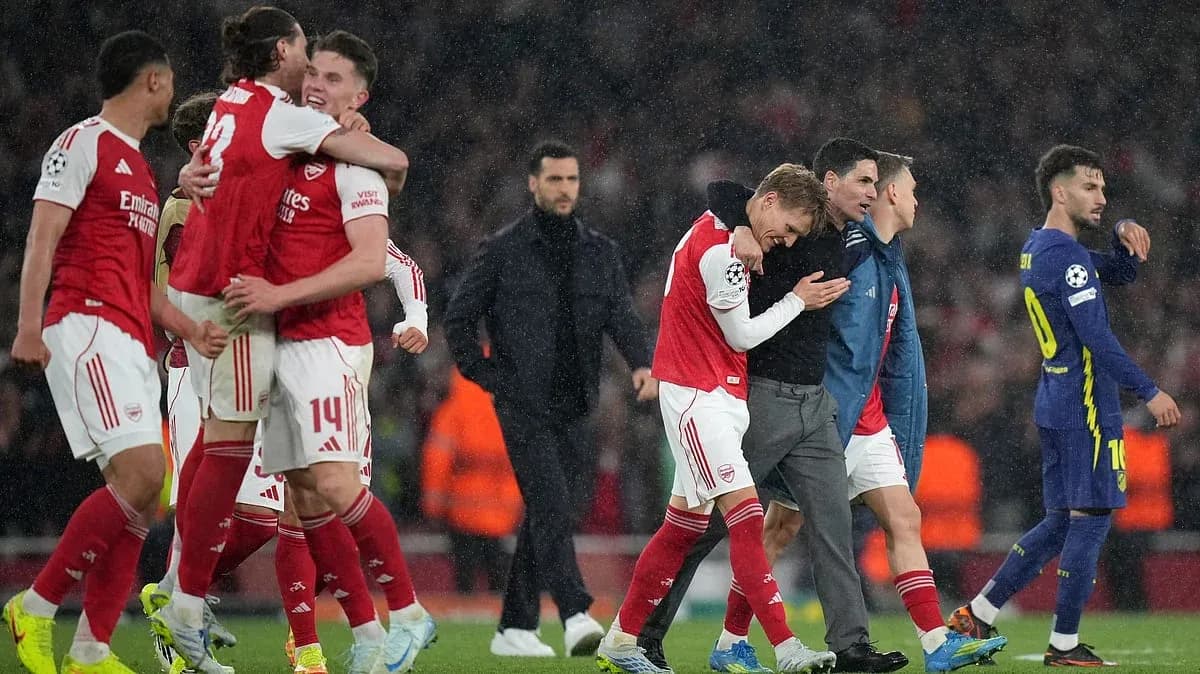
Under the lights at Emirates Stadium, this UEFA Champions League semi-final first leg finished with the narrowest of margins: Arsenal 1–0 Atletico Madrid. Following this result, the competition’s form side – Arsenal, ranked 1st in the overall standings with 24 points and a goal difference of 19 from eight games (23 scored, 4 conceded) – have edged in front of an Atletico Madrid team that has had a more turbulent route, sitting 14th with 13 points and a goal difference of 2 (17 scored, 15 conceded).
Team Formations
Arteta leaned into Arsenal’s evolving European identity with a 4-2-3-1 that felt like a sharpened version of their domestic blueprint. D. Raya anchored a back four of B. White, W. Saliba, Gabriel and R. Calafiori, screening a double pivot of D. Rice and M. Lewis-Skelly. Ahead of them, B. Saka and L. Trossard flanked E. Eze, with V. Gyökeres the lone striker. It was a structure designed to keep Arsenal’s season-long defensive record intact – they have yet to lose in 14 Champions League games, with 29 goals scored overall and only 6 conceded, averaging 2.1 goals for and 0.4 against per match.
Diego Simeone’s response was classic Atletico in shape but subtly modern in personnel. The visitors lined up in a 4-4-2: J. Oblak behind a back line of M. Pubill, R. Le Normand, D. Hancko and M. Ruggeri; a midfield four of G. Simeone, M. Llorente, Koke and A. Lookman; and a front pair of A. Griezmann and J. Álvarez. Atletico’s Champions League campaign has been defined by volatility – on their travels they have played 8 matches, winning 2, drawing 2 and losing 4, scoring 13 and conceding 17, an away average of 1.6 goals for and 2.1 against. The task at Emirates was to suppress an attack that, at home, has averaged 2.1 goals per game while conceding just 0.4.
Injuries and Tactical Constraints
Injuries added a layer of tactical constraint. Arsenal were without M. Merino (foot injury) and J. Timber (ankle injury), two players who would have broadened Arteta’s options between the lines and at full-back. Their absence nudged the coach towards a more orthodox back four and reinforced Rice’s dual role as shield and first passer. For Atletico, the loss of P. Barrios and N. Gonzalez to muscle injuries removed some of Simeone’s flexibility in rotating his midfield intensity – a subtle but important factor against an Arsenal side that thrives on sustained possession and late surges.
Disciplinary Trends
Disciplinary trends from the season hung over the tie like an invisible second referee. Arsenal’s yellow-card distribution shows a pronounced spike between 61–75 minutes, where 31.82% of their cautions arrive – a clear sign that their aggression often ramps up just as games enter the decisive phase. Atletico, by contrast, see 25.93% of their yellows between 46–60 minutes, then another combined 48.14% from 61–90 and into stoppage time (61–75: 18.52%, 76–90: 14.81%, 91–105: 14.81%). This paints a picture of a side that regularly walks the disciplinary tightrope as matches open up. In a semi-final context, that pattern is a tactical pressure point: Arsenal’s late-game dominance meets Atletico’s propensity to collect cards under fatigue.
Key Players
The “Hunter vs Shield” duel in this tie revolves around J. Álvarez and Arsenal’s defence. Álvarez has been one of the Champions League’s most ruthless forwards: in total this campaign he has 10 goals and 4 assists in 15 appearances, with 37 shots (22 on target) and 34 key passes, all while maintaining an 81% pass accuracy. He has also converted all 3 of his penalties, with no misses. His movement between the lines, dropping off Griezmann to receive and turn, is designed to pull centre-backs into awkward zones.
Yet he is running into a defensive unit that has been almost immaculate. Overall, Arsenal have conceded just 6 goals in 14 Champions League fixtures, keeping 9 clean sheets (5 at home, 4 away). Their average of 0.4 goals against both at home and away speaks to a structure rather than a stadium effect. Saliba and Gabriel, protected by Rice, have turned the central lane into a no-fly zone, and Arteta’s choice of a 4-2-3-1 – used 5 times in Europe compared to 9 outings of 4-3-3 – adds an extra layer of screening in front of the back four. Neutralising Álvarez is not just about duels; it is about denying him clean zones to combine with Griezmann.
Midfield Battles
In the “Engine Room” battle, the contrast is equally stark. For Atletico, Koke remains the metronome, but the creative and finishing burden in this campaign has fallen heavily on Álvarez, who doubles as both top scorer and top assist provider. For Arsenal, the creative threat is more distributed. Gabriel Martinelli, one of the competition’s leading forwards, has 6 goals and 2 assists in 13 appearances, with 16 key passes and 38 dribble attempts, 17 of them successful. Even from the bench at Emirates, his profile shapes the tie: his ability to attack tired full-backs late on dovetails with Arsenal’s tendency to push the tempo in the final quarter.
Behind them, Martín Zubimendi looms as a tactical card in reserve. Over 12 Champions League games he has completed 633 passes with 87% accuracy, made 17 key passes and contributed 14 tackles, 5 successful blocks and 10 interceptions. He has also collected 4 yellow cards, underlining his role as a true enforcer. If Arteta turns to him in the second leg, Zubimendi’s presence could tilt the midfield battle from Rice’s verticality towards a more controlled, possession-heavy chokehold.
Flank Duels
On the flanks, M. Pubill’s duel with Arsenal’s wide forwards is a micro-theatre of the tie. Pubill has 18 tackles, 6 successful blocks and 6 interceptions in 11 Champions League appearances, but he has also collected 4 yellow cards. Up against Saka and the potential introduction of Martinelli or N. Madueke, his aggression must be perfectly calibrated; one mistimed challenge could expose Atletico to numerical inferiority against a side that already dominates territory.
Statistical Prognosis
From a statistical prognosis perspective, the pattern is clear. Heading into this semi-final, Arsenal’s overall xG profile (implied by 29 goals from an unbeaten 14-game run with no defeats and only 1 match in which they failed to score at home) suggests a side that reliably creates high-quality chances and rarely gives them away. Atletico’s numbers – 35 goals scored but 28 conceded overall, with only 1 clean sheet and 17 goals conceded on their travels – point to an open, high-variance game model that is ill-suited to chasing a deficit against an elite defensive block.
The 1–0 scoreline at Emirates feels entirely in character: Arsenal’s control and defensive solidity edging out Atletico’s punchy but porous approach. As the tie swings to Madrid, Simeone will need Álvarez and Griezmann to bend a near-impregnable defence, while Arteta can lean on a structure that has not yet tasted defeat in Europe, and on a bench stacked with difference-makers like Martinelli, Gabriel Jesus, K. Havertz and Zubimendi. The numbers, and the narrative, both lean towards Arsenal – but Atletico’s volatility ensures that the second leg will be played on a knife-edge.