.svg&w=384&q=75 "Naijagoal logo")
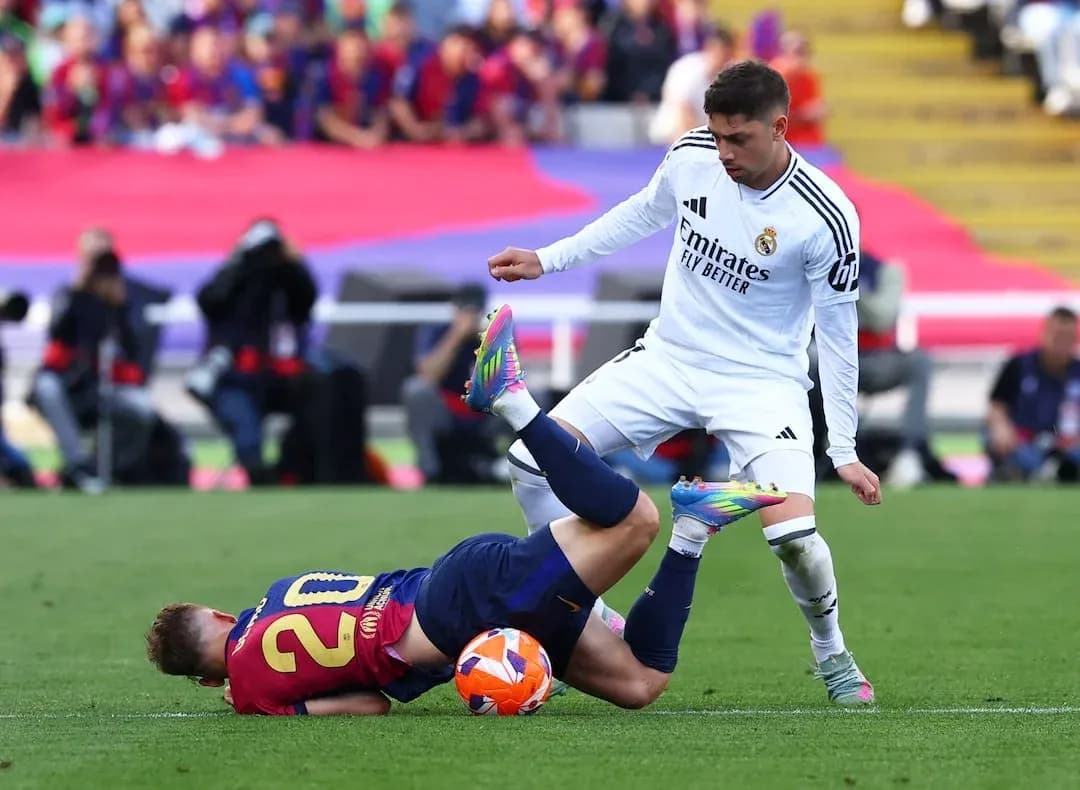
Barcelona Dominates Real Madrid in 2-0 Victory at Camp Nou
Barcelona’s 2-0 home win over Real Madrid at Camp Nou in La Liga’s Regular Season - 35 was defined by an aggressive, front-loaded game plan and a controlled defensive structure. Hansi Flick’s side built a decisive two-goal cushion inside 18 minutes and then managed the rhythm, using their 57% possession and superior passing accuracy to suffocate Real Madrid’s attempts at a comeback. Alvaro Arbeloa’s team generated some territorial pressure and eight shots, but with only one shot on target and a modest 0.79 xG, they never truly destabilised Barcelona’s 4-2-3-1 block. The halftime score of 2-0 accurately reflected a first half where Barcelona were both more incisive and more secure in both boxes.
I. Executive Summary
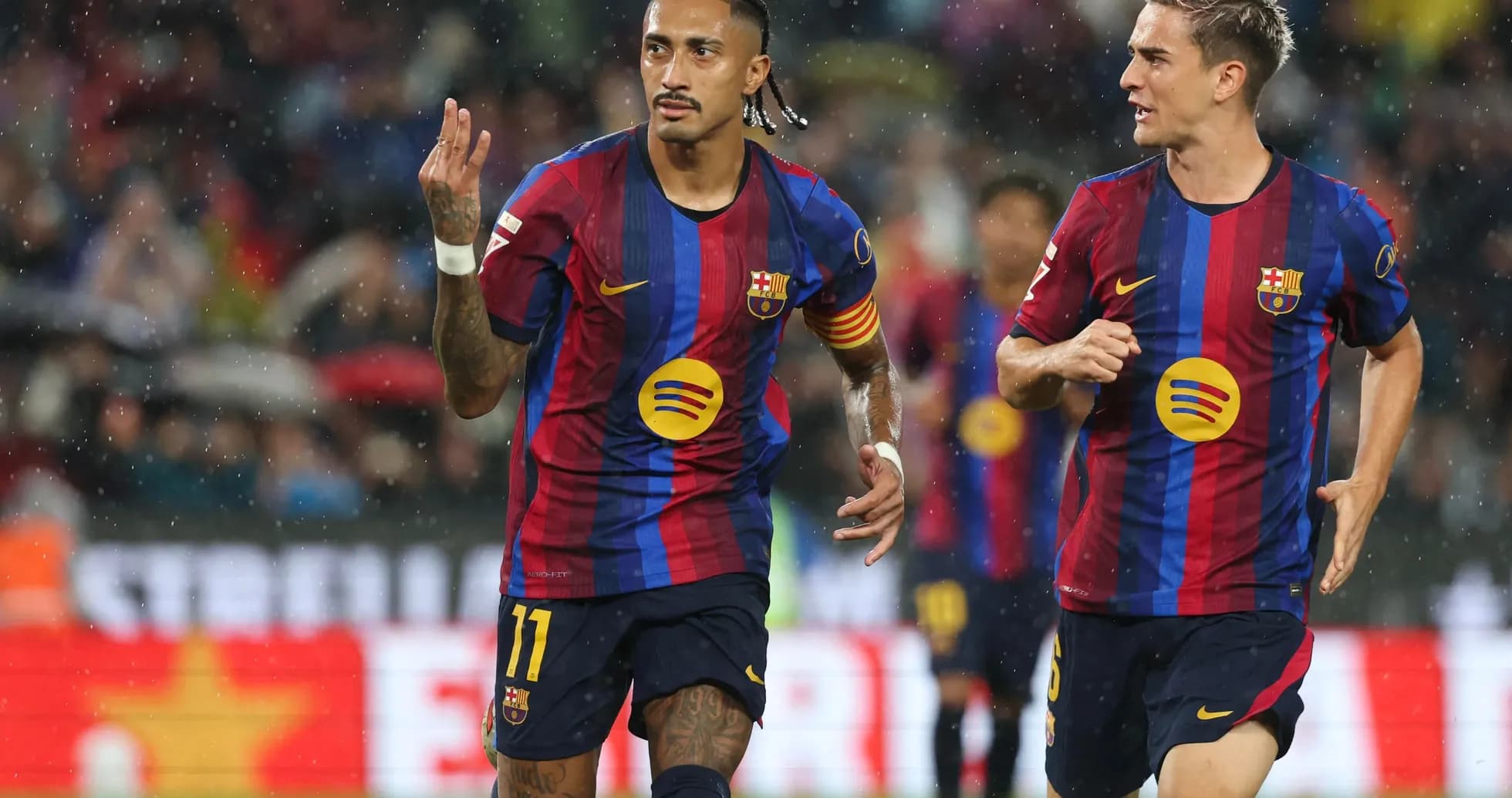
The scoring sequence was simple but tactically revealing. At 9', Marcus Rashford struck the opener for Barcelona, capitalising on the early territorial dominance and aggressive occupation of the half-spaces. At 18', Ferran Torres doubled the lead, finishing a move assisted by Dani Olmo, who operated as a central creative hub behind the striker. From that point, Barcelona shifted from high-tempo verticality to controlled circulation, prioritising stability over further risk.
The disciplinary and event chronology further illustrates the match’s tactical temperature:
- 40' Eduardo Camavinga (Real Madrid) — Foul
- 52' Dani Olmo (Barcelona) — Argument
- 52' Raúl Asencio (Real Madrid) — Foul
- 55' Jude Bellingham (Real Madrid) — Unallowed field entering
- 81' Raphinha (Barcelona) — Argument
- 81' Trent Alexander-Arnold (Real Madrid) — Argument
Card totals, locked: Barcelona: 2, Real Madrid: 4, Total: 6.
Substitutions followed a clear strategic pattern. At 64', Frenkie de Jong (IN) came on for Dani Olmo (OUT), and Raphinha (IN) came on for Marcus Rashford (OUT), signalling a shift from an aggressive 10 to a more control-oriented double pivot and fresh wide threat. Real Madrid responded at 70' with Thiago Pitarch (IN) for Eduardo Camavinga (OUT), seeking more progression. On 77', Robert Lewandowski (IN) replaced Ferran Torres (OUT) while Marc Bernal (IN) came on for Pablo Gavi (OUT), reinforcing central control and adding a reference point up front. At 79', Franco Mastantuono (IN) replaced Brahim Díaz (OUT) and César Palacios (IN) replaced Gonzalo García (OUT), Arbeloa’s attempt to inject creativity and energy between the lines. Finally, at 88', Alejandro Balde (IN) came on for Fermín López (OUT), consolidating the left side for the closing stages.
II. Tactical Breakdown & Personnel
Flick’s 4-2-3-1 was built on structural clarity. Joan García in goal sat behind a back four of Joao Cancelo, Gerard Martín, Pau Cubarsí and Eric García. In front, Pablo Gavi and Pedri formed a double pivot tasked with both first-phase progression and immediate counter-pressing. Ahead of them, Fermín López and Dani Olmo occupied the central lanes, with Marcus Rashford nominally wide but frequently attacking the inside channel, and Ferran Torres as the central forward.
The early 2-0 came from this positional aggression. Rashford’s 9' goal stemmed from Barcelona’s ability to pin Real Madrid’s back line deep and create isolation scenarios against the full-backs. With 9 of their 10 shots coming from inside the box and an xG of 0.99, Barcelona’s shot profile was high-quality rather than high-volume. Torres’ 18' strike, assisted by Olmo, highlighted the value of the 10: Olmo found pockets between Aurélien Tchouaméni and the Real centre-backs, turning and threading into the channel for the forward.
Out of possession, Barcelona’s 4-4-2/4-2-3-1 press targeted Real Madrid’s double pivot. Rashford and Torres led the first line, with Olmo stepping onto the nearest midfielder. This forced Real Madrid to build via the full-backs, particularly Trent Alexander-Arnold and Fran García, which in turn invited Barcelona’s wingers to spring traps wide. The 18 fouls Barcelona committed reflected a deliberate willingness to break play and prevent Madrid’s transitions once the ball did bypass the first press.
Real Madrid also lined up in a 4-2-3-1, with Thibaut Courtois in goal; a back four of Trent Alexander-Arnold, Raúl Asencio, Antonio Rüdiger and Fran García; Camavinga and Tchouaméni as the double pivot; Brahim Díaz, Jude Bellingham and Vinicius Júnior behind Gonzalo García. In theory, this structure offered vertical power through Bellingham and wide 1v1 threat through Vinicius, but in practice Barcelona’s compactness between the lines limited Bellingham’s touches in dangerous zones. The yellow card for “Unallowed field entering” at 55' underlined his frustration more than any tactical breakthrough.
Arbeloa’s changes were aimed at refreshing the midfield and attacking lines rather than altering the base shape. Thiago Pitarch’s introduction for Camavinga sought more forward passing, while Mastantuono and Palacios were meant to add dribbling and combination play between the lines. However, with only one shot on goal and a total of eight attempts, Madrid’s structure rarely converted possession into genuine penalty-box threat.
The discipline pattern also reflected tactical tension. Camavinga’s 40' “Foul” card came as Madrid tried to disrupt Barcelona’s tempo before halftime. At 52', in a single flashpoint, Dani Olmo (Argument) and Raúl Asencio (Foul) were booked, suggesting a duel in which Barcelona’s 10 was drawing contact and emotional responses. Later, at 81', both Raphinha (Argument) and Trent Alexander-Arnold (Argument) were carded, an indication that the right flank became a late emotional and tactical battleground as Madrid pushed and Barcelona countered.
Joan García made 1 save, while Courtois produced 5, a direct reflection of where the danger lay. Barcelona allowed Madrid some shots (8 total, 7 inside the box) but generally from crowded situations, while repeatedly forcing Courtois into interventions from clean looks.
III. The Statistical Verdict
The raw numbers support the tactical reading. Barcelona completed 527 passes, 484 accurate (92%), compared to Real Madrid’s 394 passes, 342 accurate (87%). This passing superiority, combined with 57% possession, underpinned Barcelona’s ability to dictate tempo after going 2-0 up. Their 7 shots on goal from 10 total attempts contrasted sharply with Madrid’s 1 from 8, emphasising both shot quality and efficiency in final-third execution.
Both teams registered identical “goals prevented” values of -0.53, indicating that neither goalkeeper significantly outperformed or underperformed the xG they faced; instead, the difference came from chance creation and finishing. Barcelona’s 0.99 xG turning into two goals, versus Madrid’s 0.79 xG yielding none, points to sharper execution and more coherent attacking patterns from the hosts.
Discipline-wise, the asymmetry is clear and must remain explicit: Barcelona finished with 2 yellow cards, Real Madrid with 4, total 6. The nature of the bookings — “Foul”, “Argument”, and “Unallowed field entering” — underlines how Madrid’s frustration grew as their structural adjustments failed to unlock Barcelona’s compact 4-2-3-1. Ultimately, this was a controlled, tactically mature performance from Barcelona, built on early vertical aggression and sustained by positional discipline and passing security.