.svg&w=384&q=75 "Naijagoal logo")
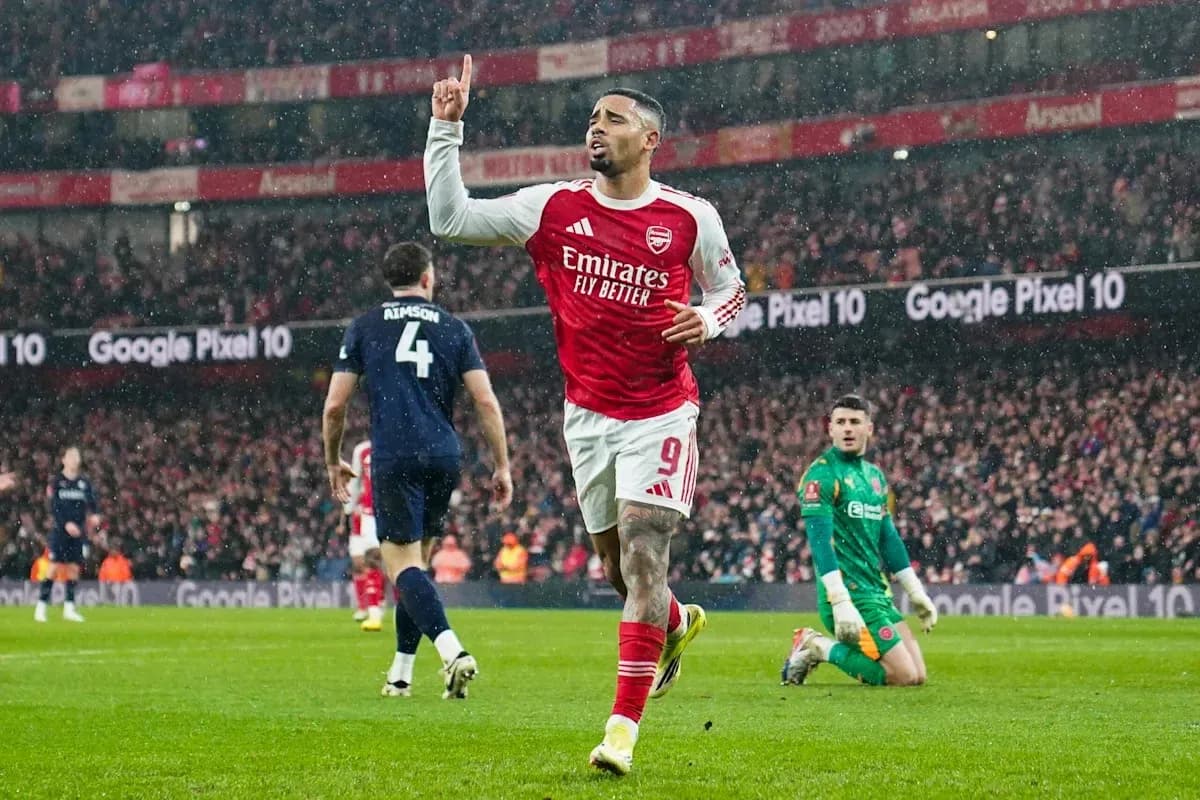

Arsenal Sets Price for Gabriel Jesus Amidst Legacy Considerations
Arsenal have drawn a clear line in this summer’s transfer market. Gabriel Jesus can leave, but only on their terms.
According to David Ornstein of The Athletic, the Premier League champions have set an asking price of between £18 million and £20 million for the Brazilian, with multiple clubs sounding out his situation. That figure tells its own story. This is not a fire sale. It is not a sentimental stand either. It is a calculated valuation from a club that now behaves like a champion.
Jesus, 29, has just 12 months left on his current deal, which runs to June 2027, and still Arsenal are adamant: he will not be sold cheaply. They know exactly what they have. An injury-hit, rotational forward on paper. A title-hardened, tactically sharp attacker in reality.
A Contract Clock Ticking Against a Manager’s Trust
This is where the balance between business and football becomes sharp.
Allowing Jesus to edge towards the final year of his contract naturally weakens Arsenal’s leverage. Any buying club can read a calendar. Yet Mikel Arteta’s staff also understand that Jesus brings more than goals. He brings structure. He brings edge.
Since returning from serious knee ligament damage, he has struggled to rediscover his old rhythm. Six goals in 27 appearances is modest output for a forward at a club chasing every major trophy. Still, one of those strikes – the opener in the 2-1 win over Crystal Palace on the final day – was a reminder of why managers trust him. He doesn’t need perfect form to affect important games.
Across his Arsenal career, the numbers are solid if unspectacular for a leading No 9: 32 goals and 22 assists in 123 matches. Not the haul of a pure finisher, but Jesus has never been just that. His pressing, his movement across the front line, his ability to knit attacks together and his emotional intensity have long been central to his value.
He changes the temperature of a game. Coaches notice that.
“Unfinished Business” Meets a Changed Reality
Jesus has not hidden how he feels about Arsenal. In December, asked about his future, he revealed that people had urged him to move on – to Saudi Arabia, or back to Brazil. He dismissed it.
“One day, I would love for everything to come full circle with Palmeiras, but not today,” he said. “I feel that I have unfinished business at Arsenal. I don’t want to leave.”
That phrase – “unfinished business” – still resonates around the Emirates. When he arrived from Manchester City in 2022, alongside Oleksandr Zinchenko, he brought more than medals. He imported a mentality. Training standards rose. Belief hardened. Arsenal stopped looking like plucky outsiders and started behaving like contenders.
But football does not slow down for sentiment.
Viktor Gyökeres and Kai Havertz now sit ahead of him in the pecking order. Jesus has started only three Premier League matches this season. For a player who once led the line as the face of Arteta’s project, that is a brutal shift. It is also the reality of a squad that has grown up around him.
Business, Not Betrayal
So what does a summer exit look like? Pragmatic, not ruthless.
A fee close to £20 million would represent smart business for Arsenal. They would bank a respectable sum for a player entering the final stretch of his contract, while clearing room in both the wage bill and the squad hierarchy. At the same time, they would not be seen to undervalue a forward with five English top-flight titles and deep Champions League experience.
Keep him, and Arsenal retain an experienced, versatile attacker who can cover multiple roles in a season that will again stretch into every competition. Sell him, and they do so from a position of strength, not desperation.
Clubs making enquiries know the situation. They know the contract timeline. They also know they are not bidding for a fading name. They are targeting a forward with proven Premier League intelligence, one who can still tilt matches at the highest level when his body allows.
A Player Who Changed the Mood
For Arsenal supporters, this is not just another line on a balance sheet.
Jesus was one of the catalysts of the club’s resurgence. When he walked through the door from Manchester City, he carried himself like a player who understood winning – not as a theory, but as a habit. That mattered to a dressing room still learning what it meant to live at the top.
His time in North London has not been flawless. Injuries have disrupted his rhythm. His finishing, at times, has frayed nerves in the stands. But his work without the ball, his willingness to press and scrap, his constant drifting to create angles and link play – those traits gave defenders long, uncomfortable afternoons and gave Arsenal a sharper edge.
At his best, he made Arsenal look quicker, more aggressive, more dangerous. He helped bridge the gap between hope and expectation.
Now, the bar has moved again. Arsenal are champions. Standards have hardened. If Gyökeres and Havertz remain ahead of him, Jesus faces a stark choice: accept a reduced role in a title-chasing machine, or seek a stage where he can once more be the main act.
A Fair Price on a Player Who Gave Belief
A £20 million valuation feels about right. It protects Arsenal’s interests. It respects Jesus’ status. It reflects a market in which proven Premier League forwards with his pedigree rarely come cheap, even when the contract clock is ticking.
If he stays, he will still have a part to play – as a flexible, experienced forward in a squad built to go deep on multiple fronts. If he goes, he should leave with appreciation rather than frustration.
Gabriel Jesus arrived before the trophies, when belief was still fragile. He helped change that. The question now is simple: will his “unfinished business” be completed in North London, or picked up somewhere else?