.svg&w=384&q=75 "Naijagoal logo")

World Cup 2026: Farewell Tours of Football Legends
The World Cup has always loved a farewell tour. In 2026, it gets an entire festival of them.
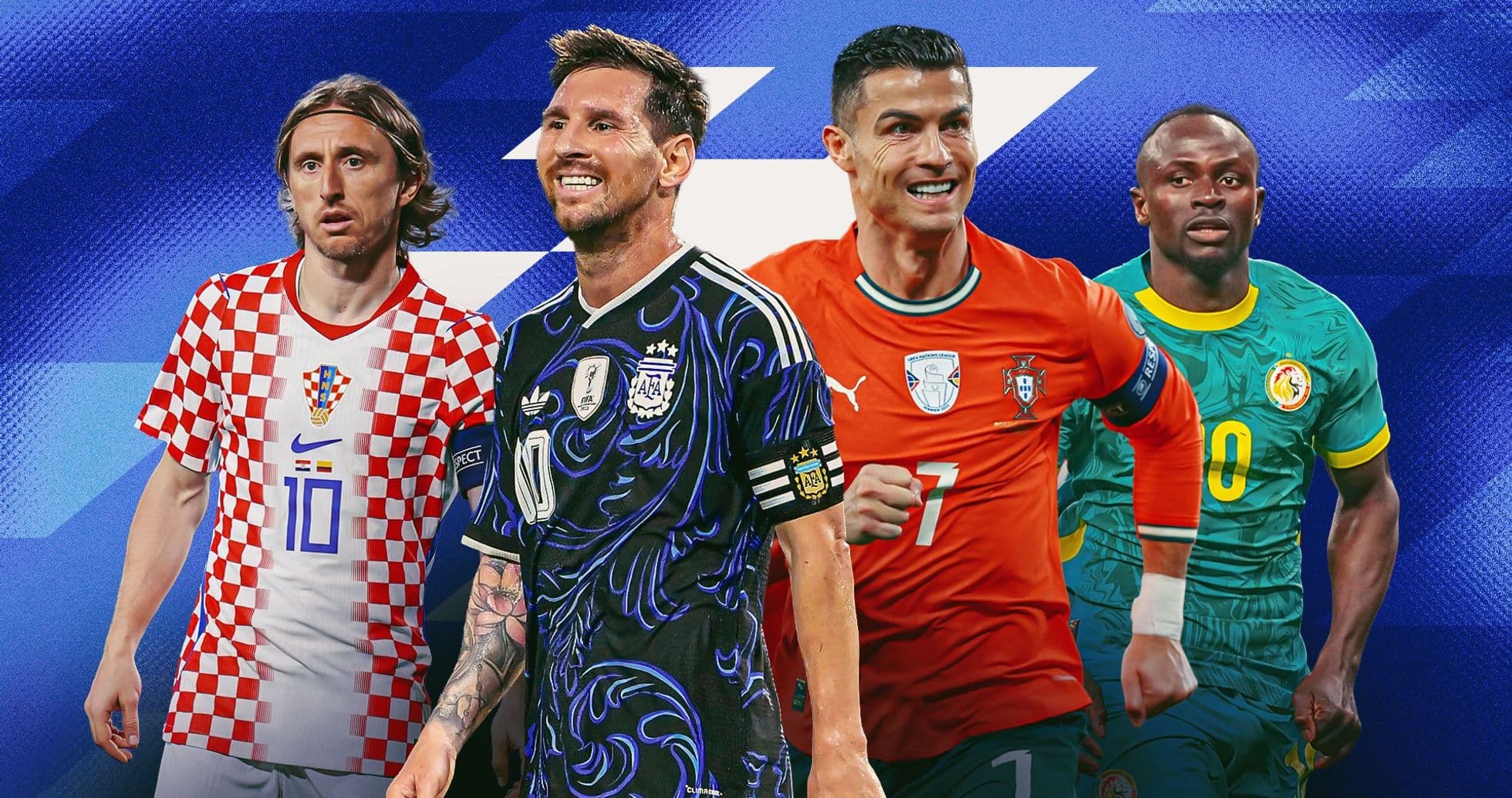
Some of the greatest players of the modern era are heading to North America with one last story to write, one final argument to make about their place in football history. Some arrive as champions. Others come still chasing the one medal that never found its way into their hands. All of them know this is probably it.
Messi and Ronaldo: the sixth act
Lionel Messi will be 39 when the ball rolls in 2026, yet he has already bent time to his will so often that age feels like a mere suggestion. He finally conquered the World Cup in 2022, dragging Argentina past France in one of the greatest finals the sport has ever seen. That felt like the perfect ending.
It wasn’t.
Messi has since traded European nights for the neon of Miami, easing the load on his body in MLS while still flicking matches to life with the same impossible vision. He remains Argentina’s genius-in-chief, still scoring, still creating, still seeing pictures nobody else can. The expanded format, the travel, the heat across the United States, Canada and Mexico will test him. So what? Betting against him has never ended well.
Cristiano Ronaldo walks into this tournament with a different burden. At 41, he could become the oldest player ever to lift the World Cup. He has won almost everything, broken almost every record, yet this competition has always resisted him. No World Cup trophy. No goal in the knockout rounds. For a player of his stature, that gap glares.
He keeps refusing to fade. In Saudi Arabia with Al‑Nassr, he still scores at a rate that would shame younger strikers, still talks as if retirement is a distant idea. Portugal, loaded with talent from Rafael Leao to Pedro Neto to Goncalo Ramos, could have moved on. Roberto Martinez hasn’t. He has built around Ronaldo again, trusting that the old finisher has one last month of ruthlessness in him. Like Messi, Ronaldo is heading for a sixth World Cup. Unlike Messi, this is his final chance to change the story.
Ochoa and Neuer: goalkeepers who won’t go quietly
Guillermo Ochoa was supposed to be done. Mexico’s cult hero, the man of a thousand World Cup saves, had slipped out of the picture with just one appearance for El Tri after the CONCACAF Nations League finals in March 2024. At 40, and with more than 150 caps behind him, his international career looked over.
Then Angel Malagon tore his Achilles in March. The door creaked open. Ochoa walked back through it.
The veteran, who has taken his gloves across Spain, Italy, France, Portugal, Belgium and most recently Cyprus with AEL Limassol, will now join Messi and Ronaldo in a sixth World Cup. He has hinted this will be his last stand. For two decades, every four years, his hair, his headband and his flying saves have become part of the tournament’s scenery. North America is likely his final curtain.
Germany have their own returning monument. With Marc‑Andre ter Stegen battling injuries and doubts hanging over Oliver Baumann, Julian Nagelsmann reached for the most familiar name of all. Manuel Neuer, 40 years old, back out of international retirement.
Neuer had stepped away after Euro 2024 on home soil, one of several veterans to draw a line under their Germany careers. Bayern Munich form, though, forced a rethink. Nagelsmann has already made it clear: Neuer will be his No.1 in North America. Germany, scarred by two straight group-stage exits, are trusting a legend to steady them one more time.
Modric and Dzeko: last chapters from the Balkans
Luka Modric has been defying logic for so long that his age almost feels theoretical. He will be 40 at this World Cup, the second-oldest outfield player behind Ronaldo, and still Croatia’s heartbeat.
He led his country to a first-ever final in 2018 and came back four years later to drag them to third place. Few midfielders have ever controlled a World Cup like Modric did in those runs. After leaving Real Madrid for AC Milan last summer to keep his legs fresher, he now heads into a fifth World Cup finals. If Messi hits 200 caps first, Modric should soon follow, becoming just the fourth player to reach that landmark.
Edin Dzeko’s path has been rougher. Bosnia and Herzegovina have only ever reached one World Cup, back in 2014. For years, it felt like that would be Dzeko’s lone taste of the biggest stage.
He refused to let it end that way. At 40, he has hauled his country back, inspiring Bosnia to a shock play-off win over Italy to book a spot in North America. Closing in on 150 caps and already past 70 goals, he remains their reference point in attack. A mid-season move to Schalke reignited his club form, his goals helping drag the German side back into the Bundesliga. This World Cup will finally give him the platform his career has long deserved.
Asian icons on the edge: Son and Salah
South Korea’s obsession with football has a single face: Son Heung‑min. He turns 34 in July, younger than many of the names on this list, yet the strain he carries is different. He is captain, talisman and national symbol rolled into one.
Son has already left Europe for LAFC in MLS, a sign that he is managing his workload and his future. By the time this World Cup ends, he may feel he has given everything he can to the national team. If he walks away, South Korea will be losing the greatest player in their history on the world’s biggest stage.
Egypt know that feeling of dependence even more sharply. Mohamed Salah, just a few days older than Son, has shouldered his country almost alone for years. He arrives this time with a little more help – most notably from Manchester City’s Omar Marmoush – but the Pharoahs will still look to Salah for the spark.
His last World Cup, in 2018, was overshadowed by the shoulder injury he suffered in the Champions League final. It robbed him of his full power and left his tournament flat. For a player of his global standing, that has always felt like unfinished business.
Salah’s Liverpool form has dipped over the past year, and a move to Saudi Arabia looms after his Anfield departure. His career is clearly entering its final phase. Expecting him to keep dragging Egypt to tournaments beyond this one feels optimistic. North America may be his final chance to leave a World Cup mark that matches his club legend.
Mane and Mahrez: African greats chasing a last run
Sadio Mane has defined Senegal’s golden era. He scored the penalty that delivered their first Africa Cup of Nations title in 2021, then drove them to back-to-back World Cup qualifications. Injury cruelly denied him a place at the 2022 tournament.
He turns 34 before this World Cup, his club career now based in Saudi Arabia with Al‑Nassr, and yet his importance to Senegal has not dimmed. He still wears the armband. He still sets the standard. Around him, players like Ismaila Sarr and Illiman Ndiaye are blooming, but Mane remains the leader. If Senegal are to make a deep run in 2026, his experience will be at the core of it.
Riyad Mahrez completes a trio of African Champions League and Premier League winners on the brink. At 35, the Algerian winger remains a joy to watch – first touch like silk, dribbling that still freezes defenders. He, too, is winding down in Saudi Arabia with Al‑Ahli, but the ball still obeys him.
The World Cup, though, has barely seen him. Mahrez has only one appearance at the tournament, back in 2014, with Algeria failing to qualify since. That makes 2026 feel like a second chance. One of Africa’s most gifted players finally gets another shot to show his full repertoire on the global stage.
De Bruyne and Van Dijk: European pillars under strain
Kevin De Bruyne heads into this World Cup with a different kind of question hanging over him: can his body still do what his brain demands? His first season at Napoli after leaving Manchester City has been riddled with injuries. He turns 35 later this month, and the fear is that the miles have caught up with him.
When fit, he remains the most complete playmaker of his generation, capable of splitting a defence with a single pass or deciding a match from distance. Belgium’s so‑called Golden Generation has faded, the squad now in transition under Rudi Garcia, but De Bruyne is still the man everything runs through. If he can stay on the pitch, Belgium could be one of the tournament’s most dangerous outsiders.
Virgil van Dijk, meanwhile, has aged into a commanding presence at the back for both club and country. He will be 35 during the World Cup, yet still stands as the central pillar of the Netherlands’ hopes.
At Liverpool, he has been the foundation of an era, the defender strikers openly admit they would rather avoid. This past season, though, has raised concerns. On Merseyside, some fear he has lost half a step, that his defensive instincts have dulled slightly. Dutch fans will hope the World Cup stage sharpens him again. This is only his second tournament, and almost certainly his last.
James, Neymar and the game that won’t let go
Few players owe as much to a World Cup as James Rodriguez. In 2014, he lit up Brazil with a tournament for the ages, earning a move to Real Madrid and etching his name into global memory. Since then, injuries have chipped away at his career.
Now 35 in July, James hops between clubs in short bursts, most recently with Minnesota United in MLS, conserving his body for Colombia duty. For his country’s supporters, his presence in North America is non-negotiable. The World Cup made him. A final appearance feels like football completing the circle.
Neymar’s story is more turbulent. Brazil’s all‑time leading scorer has not played for his country since tearing his ACL in October 2023. When Carlo Ancelotti took over the national team and continued to overlook him, the idea of Neymar at one last World Cup began to fade.
Then injuries struck Brazil’s forward line. Ancelotti relented, naming the Santos attacker in his 26‑man squad and sending a jolt of electricity through Brazilian fans. Within days, Neymar picked up yet another injury, throwing fresh doubt on his role.
His body is clearly rebelling. Imagining him lasting until 2030 feels like fantasy. This, then, is his last realistic chance to chase the sixth star that Brazil craves. Whether he can stay fit long enough to influence the story is another matter entirely.
Kane and England’s looming crossroads
Harry Kane arrives in North America at 32, right in the sweet spot for a centre-forward. He has just finished a blistering season at Bayern Munich, smashing in over 60 goals and reinforcing his status as one of Europe’s deadliest finishers. He is already England’s record scorer.
On paper, he could keep going until 2030. England supporters will cling to that thought, especially with no obvious heir of similar quality behind him. Yet the calendar complicates things. In 2028, England will co‑host the European Championship. That tournament, at home, offers a natural farewell stage for a generation.
Kane could choose to make that his final act in an England shirt. If he does, 2026 becomes his last World Cup. The same logic applies to others: Jordan Pickford, John Stones, perhaps even Marcus Rashford. The lure of bowing out in front of their own fans will be powerful.
North America, then, is not just another World Cup. It is a gathering of eras, a meeting point where legends stretch their careers to the limit in search of one more moment, one more goal, one more night that will echo long after they finally walk away.