.svg&w=384&q=75 "Naijagoal logo")
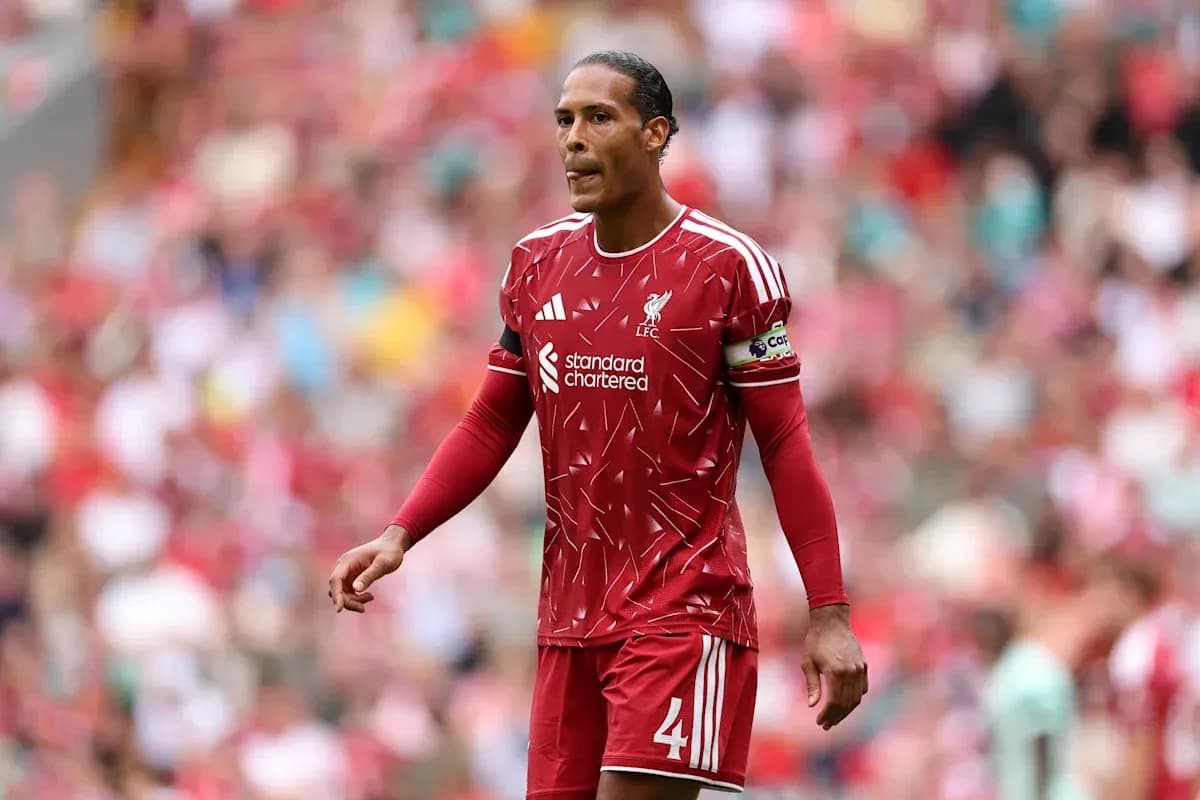

Virgil van Dijk: Liverpool's Transition and Responsibility
Virgil van Dijk has seen enough football seasons to know when one feels different. This one does.
Liverpool have a new man on the touchline in Andoni Iraola, a squad shorn of two modern pillars in Mo Salah and Andy Robertson, and a captain who freely admits the club is stepping into a new phase.
“It definitely feels like a bit of a transition, for sure,” van Dijk said, laying it out without drama but without disguise either.
Liverpool, Premier League champions only two years ago under Arne Slot, are resetting after a poor campaign that cost the Dutch coach his job and forced a summer of hard decisions.
Key players have gone. The system will change. Expectations, though, barely move an inch on Merseyside.
Van Dijk knows that better than anyone.
A captain in the middle of the storm
At 35, many defenders start to drift towards the margins, picking their games, rationing their minutes. Van Dijk bristled at the suggestion.
“Yes. What, are you going to say I'm 35 years old and I can't do it?” he fired back when asked if he could still go week in, week out.
There was no nostalgia in his voice, no talk of what he has already done for the club. His focus is brutally simple: be ready, every three days, for as long as his body allows.
“At the end of the day you have to look after yourself,” he said. “You have to do everything in your power, and that's the bare minimum for me, because I feel the responsibility to be ready each and every game.”
That word — responsibility — hangs over this Liverpool side. Iraola arrives with fresh ideas and the energy of a coach desperate to prove he belongs at the very top level. But transition seasons in English football are rarely gentle. They are played out under floodlights and scrutiny, against teams who sense vulnerability and go after it.
Van Dijk is not shying away from that reality.
“This year we want to be successful, but there's a lot of work to be done still,” he admitted. “We all know how difficult it is to be playing in the Premier League, League Cup, FA Cup, Champions League, so we need everyone at their best.”
That’s the tightrope: rebuild on the fly while still trying to compete on four fronts. Liverpool do not get the luxury of a quiet year.
Late bloomer, enduring standard
Van Dijk describes himself as a “late bloomer”. It is a reminder that his prime years came later than many of his peers, and that he still feels more like a constant than a fading star.
“Every three days I'm doing everything in my power at home, at the training ground, to be ready to play a game,” he said. “For me, I feel good. I'm also a late bloomer, so maybe… It is what it is, I feel fine, and I want to be part of a successful Liverpool team.”
There is no romanticism in that statement, just a veteran’s clarity. He knows what it takes to stay at the top. Sleep, recovery, detail, repetition. The glamorous part happens in front of the Kop; the grind happens out of sight.
And that grind, in his mind, is non‑negotiable.
What the shirt demands
Strip away the tactics, the transfers and the talk of transition, and van Dijk keeps coming back to one thing: the shirt.
“I want to make all the fans proud all over the world that support us wherever we go,” he said. “And that's by winning games, that's by showing what it means to wear that shirt every time, and that's for me the bare minimum anyway, so I will keep going.”
That is the standard he is setting for himself, and by extension, for Iraola’s Liverpool. Transition is not an excuse. It is a context.
The club has changed manager. Salah and Robertson, two of the defining figures of the recent era, have gone. The Premier League, as unforgiving as ever, will not wait for Iraola to settle or for van Dijk to ease himself into the autumn of his career.
Liverpool’s captain has made his position clear: he will not be the one asking for time.