.svg&w=384&q=75 "Naijagoal logo")
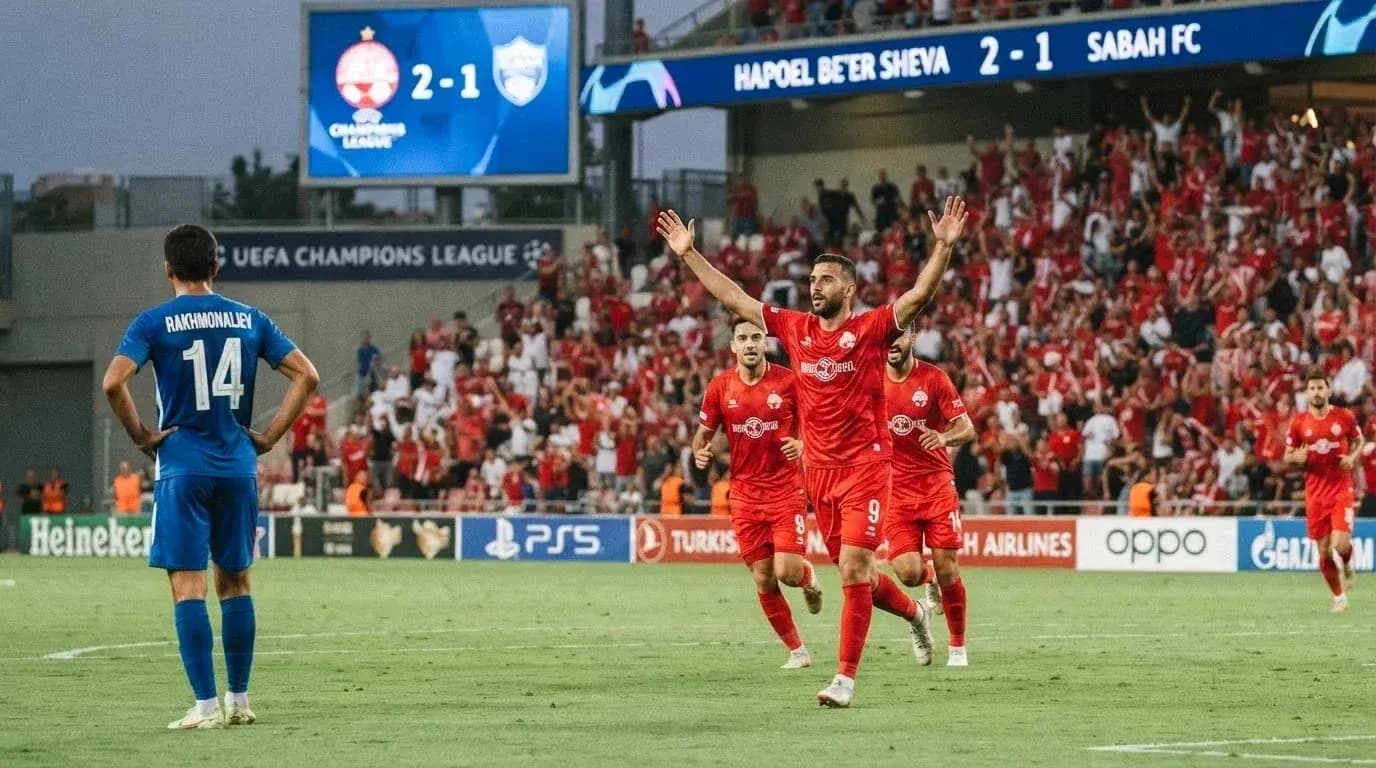

UEFA Champions League Play-offs: Sabah FA vs Hapoel Beer Sheva Preview
At the Tofiq Bahramov Stadium in Baku, this UEFA Champions League Play-offs second leg between Sabah FA and Hapoel Beer Sheva carries clear seasonal weight: it is effectively a qualification decider, with Sabah needing to overturn a first-leg deficit to keep their Champions League campaign alive, while Hapoel Beer Sheva are 90 minutes away from progressing to the group stage and securing a major financial and sporting boost for their 2026 campaign.
Head-to-Head Tactical Summary
The only recent meeting in the data is the first leg on 19 August 2026 at Superbet Arena - Giulesti in Bucharest, where Hapoel Beer Sheva, playing at home, beat Sabah FA 2-1. The half-time score was 1-1, indicating Sabah were initially competitive before Hapoel Beer Sheva edged the second half to take a narrow but valuable advantage into this return fixture in Baku.
Global Season Picture
- League Phase Performance: There is no standings data available for either Sabah FA or Hapoel Beer Sheva in the Champions League play-off phase, so current rank, points, and aggregate goals for/against in a table context cannot be quantified from the provided information.
- Season Metrics: In the league phase of this Champions League campaign, Sabah FA have played 7 matches, winning 5 and losing 2, scoring 13 goals and conceding 5. Their attack has been productive at home (7 goals in 3 games, 2.3 per match) and solid away (6 in 4, 1.5 per match), while defensively they have been excellent at home with 0 goals conceded and more vulnerable away (5 conceded in 4). They have kept 4 clean sheets and have not failed to score yet, suggesting a consistently proactive approach. Disciplinary data shows a spread of yellow cards across the match, with a notable cluster between minutes 46–60, and a single red card deep into added time (91–105), hinting at occasional late-game volatility. Hapoel Beer Sheva, across 5 matches, have 4 wins and 1 loss, scoring 8 and conceding 3. Their scoring rate is similar home and away (around 1.6 per match), with a tighter defence overall (3 conceded in 5), including 3 clean sheets. Their yellow cards are concentrated from 46–90 minutes, and they have one red card in the 46–60 minute window, indicating that intensity and risk increase after the break.
- Form Trajectory: Sabah FA’s form string of WWWWLWL shows a very strong run with four straight wins followed by a loss, a win, and then another loss. This suggests they have a high ceiling but can be exposed in higher-stakes or tighter matches, as seen in the first leg. Hapoel Beer Sheva’s form string LWWWW indicates they started this phase with a defeat but have since responded with four consecutive victories, pointing to an upward trajectory and growing confidence coming into this decisive play-off leg.
Tactical Efficiency
Without explicit comparison indices, the efficiency picture must be inferred from the season statistics. Sabah FA’s scoring profile (13 goals in 7 games, with no match where they failed to score and 4 clean sheets) points to a balanced but slightly attack-tilted side, particularly strong at home where they have yet to concede. Their average of 1.9 goals scored and 0.7 conceded per match across this Champions League campaign indicates that when they impose their structure, they control both boxes effectively. Hapoel Beer Sheva, with 8 goals for and 3 against in 5 matches, show a slightly lower attacking volume but an even more conservative defensive record (0.6 goals conceded per game) and 3 clean sheets, suggesting a compact, risk-managed approach that suits protecting leads, as they must do in Baku. The first-leg 2-1 scoreline, with Hapoel Beer Sheva conceding but still winning, reinforces the picture of a side comfortable in controlled, narrow-margin games, whereas Sabah’s task now is to stretch the game without losing their defensive discipline that has been so strong at home.
The Verdict: Seasonal Impact
This second leg is season-defining for both clubs. For Sabah FA, elimination here would halt a promising Champions League run that has showcased strong home performances and a potent attack; progression, however, would validate their upward form curve and provide a major platform for 2026, both financially and in terms of regional stature. Their perfect home defensive record in this campaign makes the tie salvageable, but they must convert that solidity into a multi-goal performance without conceding. For Hapoel Beer Sheva, carrying a 2-1 lead into Baku aligns with their profile as a compact, efficient side: successfully defending or extending that advantage would secure a place in the Champions League group stage and consolidate their current winning streak into a genuine step up in European status. Failure to progress, despite a first-leg win and strong recent form, would represent a significant missed opportunity in their 2026 trajectory. The seasonal impact, therefore, is binary: the winner steps into the group stage with momentum and resources to shape the rest of 2026 at a higher competitive level, while the loser must recalibrate ambitions to secondary European competition or domestic objectives.