.svg&w=384&q=75 "Naijagoal logo")

Uefa Challenges Infantino's Leadership Amid Crisis
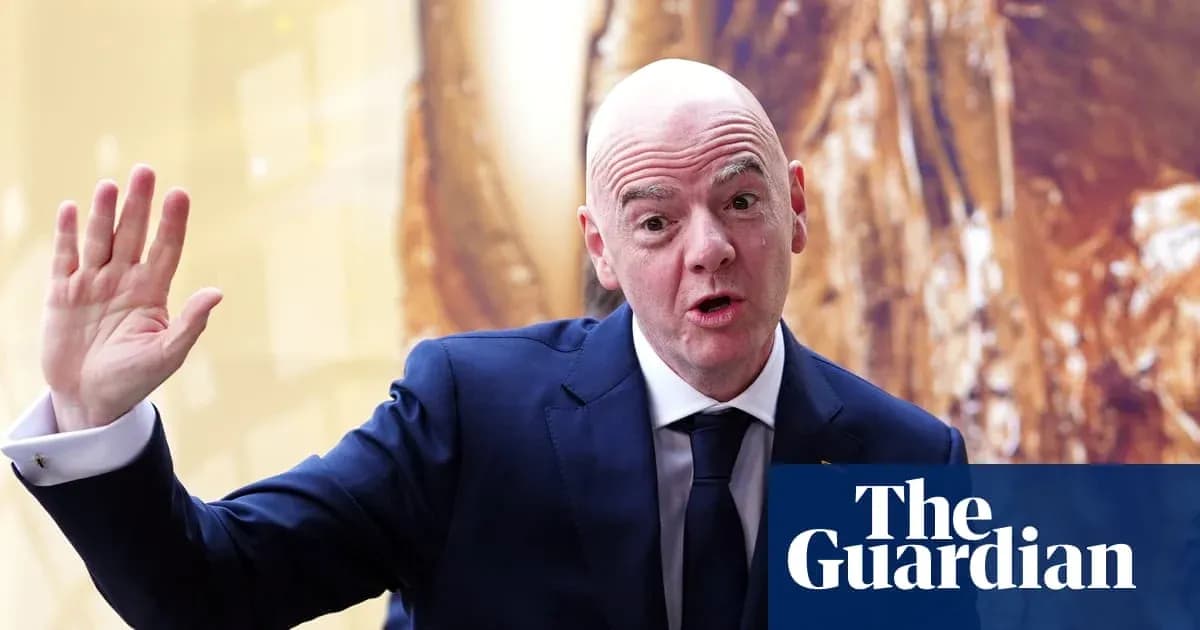
Uefa has delivered its most direct challenge yet to Gianni Infantino’s authority, warning the Fifa president that his style of leadership has pushed world football’s governing body into a crisis that can no longer be ignored.
In a blistering statement that spoke of “secret schemes”, “shabby backroom deals” and “faceless individuals”, Uefa’s leadership demanded a “thorough and fundamental” review of Fifa’s governance and made clear that business as usual under Infantino is no longer acceptable.
Uefa turns on Infantino
The flashpoint came after Fifa’s abrupt overnight U-turn on Infantino’s controversial plan to sell off stakes in the World Cup and other competitions via a new commercial vehicle. The proposal, which would have seen 20% of a new company – Fifa Forward Enterprise – sold to private investors, was pulled in the face of fierce resistance led by Europe.
The retreat has not cooled tempers. If anything, it has hardened them.
Under president Aleksander Ceferin, who last week secured unanimous backing from all 55 Uefa member associations for a World Cup boycott, European football’s governing body has now moved onto open confrontation. While it stopped short of explicitly calling for Infantino’s resignation, senior Uefa figures are understood to be determined he should not survive what they regard as a crisis of his own making.
That view, insiders say, is shared by many of the game’s most powerful national associations across the globe. Leading European officials have already started the process of identifying a candidate to run against Infantino in next year’s Fifa presidential election, with discussions expected to intensify in the coming days.
“We cannot keep going on like this with secret schemes on fast track timescales, cooked up by faceless individuals and of dubious benefit to the game,” Uefa’s statement read. “We must identify those responsible and hold them to account.”
The message was unmistakable: the era of quiet grumbling is over.
Promises turned against him
Uefa went further, turning Infantino’s own words from his first election campaign in 2016 back on him. Back then, pitching himself as the reformer who would clean up Fifa, he pledged transparency and daily engagement with member associations, insisting: “The money of Fifa is your money. It’s not the money of the Fifa president.”
Uefa now accuses him of betraying those promises.
“On both these promises, he has failed to deliver,” the statement said. “The shabby, back room, opaque deal he hatched and tried to force through were anything but transparent. And with reserves standing at over $5bn, he has also failed to use associations’ money for the benefit of the game.”
For a president who has repeatedly cast himself as the guardian of development funds, that is a stinging charge.
At the heart of the row lies the Fifa Forward programme, under which all 211 member associations receive the same central payment from Fifa over each four-year cycle. Infantino argued that by selling 20% of Fifa Forward Enterprise to private investors, he could boost those payments from $8m to $20m per cycle, with a one-off $20m signing bonus for associations that joined the scheme by 19 September.
The optics were grim. Handing out tens of millions of dollars to some of the smallest and least resourced football nations drew accusations of naked patronage and vote-buying. The deadline-linked $20m bonus was condemned as a blatant attempt to lock in support before opposition could fully mobilise.
This time, the pushback came quickly – and publicly.
Power, money and a presidency on the line
Infantino had been expected to stroll to re-election next March at the Fifa Congress in Rabat, unopposed and entrenched for a third full term. He has already collected more than 200 letters of support from member associations backing his campaign.
Those endorsements are not binding. They can be withdrawn. And the deadline for challengers to declare their candidacy does not fall until 18 November.
Suddenly, the race no longer looks like a procession.
Within Europe, the Paris Saint-Germain president Nasser Al-Khelaifi is widely admired and favoured by many as a potential challenger, but he is understood to be reluctant to stand and remains heavily involved as chairman of the influential European Football Clubs group. Other names being floated include Victor Montagliani, the Canadian president of Concacaf, and Salman al-Khalifa, head of the Asian Football Confederation, who narrowly lost to Infantino in the 2016 Fifa election.
None has yet stepped forward. Yet the very fact that heavyweight figures are being openly discussed underlines how sharply the mood has turned.
“The current Fifa leadership has not only lost Uefa’s confidence, but also that of many other members of the football family,” Uefa declared.
A fight over who controls the game
Uefa’s intervention is not only about personalities. It is about who controls football’s vast resources and how they are used.
“Uefa will begin work immediately with partners and stakeholders all over the world and right across the game to propose a new way of distributing resources through the existing Fifa Forward programme,” the statement continued. The goal, it said, is to unlock some of the more than $5bn sitting in Fifa’s reserves and direct it towards “the kick start that the grassroots and the wider game need in each of the 211 countries of Fifa.”
Then came the line that cut to the heart of the abandoned plan: “But we don’t need to sell off the family silver to pay for it.”
In Uefa’s eyes, this is not a technical debate over funding models. It is a battle for the soul of global football governance – over transparency, accountability and whether the World Cup and other flagship competitions should be partially handed over to private capital.
The collapse of the proposal has been hailed in Nyon as a landmark moment.
“This is a victory for the whole game. But it must not be the end of the story,” Uefa said. “The proposal has gone. The task of rebuilding trust in Fifa has only just begun.”
Infantino remains determined to cling to power. Uefa, newly emboldened and openly hostile, has signalled it will not quietly fall back into line.
The next few weeks will reveal whether this was a single defeat for a powerful president – or the opening act in the unravelling of his rule.